
Automotive Connector Materials: PA66, PBT & PPS
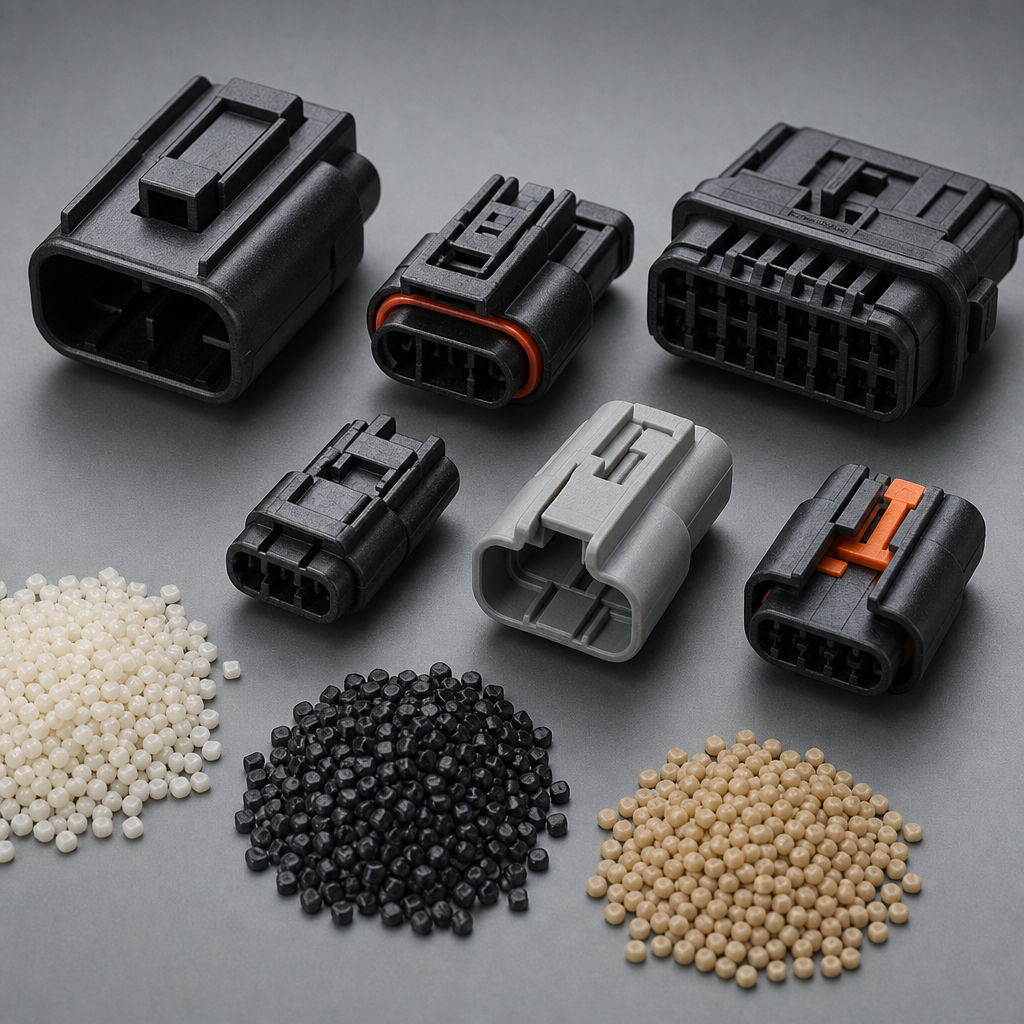
Automotive connector material must hold terminal position, maintain electrical insulation, resist heat and chemicals, and mold within tight dimensional tolerances. PA66, PBT, PPS, and flame-retardant compounds each solve a different part of that requirement. The best choice depends on the connector location, service temperature, moisture exposure, voltage, wall thickness, terminal-retention target, and validation standard.
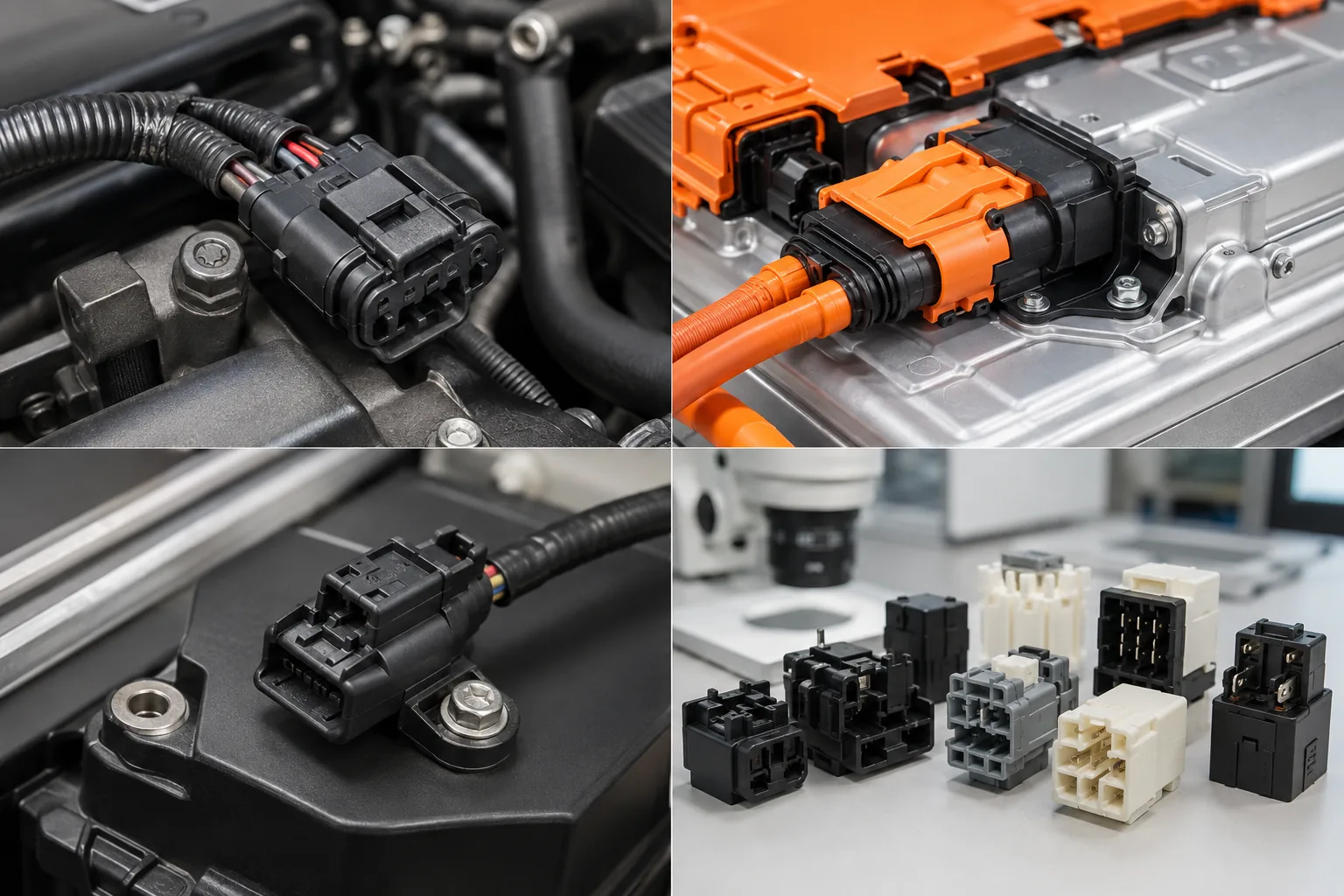
Common Connector Failure Risks
A connector housing can look acceptable after molding and still fail during assembly or service. Typical risks include warped terminal cavities, weak latch features, moisture-related dimensional change, loss of insulation after heat aging, chemical attack, and insufficient flame performance. Material selection therefore begins with the finished part and validation conditions rather than with a resin name alone.
Material Requirements to Define
Continuous and peak temperature, heat aging, reflow or welding exposure, and thermal cycling.
Insulation, tracking resistance, voltage, wall thickness, and the required UL 94 rating.
Terminal retention, latch fatigue, insertion force, vibration, impact, and creep under load.
Moisture, oil, fuel, coolant, cleaning agents, salt spray, and outdoor UV exposure.
PA66 vs PBT vs PPS for Automotive Connectors
| Material route | Main strengths | Watch points | Typical starting applications |
|---|---|---|---|
| PA66 | Strength, toughness, latch performance, heat resistance, broad modification range | Moisture conditioning and dimensional change must be checked | Harness connectors, clips, terminal blocks, under-hood housings |
| PBT | Low moisture uptake, electrical insulation, dimensional stability, good molding consistency | Impact, hydrolysis, and high-temperature requirements need grade-specific review | Sensor plugs, relay housings, precision connector bodies |
| PPS | High heat resistance, chemical resistance, low moisture sensitivity, dimensional control | Higher material cost and part-design sensitivity | High-temperature sensors and demanding power or control connectors |
| FR compounds | Flame performance combined with reinforced or unfilled base polymers | Confirm thickness, color, electrical properties, and the exact tested grade | Power distribution, charging, relay, and safety-critical electrical housings |
Recommended Material Routes and Relevant Grades
- PA66 GF20 or PA66 GF30: useful starting points when stiffness, heat resistance, and terminal retention are important. A PA66 GF20 connector can provide a balance between reinforcement and molding detail, but the exact grade must be confirmed by its current data sheet.
- Flame-retardant PA66: consider when the housing must combine nylon toughness with a specified flame rating and electrical performance.
- Glass-filled or flame-retardant PBT: suitable for precision housings where moisture stability and electrical insulation are priorities.
- Reinforced PPS: consider for higher-temperature or more chemically demanding locations after cost and molding feasibility are reviewed.
Useful starting references include WanHan's PA66 material range, PA66 GF33 grade, flame-retardant PA66, PBT GF30 grade, and the PPS material range. These links support screening; final approval should use the exact grade data and molded-part tests.
Connector Molding and Processing Controls
- Dry the selected resin to the supplier's grade-specific moisture limit and verify moisture before molding.
- Control melt temperature, mold temperature, injection speed, holding pressure, and cooling time for stable cavity dimensions.
- Position gates and vents to protect terminal cavities, latch features, knit lines, and glass-fiber orientation.
- Measure warpage, cavity pitch, flatness, insertion force, and retention force after realistic conditioning.
- Do not copy one processing window across PA66, PBT, and PPS; use the exact grade instructions and production tool.
Validation Before Production Approval
Validate the resin, molding process, and assembled connector together. A practical plan may include dimensional inspection, terminal insertion and pull-out tests, latch cycling, electrical insulation, dielectric performance, heat aging, thermal cycling, vibration, humidity, fluid exposure, and flame testing where required. Record resin lot, moisture, machine settings, tool cavity, conditioning state, and test method so results can be traced and repeated.
Custom Connector Compounds
When a standard grade does not meet the complete requirement, WanHan can screen glass-fiber reinforcement, flame retardancy, heat stabilization, impact modification, hydrolysis resistance, color, and dimensional-control options. Send the current resin, part drawing, target properties, operating environment, approval standard, annual volume, and the failure or cost issue that needs to be solved. Samples and a current technical data sheet should be reviewed before production trials.
Why Choose WanHan
Since 2005
Focused on functional engineering plastic compounds and application support.
Four Certified Systems
ISO 9001, ISO 14001, ISO 45001, and IATF 16949.
Application Testing
Material screening, sample support, test data, and processing guidance.
Custom Compounding
Reinforcement, flame resistance, stabilization, color, and formulation support.
Request a Connector Material Recommendation
Send the connector location, drawing, temperature range, voltage, wall thickness, flame requirement, chemical exposure, terminal-retention target, current resin, annual demand, and approval tests. WanHan can compare practical PA66, PBT, PPS, and flame-retardant routes and prepare samples for evaluation.
Frequently Asked Questions
What materials are commonly used for automotive connectors?
PA66, PBT, PPS, and flame-retardant compounds are common choices. The final material depends on heat, moisture, voltage, dimensional tolerance, chemicals, and required validation.
When is PA66 suitable for a connector housing?
PA66 is useful when strength, toughness, heat resistance, and latch performance are priorities. Moisture conditioning and dimensional change must be included in validation.
Why is PBT used for precision connectors?
PBT offers low moisture uptake, electrical insulation, stable dimensions, and consistent molding. Grade-specific impact, hydrolysis, temperature, and flame performance still need verification.
When should PPS be considered?
PPS is considered for higher-temperature or chemically demanding connector locations that need strong dimensional stability. Cost, mold design, and the exact reinforced grade should be reviewed.
Is PA66 GF20 suitable for automotive connectors?
A PA66 GF20 connector grade can balance stiffness, heat resistance, and molding detail. Suitability depends on the exact formulation, moisture condition, flame requirement, part geometry, and validation results.
What information is needed for a material recommendation?
Provide the drawing, connector location, temperature, voltage, wall thickness, chemicals, moisture, flame rating, terminal-retention target, current material, volume, and required tests.
Plastic Resin Pellets Supplier Guide: Materials, Quality, and Evaluation
What Is PPS Material? Properties, GF Grades, and Applications
Related Article



