
PA6 GF30 for Power Tool Housings and Motor Covers
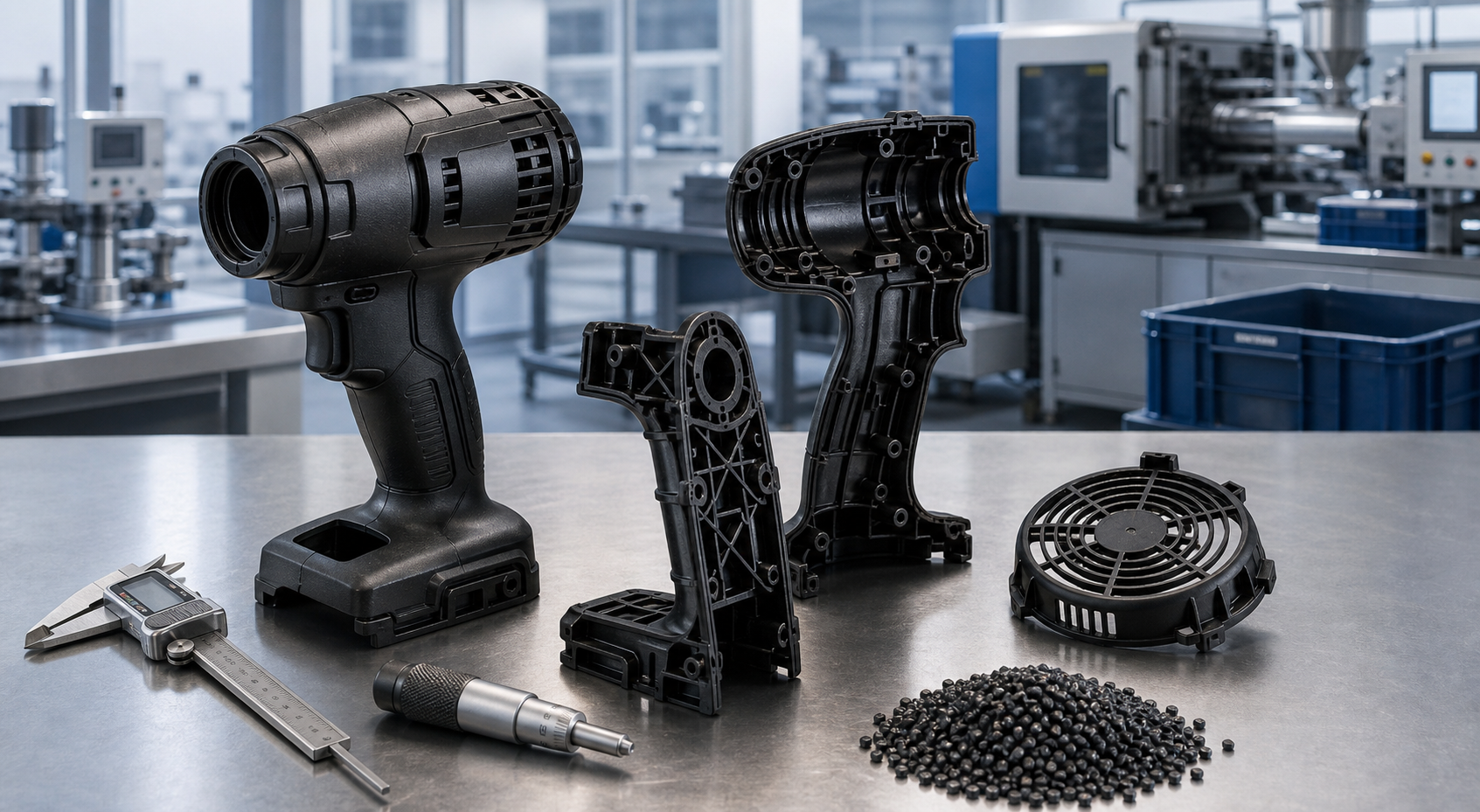
PA6 GF30 power tool housing material is used where a molded shell or motor cover must resist vibration, assembly load, heat, oil, repeated handling, and occasional impact. The 30% glass-fiber reinforcement gives nylon 6 substantially more stiffness and creep resistance than an unfilled grade.
Typical parts include drill and grinder motor covers, internal bearing carriers, gear-case supports, fan guards, handles with structural ribs, and other reinforced components. WanHan can compare PA6 glass-filled grades, PA6 GF30 compounds, and PA66 glass-filled nylon according to the real temperature and load profile.
The best grade is determined by the part drawing and failure mode. A rigid internal carrier, a visible outer shell, and a hot motor-adjacent cover may require different impact, surface, heat-stabilization, or color packages even when each part is marked PA6 GF30.
What a Power Tool Housing Must Withstand
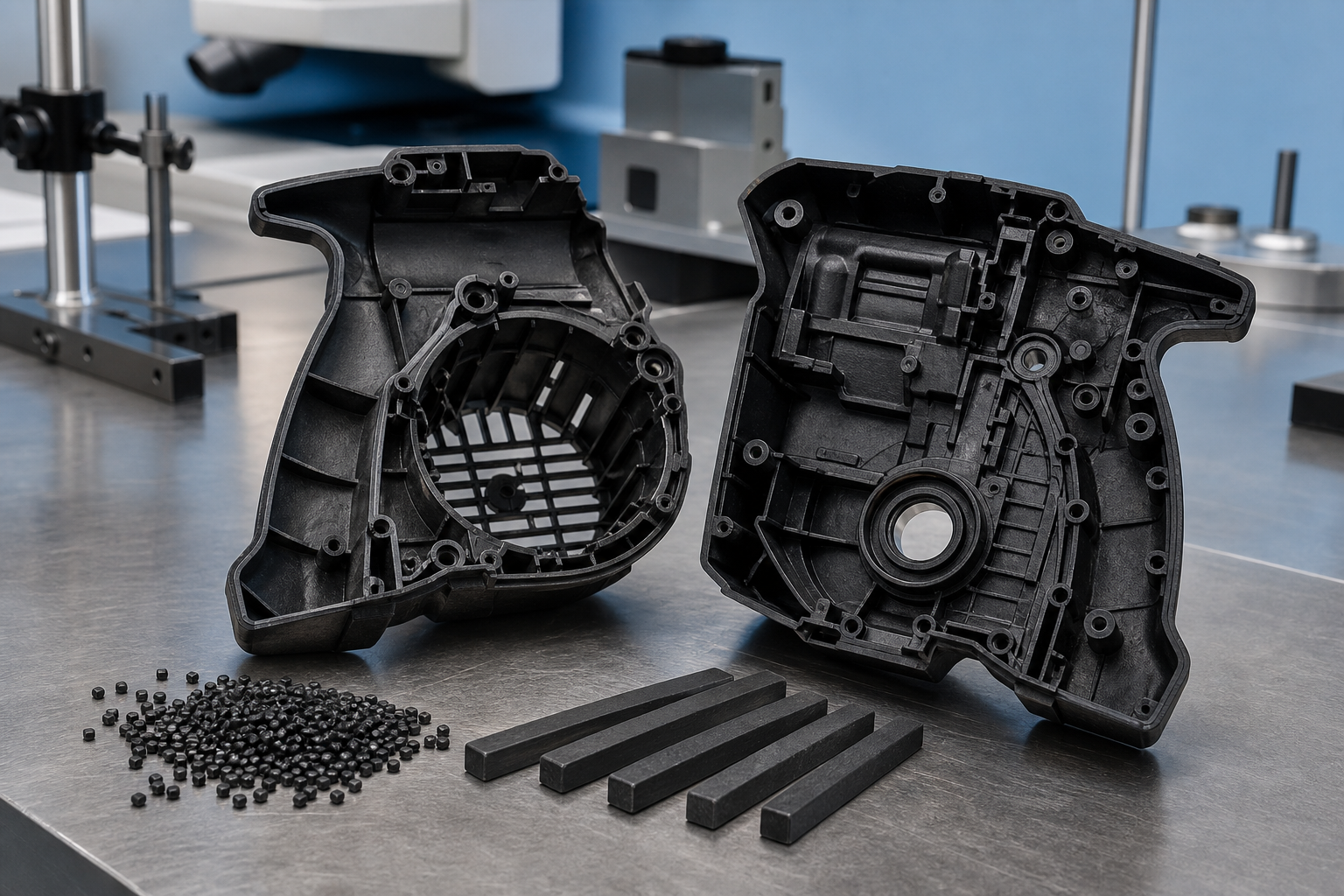
Power tool components experience cyclic vibration, screw-boss stress, local motor heat, lubricant or workshop chemical contact, and drop or strike loads. Glass fiber improves stiffness, but fiber orientation and weld-line position can create weak directions if the mold and gate are not designed around the load path.
For a visible housing, surface quality and color consistency also matter. A high-glass structural grade may be better for an internal carrier than for a cosmetic shell unless the formulation and tool texture are selected together.
- Cracking around screw bosses, inserts, or bearing seats
- Warping that changes motor, shaft, or gear alignment
- Strength loss after moisture conditioning or heat aging
- Visible fiber, flow marks, weld lines, or color variation
- Chemical attack from grease, oil, cleaners, or workshop fluids
Material and Grade Selection
| Project condition | Recommended material route | Validation focus |
|---|---|---|
| Rigid motor cover or bearing carrier | PA6 GF30 or heat-stabilized PA6 GF30 | Creep, heat aging, alignment, and weld-line strength |
| Higher continuous temperature | PA66 GF30 comparison | Thermal aging, moisture, and dimensional retention |
| Visible reinforced housing | Surface-improved or color-matched PA6 GF | Texture, gloss, fiber read-through, and color lot consistency |
| Impact-sensitive outer shell | Toughened reinforced nylon or PC/ABS comparison | Drop test, notch sensitivity, and screw-boss durability |
Part Design and Injection Molding Notes
PA6 GF30 must be dried to the grade supplier's recommended moisture level before molding. Excess moisture can reduce molecular weight and cause poor surface, flash, or lower mechanical strength. Barrel residence time should be controlled to limit thermal degradation.
Gate position should direct fiber along the primary load path while keeping weld lines away from bosses, snap fits, bearing seats, and thin transitions. Uniform wall thickness, radiused ribs, and correctly sized bosses reduce local stress concentration.
- Confirm drying temperature, time, and allowable moisture content
- Review gate location, flow direction, weld lines, ribs, and boss geometry
- Avoid abrupt wall changes that increase sink, warpage, or stress
- Condition molded samples before final dimensional and impact approval
Prototype and Production Validation
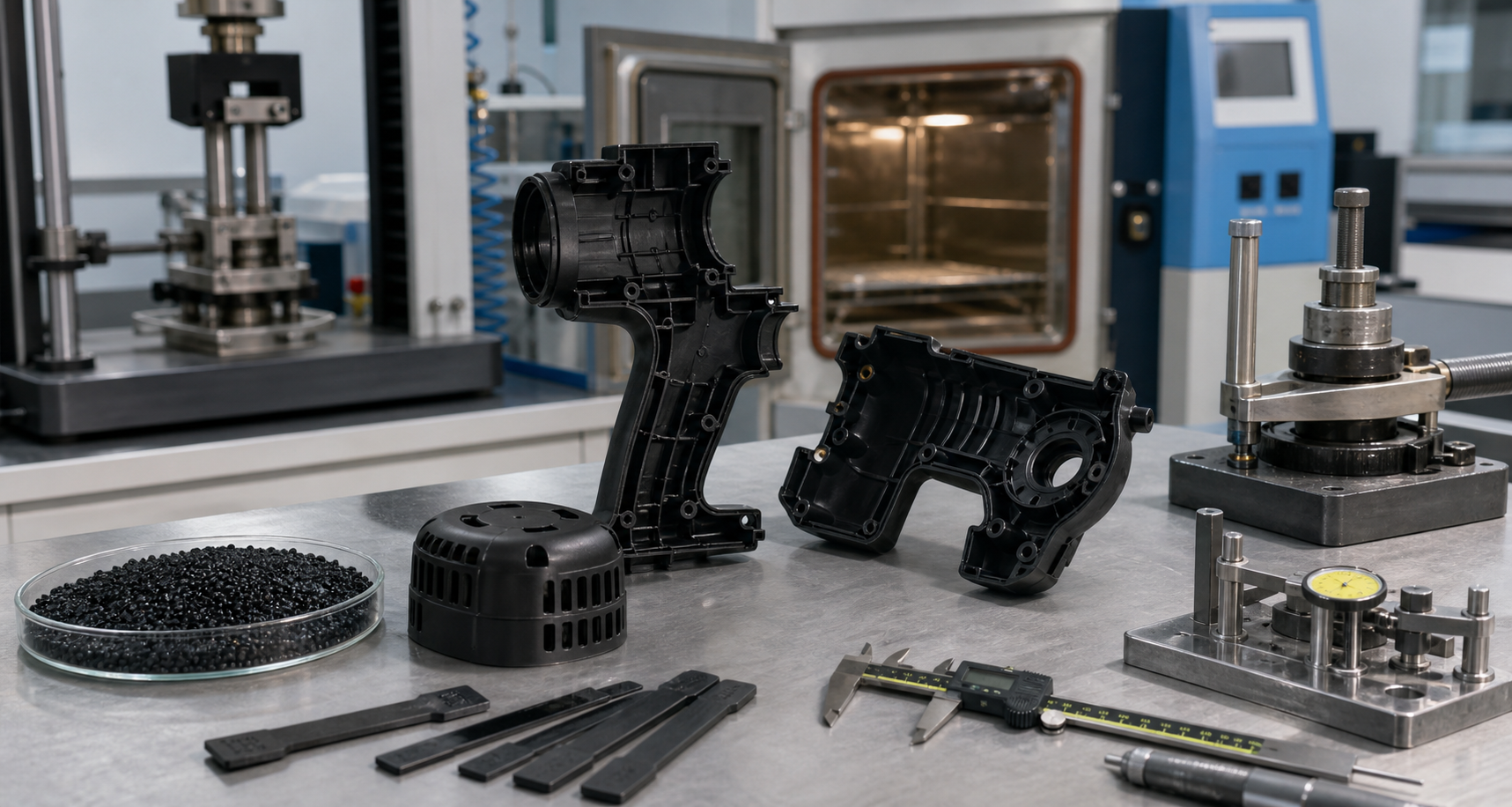
Start with molded samples from the production tool or a representative cavity. Test the housing after moisture conditioning and after the expected heat-aging cycle, not only in the dry-as-molded state.
Useful checks include dimensional capability, assembly torque, drop or impact testing, vibration endurance, chemical exposure, thermal cycling, and inspection of weld-line or insert areas. Production approval should also include color and batch consistency when the part is visible.
- Part drawing, wall thickness, tool type, and annual demand
- Continuous and peak temperature near the motor or gearbox
- Drop height, vibration profile, torque, and assembly method
- Color, surface texture, chemical contact, and compliance requirements
Why Choose WanHan
Since 2005, WanHan has developed engineering plastics for demanding industrial applications, with independent R&D, production, and sales of functional polymer materials.
WanHan is certified with ISO 9001, ISO 14001, ISO 45001, and IATF 16949. Full sets of testing equipment support incoming material control, formulation development, process inspection, and finished-batch verification.
- Modified PA6, PA66, PBT, PC/ABS, glass-filled, flame-retardant, heat-stabilized, color, and custom compound options
- Application review, grade comparison, sample support, data sheets, test coordination, and production follow-up
- Materials exported to 30+ countries for automotive, electronics, home appliance, and industrial components
Discuss Your Material Requirement
Send the power tool part drawing, service temperature, drop or vibration target, screw or insert details, color, and expected production volume. WanHan can recommend a PA6 GF30 starting grade and a backup PA66 GF30 or impact-modified route for mold trials.
Send your application details to WanHan or review our engineering plastic product range.
Frequently Asked Questions
Q: Why is PA6 GF30 used in power tool housings?
A: It provides a practical balance of stiffness, strength, heat resistance, creep control, and injection molding performance for reinforced housings and internal structures.
Q: Is PA6 GF30 suitable for the complete outer shell?
A: It can be, but visible surface quality, drop performance, fiber read-through, grip design, and local stress must be validated. Some outer shells use another resin while PA6 GF30 supports internal load-bearing parts.
Q: Should PA66 GF30 be used instead of PA6 GF30 near a motor?
A: PA66 GF30 may provide additional heat margin, but moisture behavior, impact, processing, and cost should be compared against the actual temperature profile.
Q: How should PA6 GF30 samples be conditioned before testing?
A: Use the conditioning method required by the customer or end-use standard and compare dry-as-molded and conditioned dimensions and mechanical performance where relevant.
Q: Can WanHan provide color-matched or heat-stabilized PA6 GF30?
A: Yes. WanHan can discuss heat stabilization, color, impact modification, glass content, sample quantities, and production documentation for power tool projects.
PA66 GF30 for Automotive Radiator Tanks and Coolant Parts
Sports Equipment Plastic Materials for Lightweight and Impact-Resistant Parts
Related Article



