
Category


PA6 GF60 Glass Fiber Reinforced Nylon 6 Pellets
PA6 GF60 is a nominal 60% glass fiber reinforced Nylon 6 compound for evaluating rigid molded structural cradles, motor support bases and equipment brackets. It is a material route for designs where loaded deflection and mounting alignment drive the selection. WanHan supplies the compound as pellets and supports formulation review, molding trials and production planning around your geometry, load case and required conditioning.
Product Information
| Item | Details |
|---|---|
| Material | Glass fiber reinforced Polyamide 6 (Nylon 6) |
| Grade | PA6 GF60 |
| Reinforcement | Nominal 60% glass fiber |
| Form | Pellets for injection molding |
| Sample appearance | Off-white, with project color requirements available for review |
| Grade documentation | Request current TDS, conditioning and processing guidance |
Product Advantages of PA6 GF60
1. 60% glass fiber reinforcement
The nominal 60% glass fiber loading makes this a compound to evaluate where rigidity is a primary design requirement. Compare the exact grade's stiffness and strength data with the load direction and acceptable displacement of your component.
2. Ribbed structural geometry
A molded cradle or base can distribute loads through ribs and mounting feet. Review rib intersections, wall transitions and fillets with the toolmaker. An efficient geometry helps the part use the reinforced material without concentrating strain at a sharp corner.
3. Dimensional control at mounting features
Glass reinforcement can limit deformation, while fiber orientation and flow paths affect shrinkage. Inspect mounting-hole pitch, datum flatness and alignment on real moldings. Include the joint hardware and assembly torque in the evaluation.
4. PA6 conditioning in the specification
Moisture changes PA6 dimensions and mechanical behavior. Define the humidity state used for comparison and measure the reinforced molding after representative conditioning. This connects the material decision to the fit your assembly must maintain.
5. Integration of brackets and supports
Injection molding can combine ribs, positioning features and mounting bosses in one component. Identify the assembly operations those features replace, then confirm fill, ejection and local load transfer during the tooling review.
6. Sustained-load trial planning
A motor support or fixture often sees continuous load and vibration. Test at the expected temperature for a relevant duration and measure movement at the working interface. Inspect fastening torque retention and residual set after unloading.
7. High-reinforcement molding review
Request the grade-specific drying and processing sheet. Review gate size, fill length, venting, weld lines and tool wear before sampling. Record material preparation and process settings alongside the dimensional and load-test results.
8. OEM development around the part
WanHan can review glass fiber content, impact modification, heat, flame, wear and color requirements. Share the current part limitation and target so formulation review and the sample trial address a defined acceptance criterion.
PA6 GF60 Application Concepts
These molded-part examples help frame the engineering review. Confirm the compound against your drawing, operating environment and required component tests.
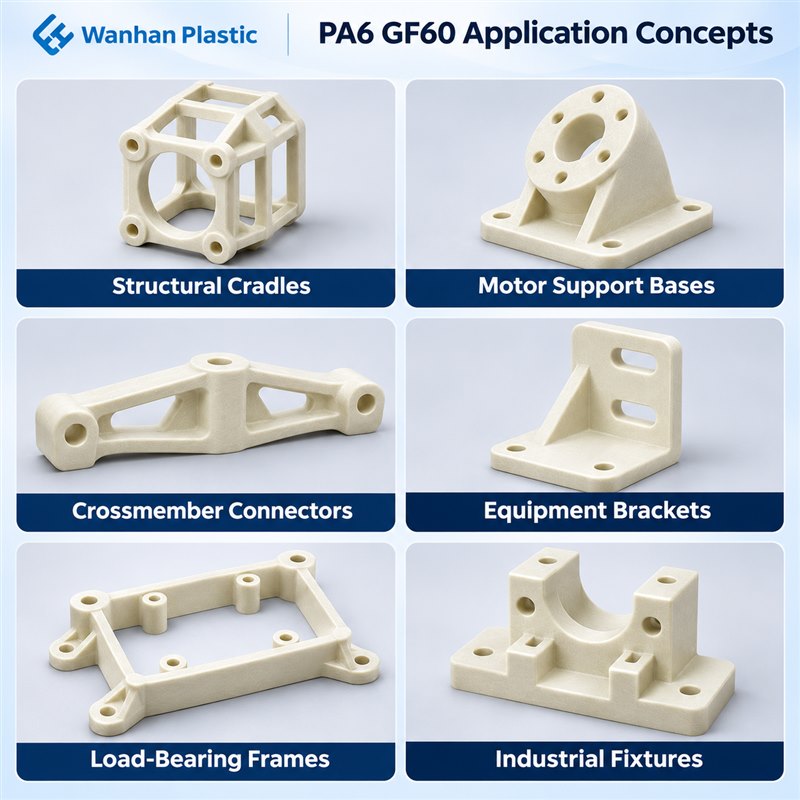
Structural Cradles
For a cradle carrying equipment mass, define the load and allowable movement at each support point. Include vibration and fastener preload. Inspect the rib roots and feet after conditioning and repeated loading.
Motor Support Bases
Measure alignment under motor mass, reaction loads and the intended vibration cycle. Check mounting-hole pitch and seating flatness on conditioned moldings. Test with the real fasteners and load-spreading hardware.
Crossmember Connectors
Review bending and torsion through the connector interfaces. Align the tooling review with the main load path and inspect weld lines at critical roots. Evaluate joint clearance and repeatability after the service temperature and humidity cycle.
Equipment Brackets
Use mounting span, load direction and fastening position to set a deflection limit. Check screw retention and pull-through at the molded feet. Include any impact or occasional overload requirement in the material review.
Load-Bearing Frames
An open frame needs stiff corners and stable locating surfaces. Review rib intersections and gate placement, then measure assembly deflection and flatness at service conditions. Qualify the complete frame and its joints together.
Industrial Fixtures
Identify clamp forces and locating datums before sampling. Measure repeatability through the intended clamping cycle, including temperature and humidity exposure. Record permanent movement as well as loaded displacement.
Prepare the Structural Molding Trial
Mark loaded interfaces, mounting faces and critical dimensions before the tooling review. Ask the molder to assess flow direction, gate size and weld lines at rib roots and mounting feet. Record handling and processing conditions, then compare flatness, alignment and loaded deflection after representative conditioning. Include the real fastening arrangement so the trial measures the behavior of the assembled support.
Engineering and Supply Support from WanHan
Guangdong Wanhan New Material Technology Co., Ltd. has specialized in modified engineering plastics since 2005. We manufacture PA6, PA66, PA11, PA12, ABS, PC, PC/ABS, PBT, PET, PPS, PPA and PP compounds. Our team supports material selection, development, sample evaluation and the transition to mass production. For a structural molding, share the drawing and allowable movement so the compound review starts with the target that determines part approval.
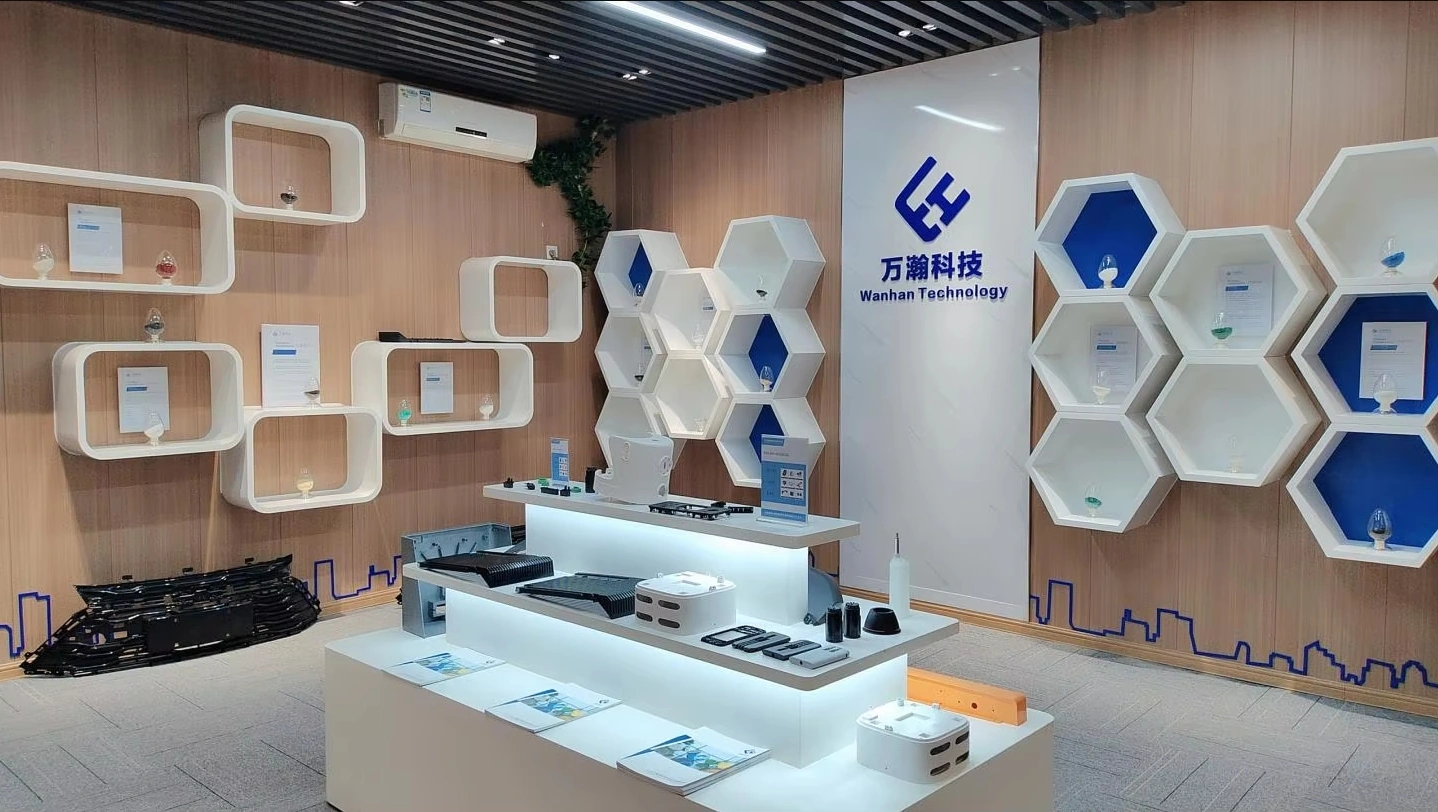
- Formulation review. Discuss reinforcement and modification requirements with the service environment, tool design and process constraints in view.
- Sample evaluation. Agree critical dimensions, conditioning and load measurements before trial molding. Share the observed results so further review addresses the behavior of the actual part.
- Qualification documents. Identify the TDS, processing guidance and compliance documents engineering and purchasing need. Include the approved grade and test conditions in the supply specification.
- Production planning. Discuss volume, packaging, destination and delivery schedule with the quotation so sample approval and ongoing supply support the same specification.
Frequently Asked Questions
What does GF60 mean?
It denotes nominal 60% glass fiber reinforcement in the PA6 compound. Request the current exact-grade TDS with the relevant test methods and conditioning for your project.
Can PA6 GF60 replace a metal support?
Compare the full assembly for mass, stiffness, service temperature, fastener loads and long-term movement. A molded design may need a different rib layout or insert strategy. Qualify production-representative moldings against the intended duty cycle.
How should I compare GF60 with GF30 or GF50?
Use current grade data and the same conditioning when comparing stiffness, impact, shrinkage and processing. Test the proposed grades in a geometry that reflects your load path and assembly requirements.
Does a highly glass-filled PA6 part still need moisture checks?
Yes. Define the humidity state and expected dimensional range for the reinforced PA6 molding. Measure the part after representative conditioning as part of material approval.
What molding guidance should I request?
Ask for the exact formulation's drying and processing sheet. Share machine, shot size, gate dimensions and geometry so the molder can review fill behavior, tool wear and the trial window.
What do you need for samples and pricing?
Send the drawing, load case, service temperature and humidity, expected demand and destination. Include required documentation, appearance and qualification tests so WanHan can review the grade, sample scope and delivery terms.
Request PA6 GF60 Grade Data and Samples
Send WanHan the drawing, load case, service temperature and humidity, projected demand and delivery destination. Ask for current grade data, a sample and a quotation covering your qualification requirements.
 PA6 CF25 Carbon Fiber Reinforced Nylon 6 PelletsEvaluate PA6 CF25 pellets for rigid molded power-tool housings, drive supports and brackets. Ask WanHan for current grade data and samples for your molding trial.PA6 CF25Send Inquiry
 PA6 CF40 Carbon Fiber Reinforced Nylon 6 PelletsWanHan PA6 CF40 nylon 6 pellets contain 40% carbon fiber reinforcement. Review this compound for industrial brackets, robotics components and precision fixtures. Request the current grade TDS and molded samples for application validation.PA6 CF40Send Inquiry
 PA6 High Impact Cold Resistant Polyamide 6 Resin Pellets - WanHanWanHan PA6 high impact polyamide 6 resin pellets are super tough impact-modified with cold resistance to -40°C, ideal for automotive clips, fasteners, and outdoor equipment. We are an experienced manufacturer with advanced twin-screw extrusion lines, ISO 9001 certification, and a dedicated R&D team for custom formulations.PA6-WH460Send Inquiry
 Thermally Conductive Flame Retardant PA6 PelletsPA6 WH-TC270 thermally conductive flame retardant nylon pellets for molded electrical and industrial parts. Request TDS, samples and a quote.PA6 WH-TC270Send Inquiry
Send Message
ABOUT US -- WanHan Technology
--Boasting 18 years of extensive experience in both the Chinese and international markets.
--Highly specialized in catering to the specific needs of the industry.Boasting a highly qualified development team.
--Owns its own production plant.
--Customer-centric approach, providing customized final outcome plans.
--Material quality meets international standards, ensuring excellence.ISO9001, IATF16949, ISO14001, ISO45001, SGS, REACH, ROSH