
PA66 FR V0 for Terminal Blocks and Electrical Insulators
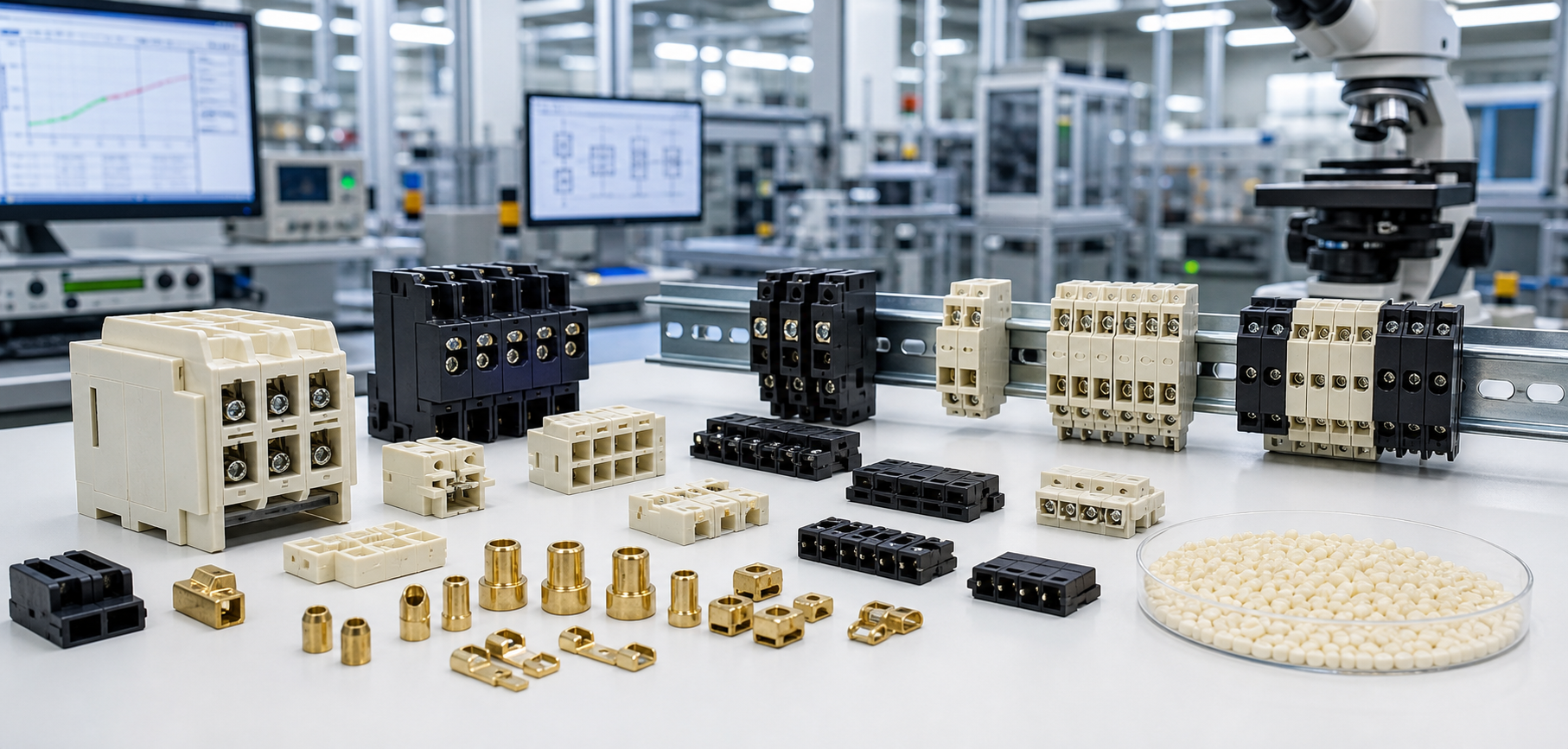
PA66 FR V0 terminal block material is selected when an insulating body must retain mechanical strength while meeting flame, electrical, and thermal requirements. Typical parts include DIN-rail terminal blocks, barrier strips, switch bodies, relay bases, terminal carriers, and internal electrical supports.
PA66 provides useful toughness and heat performance, while the flame-retardant package is formulated for the required UL 94 classification at a stated thickness. WanHan supplies PA66 flame-retardant grades and can compare them with PBT FR materials for dimension-sensitive electrical parts.
A V0 label is only one checkpoint. The material must also be reviewed for comparative tracking index, dielectric behavior, glow-wire requirements, color, mechanical retention after heat aging, and stable molding around thin walls and metal inserts.
Terminal Block Material Requirements
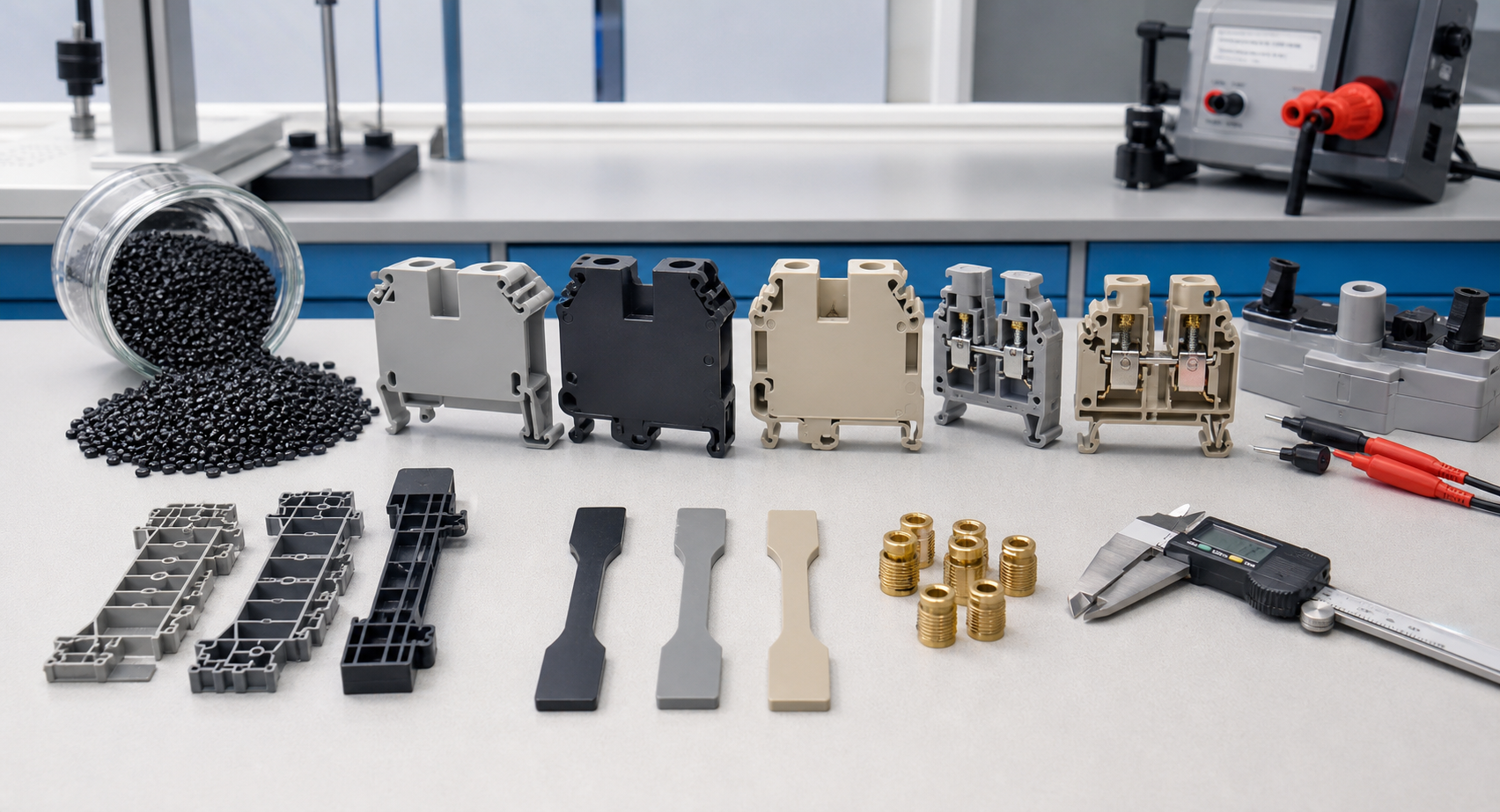
Terminal blocks combine current-carrying metal parts with a plastic insulating body. The housing must resist insertion force, screw or spring pressure, local temperature rise, and repeated installation without cracking or losing dielectric separation.
Thin sections, ribs, barriers, and metal inserts create demanding flow paths. The grade needs enough flow for complete filling while maintaining mechanical and electrical properties after molding.
- Flame rating not verified at the actual minimum wall thickness
- Low CTI or tracking performance for the required creepage design
- Cracking around screws, springs, pins, or press-fit metal parts
- Mold deposit, corrosion, gas marks, or incomplete thin-wall filling
- Color or property drift after heat aging and production scale-up
Material and Grade Selection
| Selection item | PA66 FR checkpoint | Information to confirm |
|---|---|---|
| Flammability | UL 94 V0 at the specified thickness | Minimum wall and certification target |
| Electrical safety | CTI, dielectric strength, glow-wire behavior | End-product standard and voltage class |
| Mechanical retention | Toughness and creep under clamping force | Terminal design, torque, and temperature rise |
| Molding | Flow, venting, deposit control, and insert compatibility | Tool layout, cavity count, color, and cycle target |
Part Design and Injection Molding Notes
PA66 FR compounds require disciplined drying and residence-time control. Moisture can reduce strength and surface quality, while excessive heat history can degrade the flame-retardant system or increase deposits. The approved process window should be documented during tool trials.
Venting is especially important at the end of thin barriers and around inserts. Gate position should minimize weld lines at latch points, screw towers, and narrow insulating walls. Insert temperature and mold temperature can affect knit-line strength and dimensional stability.
- Use verified drying equipment and protect dried resin during transfer
- Check end-of-fill venting, gas marks, deposits, and tool corrosion
- Test torque, pull-out, latch, and insert retention after heat aging
- Measure critical creepage and clearance dimensions after conditioning
Prototype and Production Validation
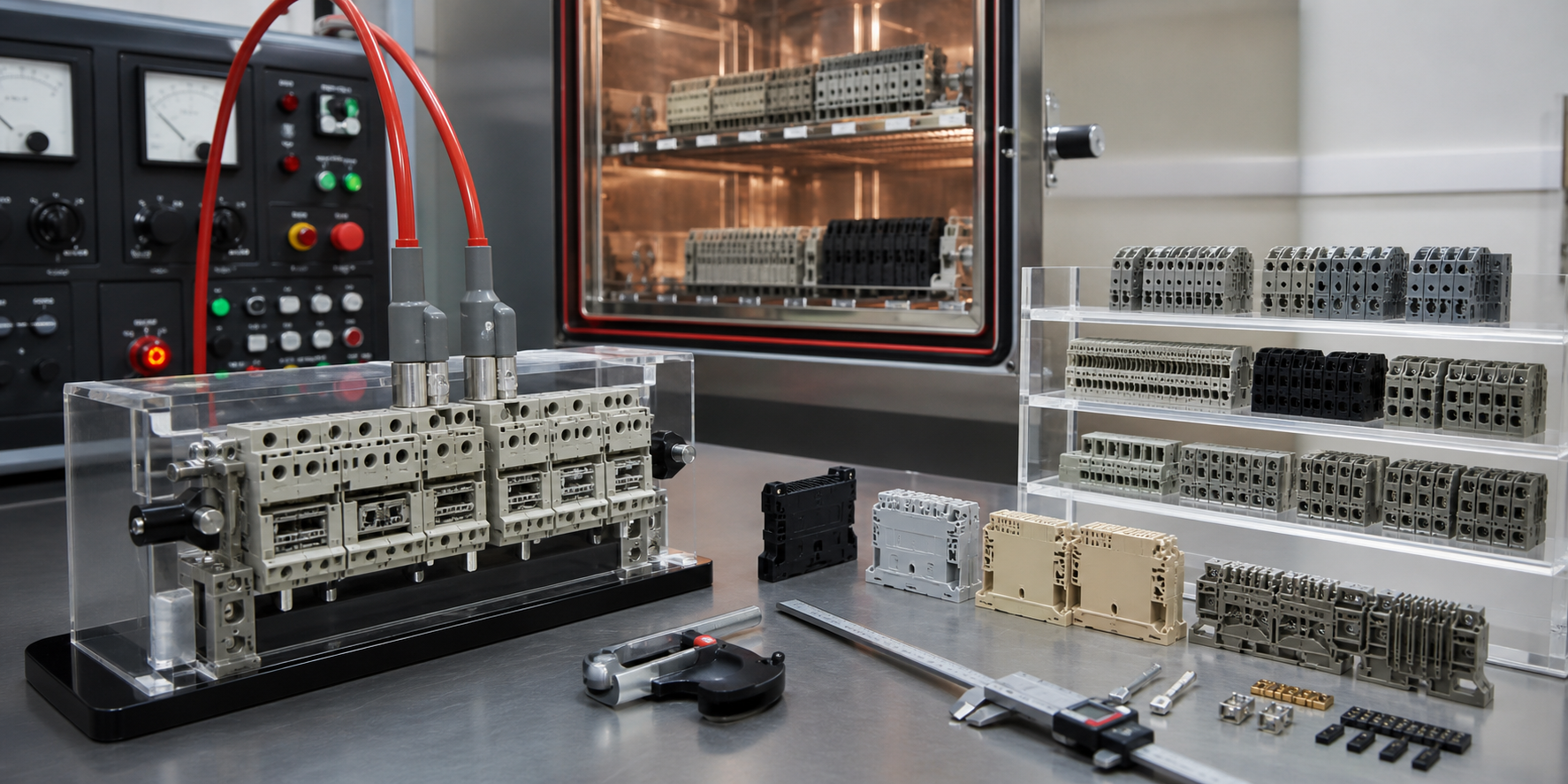
Validation should match the electrical product standard. Depending on the application, this may include UL 94, CTI, glow-wire, dielectric strength, ball pressure, heat aging, torque, pull-out, and temperature-rise testing.
For a new terminal design, compare at least one PA66 FR route with a PBT FR alternative when moisture-driven dimensional change or very thin-wall flow is critical. The final choice should be based on molded-part electrical and mechanical results.
- Minimum wall thickness, terminal geometry, and metal-insert design
- UL 94, CTI, glow-wire, dielectric, and end-product standards
- Continuous temperature, current, voltage, torque, and clamping load
- Color, halogen requirement, sample quantity, and annual demand
Why Choose WanHan
Since 2005, WanHan has developed engineering plastics for demanding industrial applications, with independent R&D, production, and sales of functional polymer materials.
WanHan is certified with ISO 9001, ISO 14001, ISO 45001, and IATF 16949. Full sets of testing equipment support incoming material control, formulation development, process inspection, and finished-batch verification.
- Modified PA6, PA66, PBT, PC/ABS, glass-filled, flame-retardant, heat-stabilized, color, and custom compound options
- Application review, grade comparison, sample support, data sheets, test coordination, and production follow-up
- Materials exported to 30+ countries for automotive, electronics, home appliance, and industrial components
Discuss Your Material Requirement
Send the terminal-block drawing, minimum wall, flame and CTI targets, glow-wire requirement, operating temperature, color, and insert details. WanHan can recommend PA66 FR V0 samples and compare PBT FR when dimensional stability is a priority.
Send your application details to WanHan or review our engineering plastic product range.
Frequently Asked Questions
Q: Is PA66 FR V0 commonly used for terminal blocks?
A: Yes. It is widely considered for terminal blocks and insulating bodies that need mechanical strength, heat resistance, electrical insulation, and flame performance.
Q: Does UL 94 V0 apply at every wall thickness?
A: No. The rating is tied to the tested grade, color, specimen thickness, and test conditions. Confirm the value at or below the part's minimum wall.
Q: What electrical data should be checked besides V0?
A: CTI, dielectric strength, volume resistivity, glow-wire behavior, heat aging, and the relevant end-product standard may all be important.
Q: When is PBT FR preferred over PA66 FR for a terminal block?
A: PBT FR may be attractive when lower moisture sensitivity and dimensional stability are priorities, while PA66 FR can provide a strong balance of heat resistance and toughness.
Q: Can WanHan support colored and glass-filled PA66 FR grades?
A: Yes. WanHan can discuss color, glass reinforcement, halogen requirements, electrical targets, sample validation, and production documentation.
PBT GF30 for Automotive Sensor Housings and ECU Connectors
PA66 GF30 for Automotive Radiator Tanks and Coolant Parts
Related Article



