PBT GF15 Properties, Datasheet and Applications
PBT GF15 is polybutylene terephthalate reinforced with 15% glass fiber. It offers a practical balance of stiffness, strength, dimensional control, electrical insulation and moldability for automotive, electrical, appliance and industrial components.
This guide explains the published WanHan PBT GF15 reference data, typical applications, design considerations and molding checks. Final material approval should use the current grade-specific TDS, molded samples and tests on the finished part.
What Is PBT GF15?
The designation combines a PBT base resin with 15% glass-fiber reinforcement. Compared with unfilled PBT, the reinforcement generally increases stiffness, strength and dimensional stability. Compared with grades containing more glass fiber, PBT GF15 can offer easier flow and a useful balance between rigidity and processing for thin or detailed molded parts.
Material behavior still depends on the exact formulation, moisture control, molding conditions, part geometry and fiber orientation. Use the values below as the published reference for this WanHan PBT GF15 page, not as universal values for every PBT GF15 compound.
Published PBT GF15 Reference Data
| Property | Test Method | Unit | Published Value |
|---|---|---|---|
| Tensile strength | ISO 527 | MPa | 90 |
| Elongation at break | ISO 527 | % | 6 |
| Flexural strength | ISO 178 | MPa | 138 |
| Flexural modulus | ISO 178 | MPa | 4,800 |
| Notched Izod impact strength | ISO 180 | kJ/m² | 7 |
| Heat deflection temperature | ISO 75 | °C | 165 |
| Melt flow index | ISO 1133 | g/10 min | 25 |
| Density | ISO 895 | g/cm³ | 1.42 |
| Molding shrinkage | ISO 2577 | % | 0.7 |
| Flammability at 1.6 mm | UL 94 | Class | HB |
Important: the published flammability value is UL 94 HB at 1.6 mm. If a project requires V-0, choose a suitable flame-retardant grade and verify the rating at the required thickness.
PBT GF15 Properties in Part Design
- Stiffness and strength: useful for housings, frames, supports and connector bodies that must retain shape under assembly loads.
- Dimensional stability: supports tighter molded dimensions, but fiber orientation, gate position and wall transitions still affect shrinkage and warpage.
- Electrical insulation: suitable for connector, terminal and coil-support applications when the complete electrical specification is validated.
- Heat performance: the published heat-deflection value helps initial screening; actual temperature capability depends on load, duration and the finished-part design.
- Chemical and wear considerations: confirm resistance against the exact fluid, cleaner, lubricant and duty cycle used by the part.
Typical PBT GF15 Applications
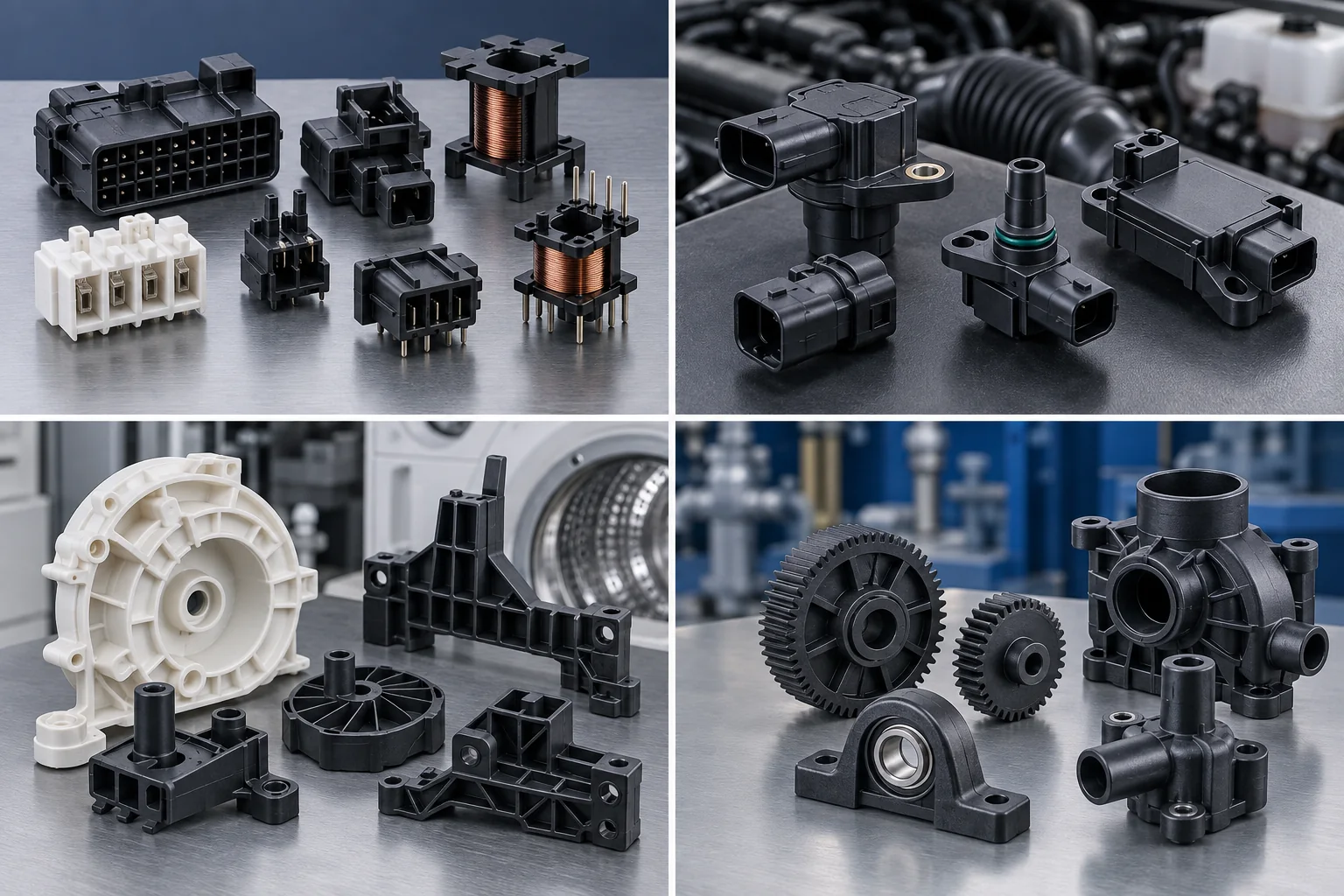
- Electrical and electronic: connector bodies, terminal blocks, relay housings, switches, coil bobbins and small insulating supports.
- Automotive: sensor housings, electrical brackets, small actuator parts and protected under-hood components.
- Appliances: internal frames, motor supports, switch housings and structural parts that require stiffness and electrical insulation.
- Industrial equipment: compact gears, bearing supports, pump or valve housings and precision molded frames.
Molding and Validation Guidance
PBT is moisture-sensitive during melt processing. Dry the material according to the current grade-specific processing sheet and confirm dryer performance before molding. Excess moisture, excessive residence time or unsuitable melt temperature can reduce performance and surface quality.
- Review gate location and flow direction because glass-fiber orientation affects shrinkage, weld lines and warpage.
- Use smooth wall transitions and appropriate radii to reduce stress concentration.
- Check critical dimensions, insertion forces, torque, thermal cycling, vibration and chemical exposure on molded parts.
- Request the current TDS and a sample batch before production approval.
For a specific material review, see the WanHan PBT GF15 product page or browse the PBT material range.
Why Choose WanHan for PBT GF15?
Guangdong WanHan New Material Technology Co., Ltd. has developed and manufactured modified engineering plastics since 2005. We support material screening, color matching, sample molding, technical review and stable production for international projects.
Send the part drawing, service environment, required properties, approvals, color and annual demand.
Request TDS, Sample & Quote →Frequently Asked Questions
Q: What does PBT GF15 mean?
A: It means a PBT compound reinforced with 15% glass fiber. The exact performance depends on the formulation and molding conditions.
Q: Are the values on this page universal for every PBT GF15 grade?
A: No. They are the published WanHan PBT GF15 reference values shown on this page. Confirm the current grade-specific TDS before design approval.
Q: Is this PBT GF15 reference grade UL 94 V-0?
A: No. The published value is UL 94 HB at 1.6 mm. Select a suitable flame-retardant grade when V-0 is required.
Q: What parts are commonly considered for PBT GF15?
A: Typical candidates include connectors, terminal blocks, sensor housings, coil bobbins, appliance structures and compact industrial components.
Q: Does PBT GF15 need drying before injection molding?
A: Yes. Follow the current grade-specific drying and processing sheet, and confirm moisture control before molding.
Q: What information should I send for material selection?
A: Share the drawing, service temperature, load, electrical needs, chemical exposure, approvals, color, annual demand and current material issue.
PBT GF30 properties and applications
PBT GF30: Engineering Excellence Unveiled
Related Article