
Carbon Fiber Reinforced Nylon Pellets: Buyer Guide
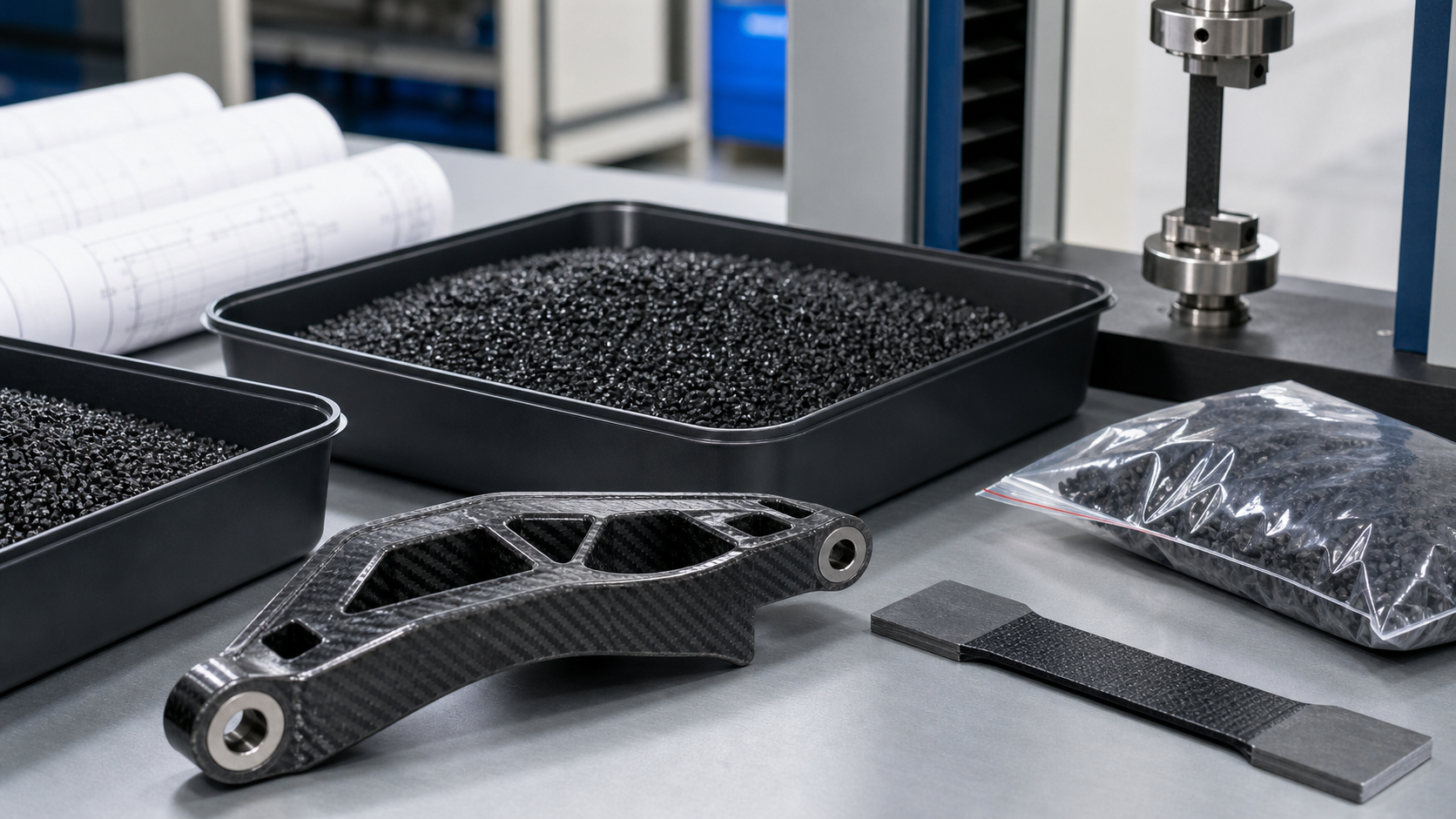
carbon fiber reinforced nylon pellets are usually specified when carbon fiber nylon is already the target direction and the next step is to compare base resin, CF loading, molding behavior, and finished-part validation.
The right grade depends on the nylon base resin, carbon-fiber percentage, stiffness target, anisotropy tolerance, and service environment.
WanHan can support this topic by connecting the article to the published carbon fiber nylon guide, the PA12 carbon-fiber category, and the PA12 CF30 product example.
Why This Phrase Appears in Real Material Selection
Compared with broader searches like carbon fiber nylon, the phrase carbon fiber reinforced nylon pellets usually points to a buyer looking for a deliverable engineering compound, not just a general material definition.
- Which nylon family should carry the carbon fiber system: PA6, PA66, PA12, or a specialty nylon?
- Is the target closer to CF15, CF20, CF25, or CF30?
- How much stiffness is needed, and how much brittleness can the design tolerate?
- Will the molding setup handle abrasive CF compounds efficiently?
- Is the buyer optimizing for lightweight, dimensional stability, or premium appearance?
How to Compare Carbon Fiber Nylon Pellet Options
| Selection variable | What it changes | B2B validation point |
|---|---|---|
| Base resin | Moisture behavior, toughness, chemical resistance, and processing window | Match PA12, PA66, or another system to the real service environment |
| CF loading | Stiffness, weight reduction, brittleness, and anisotropy | Compare at least one lower and one higher CF option during trials |
| Geometry and flow | Warpage, weld-line behavior, and fill balance | Review runner, gate, wall thickness, and fiber orientation risk |
| Production wear | Tooling and screw wear rise with more aggressive CF systems | Check hardware suitability before scale-up |
Why CF PA12 Gets So Much Attention
CF PA12 appears frequently in buyer searches because PA12 is often associated with low-moisture, precision-oriented, and lightweight applications. That makes it attractive where dimensional stability and specialty positioning matter more than commodity pricing.
PA12 should not be selected automatically. The better question is whether PA12 truly improves the project compared with PA6 or PA66 once stiffness, cost, processing, and environment are evaluated together.
Useful next references include the broader carbon fiber nylon guide and the specific PA12 CF30 product page.
Why Choose WanHan
Carbon fiber reinforced nylon projects often require more than a simple material quote. Most programs need help comparing nylon family, carbon-fiber loading, and real processing behavior before choosing a production grade.
- Support for PA12-based, PA66-based, and alternative CF nylon systems
- Sample preparation for grade comparison and project validation
- Technical discussion around stiffness, dimensional stability, and molded-part behavior
- Follow-up for custom color, reinforcement, and production consistency needs
Frequently Asked Questions
Q: What are carbon fiber reinforced nylon pellets?
A: They are nylon compounds pre-filled with chopped carbon fiber to improve stiffness and support lightweight structural applications.
Q: Why is CF PA12 a common search term?
A: Because PA12 is often reviewed for low-moisture, lightweight, and dimensional-stability applications in specialty carbon-fiber nylon systems.
Q: Is CF30 always better than CF15?
A: No. Higher carbon loading can increase stiffness, but it can also increase brittleness, anisotropy, processing difficulty, and hardware wear.
Q: Should buyers choose the CF percentage before choosing the nylon family?
A: Usually no. The nylon base resin and end-use environment should be reviewed first because they shape what CF percentage is realistic.
Q: What should I send when asking for a carbon fiber nylon sample?
A: Send the part use, target properties, molding method, service temperature, and whether you prefer a PA12-based or alternative nylon system.
Q: What technical support should a carbon fiber nylon supplier provide?
A: A capable supplier should help buyers compare nylon family, carbon loading, processing window, dimensional stability, and backup grades instead of only quoting a single CF percentage.
Q: Can I request trial material before a bulk CF nylon order?
A: Yes. Sample quantities and a second comparison grade should be requested so molding trials can verify stiffness, appearance, and processability before commercial release.
Conclusion
Carbon fiber reinforced nylon pellets are best selected through application-level comparison rather than CF percentage alone. WanHan can help buyers review CF PA12 and related carbon-fiber nylon routes through sample validation and technical follow-up.
Electrical Housing Plastic: How to Choose the Right Material
Glass Fiber Reinforced Nylon Pellets: Buyer Guide
Related Article



