
Category


PA11 CF40 Carbon Fiber Reinforced Nylon 11 Pellets
PA11 CF40 is a nominal 40% carbon fiber reinforced Nylon 11 pellet grade for evaluating stiff, lightweight injection molded structural parts. Consider it for camera mounts, robot linkages, instrument brackets and fixtures where deflection and assembly fit matter. Share the part drawing, load directions and conditioning requirements so WanHan can review the grade and define the right trial with your molder.
Product Information
| Item | Details |
|---|---|
| Material | Polyamide 11 (PA11), carbon fiber reinforced |
| Grade designation | PA11 CF40 |
| Reinforcement | Nominal 40% carbon fiber |
| Material form | Pellets for injection molding |
| Project options | Discuss reinforcement, impact modification, flame retardancy, heat and wear requirements, and color |
| Grade documentation | Request current grade TDS and processing guidance |
Product Advantages of PA11 CF40
1. 40% carbon fiber reinforcement
The nominal 40% carbon fiber loading makes this compound a candidate when deflection limits drive material selection. Identify the load direction first. In a molded bracket, fiber orientation along a rib and across a knit line can produce very different behavior.
2. Rigidity where tool alignment matters
On a camera mount or instrument bracket, start with allowable rotation under load. Test the complete assembly with the actual fasteners and stand-off distance to determine how much of the movement comes from the molding and how much comes from the joint.
3. Dimensional control after conditioning
Measure bolt spacing, datum flatness and locating features both after molding and after representative heat and humidity exposure. The useful comparison is the tolerance measured in your assembly, with the same conditioning for all candidates.
4. Lower moisture uptake as a resin-family advantage
PA11 generally absorbs less moisture than shorter-chain polyamides such as PA6. Request conditioned data for this compound and qualify the molded geometry at the humidity extremes that affect fit.
5. Lightweight structure with integrated features
An injection molded design can combine ribs, cable guides and positioning features in one component. Evaluate total assembly mass and stiffness, including any inserts or metal load-spreading hardware necessary at the mounting points.
6. Deflection under sustained loads
A supported sensor or clamped instrument may see a constant load for months. Include dwell at service temperature in the trial and measure movement under load and permanent set after unloading.
7. Injection molding feasibility
Request grade-specific handling and processing guidance. Review the gate location, flow paths, venting and tool wear with the molder. High reinforcement makes gate and weld-line placement especially important on a loaded part.
8. OEM formulation around a stated requirement
WanHan can discuss fiber loading, impact modification, flame retardancy, heat, wear and color requirements. Share the performance target so the team can recommend a development direction and a practical sample evaluation.
PA11 CF40 Application Concepts
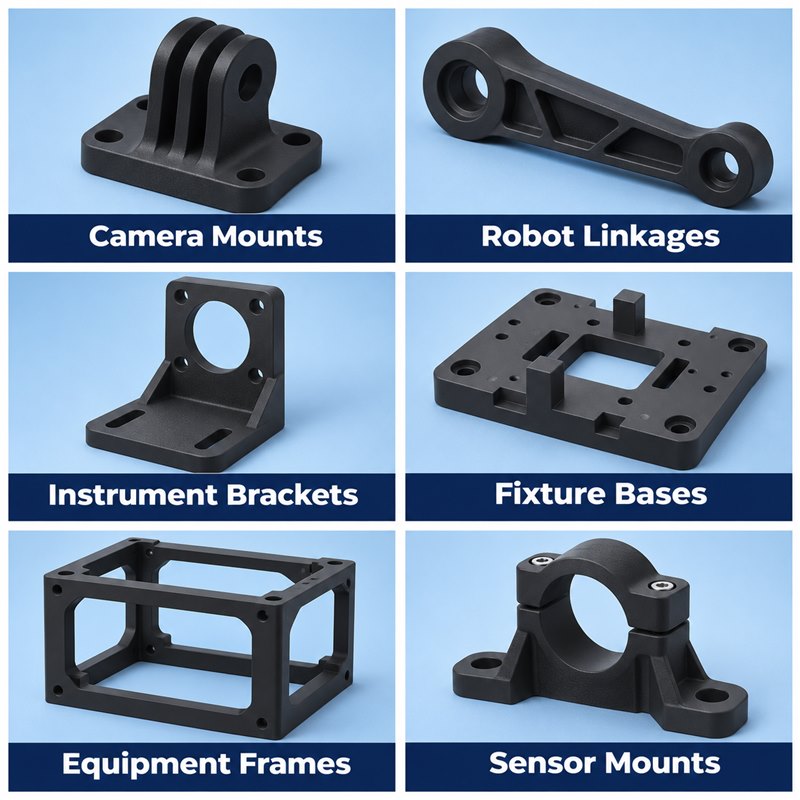
Use these molded-part examples to frame the first engineering review. Confirm the material against your actual design, loads and service environment.
Camera Mounts
Define allowable lens pitch and yaw under gravity and vibration. Use the actual camera mass and screw stack to measure alignment at the optical reference.
Robot Linkages
For a short arm or sensor linkage, check both bending and torsion through the operating cycle. Place gates and weld lines with the peak load path in mind.
Instrument Brackets
Measure panel flatness and threaded insert movement after the intended temperature and humidity cycle. Use actual fastener torque during validation.
Fixture Bases
Check locating-pin spacing and datum repeatability under the clamp load. Inspect the molded part after sustained loading at the expected operating temperature.
Equipment Frames
Focus on the stiffness of rib intersections, mounting bosses and joints. If the part substitutes for a metal frame, evaluate assembly deflection and service access at the target mass.
Sensor Mounts
Confirm that the mounted sensor stays within its positional tolerance after vibration, thermal cycling and reassembly. Where electrical isolation or antenna interaction matters, request electrical data and test the complete assembly.
Material Selection and Molding Trial
For a first trial, show the molder the primary load path, cosmetic surfaces and assembly datums. Use these to evaluate gate placement and knit lines. Record cavity, processing conditions, material conditioning and the fit of each molded sample. Decide which tolerances and loaded deflection limits will control approval before committing to production tooling.
Engineering and Supply Support from WanHan
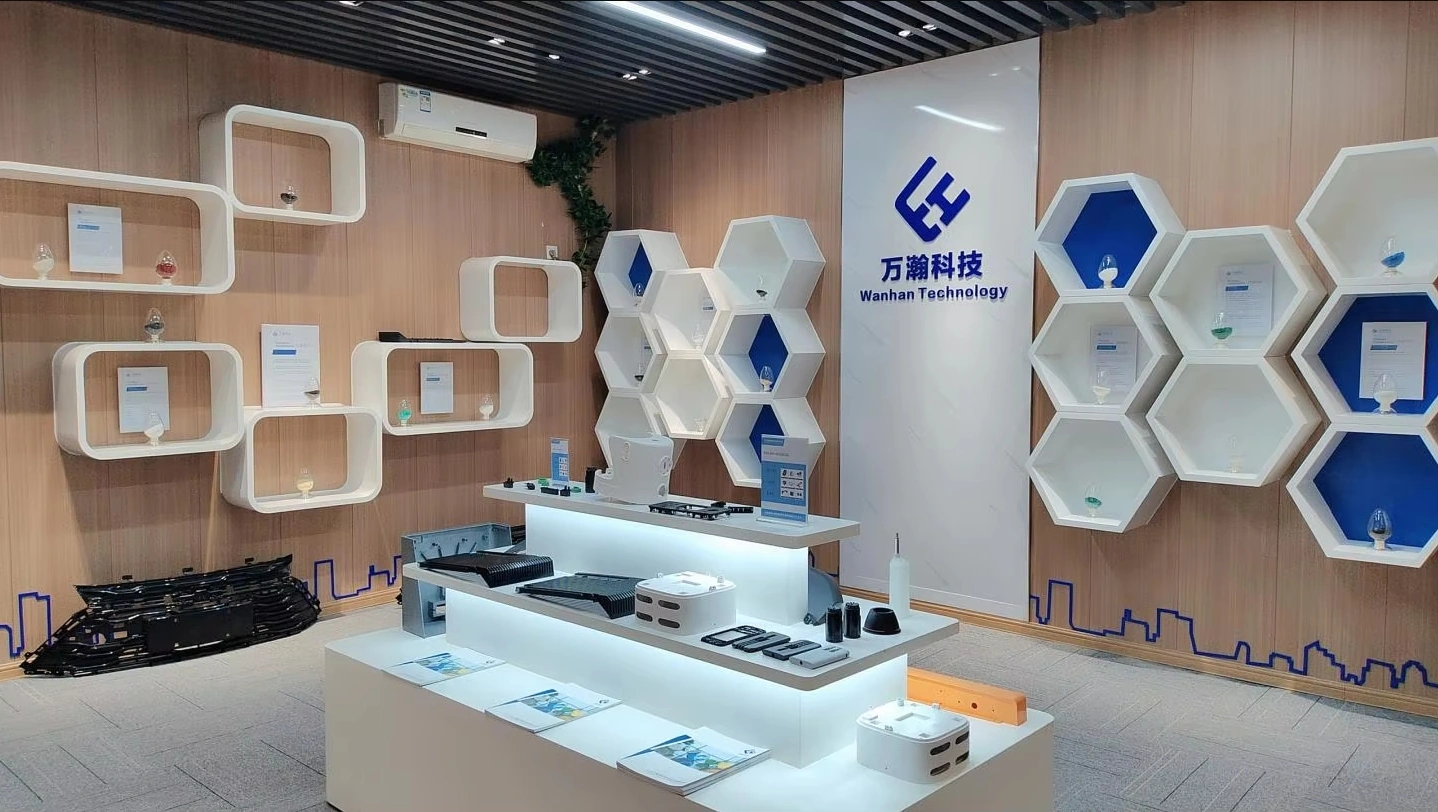
Guangdong Wanhan New Material Technology Co., Ltd. has specialized in modified engineering plastics since 2005. We manufacture PA6, PA66, PA11, PA12, ABS, PC, PC/ABS, PBT, PET, PPS, PPA and PP compounds. For a PA11 CF40 project, our team can support formulation review, sample evaluation and transition to mass production. Share your expected volume, packaging and delivery requirements, along with any documents your qualification process calls for, so the quotation covers the specification you will actually approve.
Frequently Asked Questions
Can PA11 CF40 replace aluminum in a bracket?
Start by comparing geometry, operating temperature, fastener loads and allowable deflection. A polymer design typically needs a revised rib layout or insert strategy. Test the complete assembly under its expected load cycle.
How is this different from PA11 CF30?
The nominal fiber loading differs. Compare the actual TDS, fill behavior, impact and conditioned stiffness of the available grades. A highly reinforced grade may need different gating or thickness in your tool.
What should I measure during a first trial?
Record critical dimensions, flatness, knit-line location, fastener retention and loading deflection. Measure after molding and after representative conditioning so the results predict fit in service.
Can you provide molding temperatures and drying guidance?
Request the current grade-specific processing sheet. Share screw size, shot size, gate dimensions and residence-time constraints so the molder can plan a realistic process window.
Can PA11 CF40 be used near a sensor antenna or insulating interface?
Carbon fiber may affect electrical behavior. State the required dielectric behavior or radio-frequency constraints and test the material in the actual layout before release.
What information is needed for a sample or quote?
Send the drawing, service loads, operating conditions, approximate demand, delivery destination and any required test or compliance documentation. WanHan can use that information to define the material review and sample scope.
Request Grade Data and a Sample
Send your drawing, load case, service temperature and humidity, molding requirements and projected demand. Ask WanHan for the current PA11 CF40 TDS, a sample and a quotation for your project.
 PA11 GF10 Glass Fiber Reinforced Nylon 11 PelletsEvaluate PA11 GF10 pellets for molded sensor housings, cable guides and connector bodies. Ask WanHan for grade data, formulation support and trial samples.PA11 GF10Send Inquiry
 PA11 GF15 Glass Fiber Reinforced Nylon 11 PelletsPA11 GF15 reinforced Nylon 11 pellets for molded instrument housings, cable guides and sensor holders. Ask WanHan for grade data, samples and formulation support.PA11 GF15Send Inquiry
 PA11 GF40 Glass Fiber Reinforced Nylon 11 PelletsEvaluate PA11-WHG40 nylon 11 pellets with 40% glass fiber for rigid molded supports, brackets and housings. Request grade data, samples and material review.PA11-WHG40Send Inquiry
 PA11 GF30 Glass Fiber Reinforced Nylon 11 PelletsEvaluate PA11-WHG30 nylon 11 pellets with 30% glass fiber for rigid molded brackets, housings and supports. Request grade data, samples and application guidance.PA11-WHG30Send Inquiry
Send Message
ABOUT US -- WanHan Technology
--Boasting 18 years of extensive experience in both the Chinese and international markets.
--Highly specialized in catering to the specific needs of the industry.Boasting a highly qualified development team.
--Owns its own production plant.
--Customer-centric approach, providing customized final outcome plans.
--Material quality meets international standards, ensuring excellence.ISO9001, IATF16949, ISO14001, ISO45001, SGS, REACH, ROSH