
Category


PA11 GF10 Glass Fiber Reinforced Nylon 11 Pellets
PA11 GF10 is a nominal 10% glass fiber reinforced Nylon 11 compound for evaluating compact molded sensor housings, cable guides and connector bodies. It offers a reinforced PA11 material route when the part needs defined mounting features and reliable assembly fit. The selection should balance rigidity, local strain and dimensional behavior in the intended environment. WanHan supplies the material as pellets and supports formulation review, sample molding and production planning around your drawing and acceptance criteria.
Product Information
| Item | Details |
|---|---|
| Material | Glass fiber reinforced Polyamide 11 (Nylon 11) |
| Grade | PA11 GF10 |
| Reinforcement | Nominal 10% glass fiber |
| Form | Pellets for injection molding |
| Sample appearance | Olive-gray; project color requirements available for review |
| Grade documentation | Request current TDS, conditioning and processing guidance |
Product Advantages of PA11 GF10
1. 10% glass fiber reinforcement
The nominal 10% glass fiber content gives the PA11 matrix a reinforcement option for compact molded components. It is a useful starting point when an unfilled part needs more support at ribs, bosses or locating features, while the design still needs an appropriate balance of stiffness and assembly behavior. Select against current grade data and the actual part trial.
2. A long-chain nylon material route
PA11 is a long-chain polyamide. As a material family, it generally takes up less moisture than PA6 or PA66, which can help when assembly fit changes with humidity. The supplied formulation and conditioning still matter: define the service environment and measure the dimensions that locate or retain your component.
3. Integrated housing features
A molded sensor shell can combine mounting ears, screw bosses, cable-entry features and internal supports. That gives the designer a route to reduce separate brackets and assembly operations. Align wall thickness, radii and rib locations with the toolmaker so the intended geometry fills and releases consistently.
4. Reinforcement matched to the assembly
More glass fiber is not automatically better for a clip or small connector. A GF10 formulation can be considered alongside unfilled, GF15 and GF20 alternatives when insertion force, local strain, surface finish and stiffness all influence approval. Compare the same part and conditioning state rather than selecting by reinforcement percentage alone.
5. Defined locating and fastening surfaces
Glass reinforcement supports rigidity, but shrinkage and fiber orientation remain part of dimensional control. For a cable guide, mark the hole pitch, channel position and mounting flatness as inspection dimensions. For a housing, include cover fit and boss positions in the first sample report.
6. Geometry tailored to molded parts
Injection molding allows cable channels, ribs, stops and locating faces to be formed together. A well-designed component can use these features to manage movement without unnecessary bulk. Review undercuts, draft and sharp transitions before tooling; check fastening torque and repeated assembly on representative samples.
7. Pellet supply for a controlled molding trial
Pellet form supports a defined material-preparation and molding routine. Request the processing sheet for the supplied formulation, including handling and drying guidance. Keep the process record with the sample measurements so dimensional changes can be compared against both material condition and machine settings.
8. OEM formulation tied to your requirement
WanHan reviews glass content, impact modification, heat, flame, wear and color requirements around the application. Bring the problem that limits the current part: closure movement, retention, cosmetic finish or process behavior. A clear acceptance target makes sample development more useful than a general request for a stronger plastic.
PA11 GF10 Application Concepts
These component concepts show starting points for material selection. Confirm the proposed grade against the drawing, environment and qualification tests for your project.
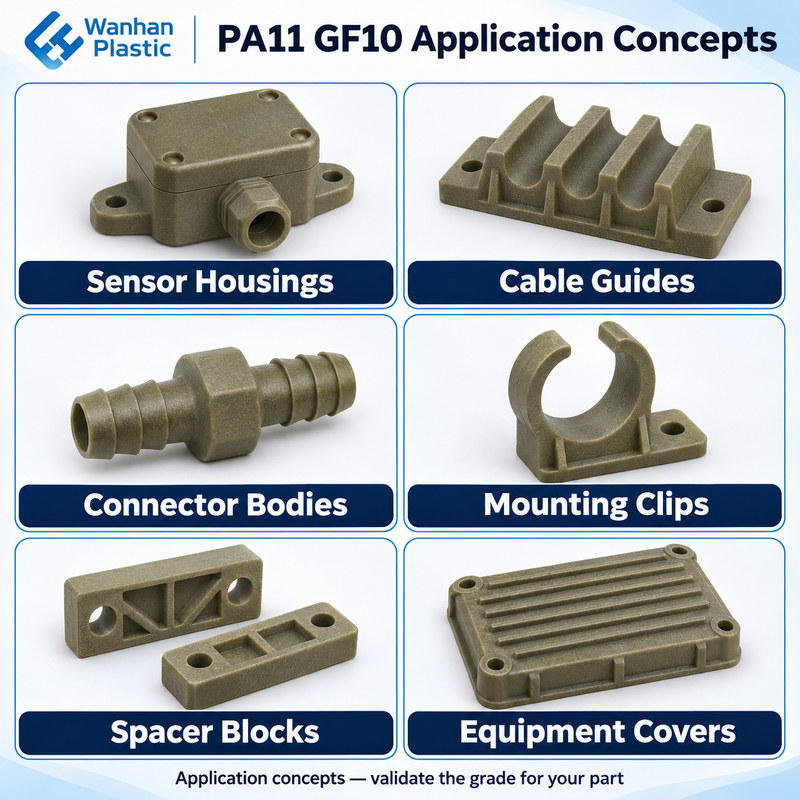
Sensor Housings
Start with the cover joint, mounting ears and the location of the sensing assembly. Review screw-boss retention, internal clearance and cable-entry geometry, then test closure fit through the intended temperature and humidity cycle. Any ingress, electrical or flame requirement belongs in the qualification of the exact grade and complete assembly.
Cable Guides
Specify cable diameter, bend path and how the guide attaches to the equipment. Channel edges should protect the cable during assembly and movement. Check mounting-hole pitch, clamping force and vibration on a molded guide with the actual cable; include exposure to the cleaning agents used in service.
Connector Bodies
Molded connector geometry can consolidate locating and attachment features. Identify sealing surfaces, insertion loads and the exact medium if fluid contact is involved. Validate chemical exposure, joint retention and pressure where applicable on the intended assembly. The illustrated body is a design concept, not a qualified pressure fitting.
Mounting Clips
Define the required insertion force and retention after repeated installation. Review local strain at the clip root and weld-line placement with the toolmaker. Glass-filled material selection needs to account for the available flexing length and the temperatures experienced during fitting and use.
Spacer Blocks
Locate the part using defined datums and state the compressive load and fastener torque. Measure spacer height, hole location and seating flatness after the agreed conditioning cycle. For continuously loaded joints, include long-term movement at service temperature in the trial.
Equipment Covers
Agree the cosmetic face, screw pattern and acceptable edge movement. Use trial moldings to inspect flatness, rib read-through and the fit to the mating structure. Include handling, fastening and cleaning exposure in the test plan so the cover is approved as part of the equipment.
Turn the Drawing into a Useful Molding Trial
For a housing, mark the mounting-hole pitch, cover joint, internal supports and cosmetic face. For a cable guide or clip, include the mating cable or component and define installation and retention forces. Review gates, weld lines, draft and venting before cutting the tool. Record material handling and molding conditions, then inspect the agreed dimensions after molding and after representative conditioning. Use the actual fasteners and assembly sequence in the trial; those details often determine whether the molded part works in service.
Engineering and Supply Support from WanHan
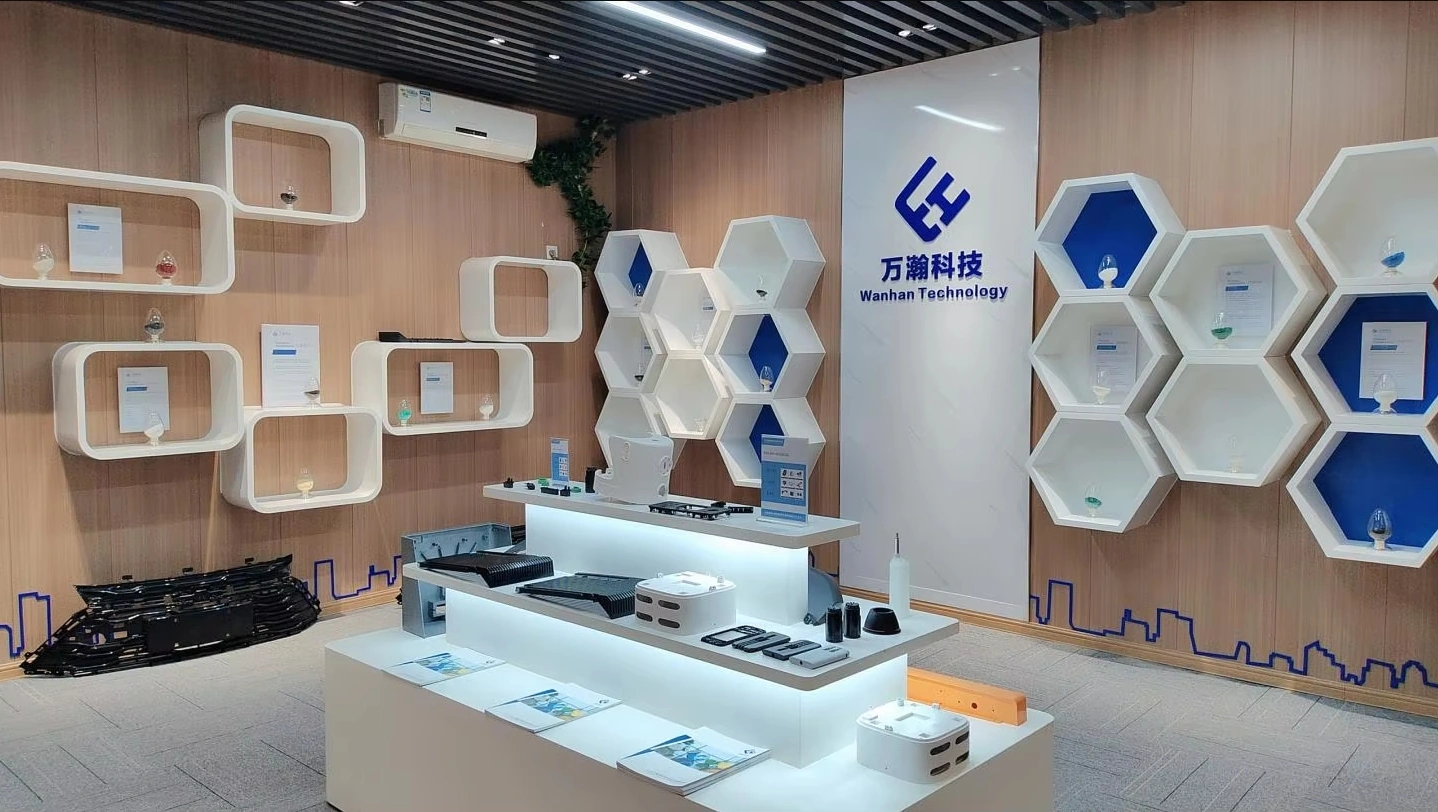
Guangdong Wanhan New Material Technology Co., Ltd. has specialized in modified engineering plastics since 2005. We manufacture PA6, PA66, PA11, PA12, ABS, PC, PC/ABS, PBT, PET, PPS, PPA and PP compounds. Our team supports material selection, development, sample evaluation and the transition to mass production. With a PA11 GF10 project, the discussion starts with the assembly: what must stay in position, what needs to flex and which service conditions control the material decision.
- Formulation development. Review glass fiber content and modification options alongside the mold design, target properties and process constraints. Agree which measurements will determine sample acceptance.
- Sample evaluation. Test with the intended geometry and mating parts where practical. Share dimensional results, conditioning, surface observations and assembly behavior so the next development step addresses a specific limitation.
- Qualification documentation. Identify the TDS, processing instructions and project compliance documents engineering and purchasing need. Keep the supplied formulation and agreed test conditions in the material specification.
- Production and supply planning. Discuss demand, packaging, destination and delivery schedule with the quotation. Align the approved sample specification with the material supplied for ongoing production.
Frequently Asked Questions
What does PA11 GF10 mean?
It identifies a Nylon 11 compound with nominal 10% glass fiber reinforcement. Ask for the current supplied-grade TDS, test methods and conditioning state. The designation describes the material family and reinforcement level; it does not by itself establish a flame rating or application approval.
When should I evaluate GF10 instead of GF15 or GF20?
Use the part requirements to decide. A housing may be governed by stiffness and flatness, while a clip may also be governed by insertion strain and repeated assembly. Compare current grade data and representative moldings for those requirements under the same conditions.
How does PA11 compare with PA6 or PA66 in humid conditions?
PA11 generally has lower moisture uptake than those shorter-chain nylons. That family-level difference can be useful for fit-sensitive parts, but the exact compound, geometry and service environment determine the result. Confirm critical dimensions on conditioned trial parts.
Can PA11 GF10 be used for a sensor enclosure or fluid connector?
It can be evaluated for suitable molded designs. State temperature, mechanical loads, chemicals and any sealing, electrical, flame or pressure requirements. Qualify the exact formulation and assembled component against those requirements before production use.
Which drying and molding settings should the molder use?
Use the processing sheet for the formulation supplied, rather than copying settings from another nylon grade. Share the machine, shot size, wall thickness, gate and cycle requirements. Record material handling and process conditions with the first sample inspection.
What should I send for a sample and quotation?
Send the drawing or sample, application environment, critical dimensions, assembly loads, projected demand and destination. Include appearance and documentation requirements. WanHan can review a formulation proposal, sample scope, packaging and delivery terms for the project.
Request PA11 GF10 Grade Data and Samples
Send WanHan your drawing, assembly requirements, service temperature and humidity, chemical exposure, projected demand and delivery destination. Ask for the current grade data, an evaluation sample and a quotation covering your specification and required documents.
 PA11 GF15 Glass Fiber Reinforced Nylon 11 PelletsPA11 GF15 reinforced Nylon 11 pellets for molded instrument housings, cable guides and sensor holders. Ask WanHan for grade data, samples and formulation support.PA11 GF15Send Inquiry
 PA11 CF40 Carbon Fiber Reinforced Nylon 11 PelletsEvaluate PA11 CF40 pellets for stiff, lightweight molded camera mounts, robot linkages and brackets. Request grade data and samples for your part trial.PA11 CF40Send Inquiry
 PA11 GF40 Glass Fiber Reinforced Nylon 11 PelletsEvaluate PA11-WHG40 nylon 11 pellets with 40% glass fiber for rigid molded supports, brackets and housings. Request grade data, samples and material review.PA11-WHG40Send Inquiry
 PA11 GF30 Glass Fiber Reinforced Nylon 11 PelletsEvaluate PA11-WHG30 nylon 11 pellets with 30% glass fiber for rigid molded brackets, housings and supports. Request grade data, samples and application guidance.PA11-WHG30Send Inquiry
Send Message
ABOUT US -- WanHan Technology
--Boasting 18 years of extensive experience in both the Chinese and international markets.
--Highly specialized in catering to the specific needs of the industry.Boasting a highly qualified development team.
--Owns its own production plant.
--Customer-centric approach, providing customized final outcome plans.
--Material quality meets international standards, ensuring excellence.ISO9001, IATF16949, ISO14001, ISO45001, SGS, REACH, ROSH