
Plastic Extrusion Explained: Process, Materials, Types, and Applications
Plastic Extrusion Explained: Process, Materials, Types, and Applications
Plastic extrusion is one of the most widely used manufacturing methods for producing continuous plastic shapes such as pipe, sheet, tubing, film, cable jacketing, and custom profiles. When engineers, processors, or project teams search for plastic extrusion or extrusion plastic, they usually want a practical answer: how the process works, which materials are suitable, and how to reduce defects in mass production.
In simple terms, the plastic extrusion process melts thermoplastic resin and pushes it through a shaped die to create a continuous profile. Unlike injection molding, which fills a closed mold for individual parts, extrusion creates a constant cross-section that can be cut to any required length.
What Is Plastic Extrusion?
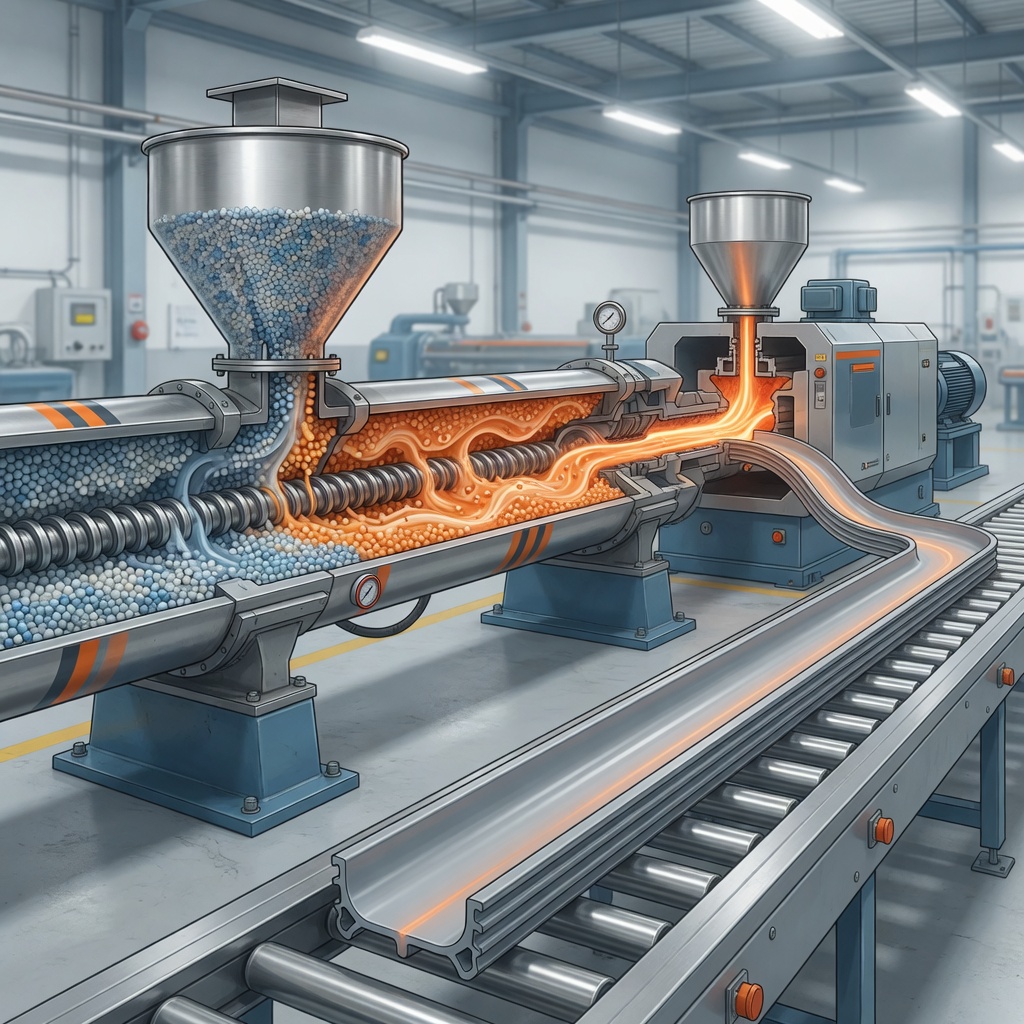
Plastic extrusion is a continuous manufacturing process in which polymer pellets or powder are fed into an extruder, heated inside a barrel, mixed by a rotating screw, and forced through a die. The die determines the final cross-sectional shape of the product.
This process is commonly used when manufacturers need:
- Continuous length production
- Stable cross-sectional geometry
- Efficient high-volume output
- Lower tooling complexity than some molding methods
- Profile, tube, sheet, or film manufacturing
How the Plastic Extrusion Process Works
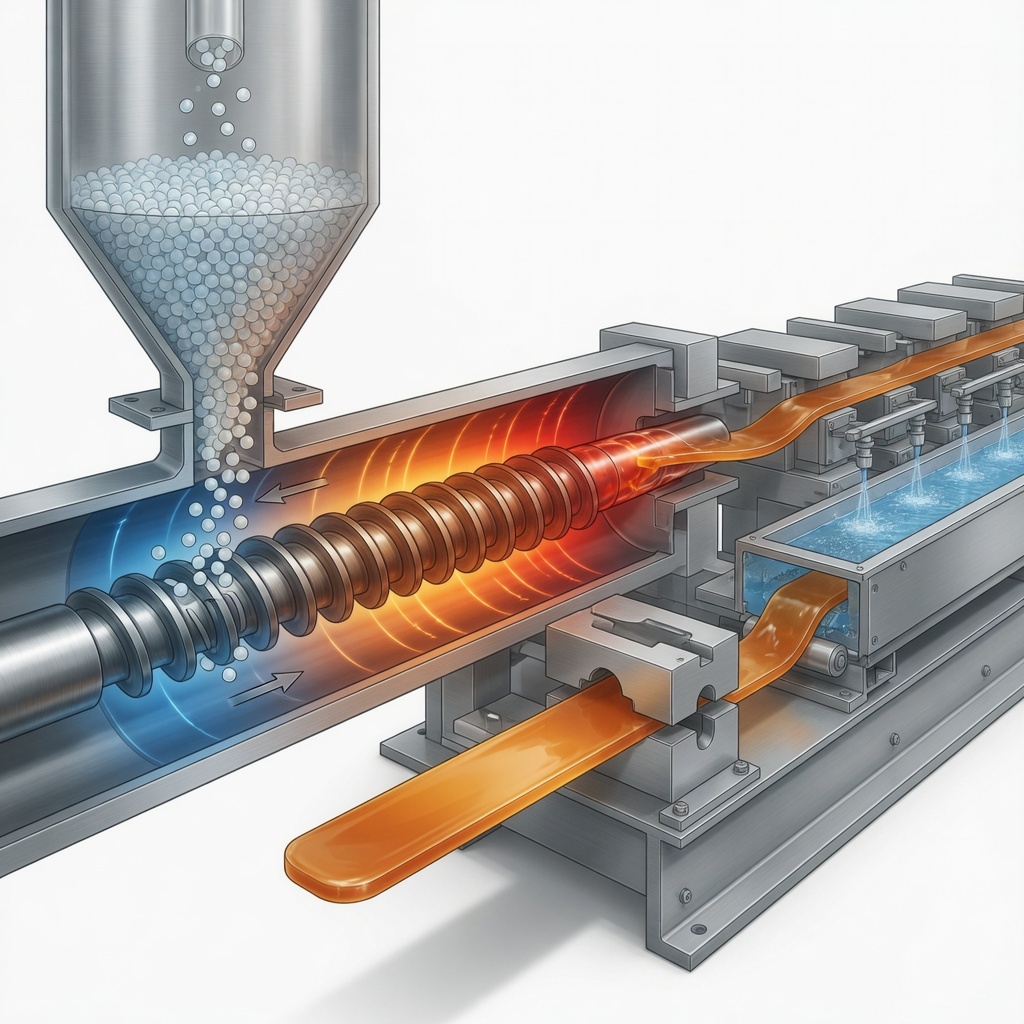
The plastic extrusion process usually follows five basic stages:
- Feeding: Plastic resin enters the hopper.
- Melting: The screw conveys resin through heated barrel zones.
- Mixing and pressure building: The rotating screw homogenizes the melt.
- Shaping: The melt exits through the die and takes the target profile.
- Cooling and haul-off: The profile is cooled, sized, pulled, and cut.
If screw design, melt temperature, line speed, or cooling balance is not controlled well, extrusion defects such as dimensional drift, surface roughness, melt fracture, voids, or warpage may appear.
Common Materials Used in Plastic Extrusion
Material selection is critical because not every thermoplastic behaves the same way in extrusion. Common extrusion plastic materials include:
- PE: widely used for pipe, film, and tubing
- PP: suitable for sheet, profiles, and packaging applications
- PVC: common in rigid profiles, conduit, and window frame systems
- ABS: selected for rigid profiles and application-specific housings
- PA6 and PA66: used where higher mechanical performance is required
- TPE and TPU: preferred for flexible extruded components
- PC and modified engineering plastics: used in specialty profiles with higher heat or impact requirements
For engineering plastics, extrusion performance depends not only on resin family but also on viscosity, filler content, moisture control, thermal stability, and downstream dimensional requirements. This is why compound selection and processing support often matter as much as nominal material type.
What Products Are Made by Plastic Extrusion?
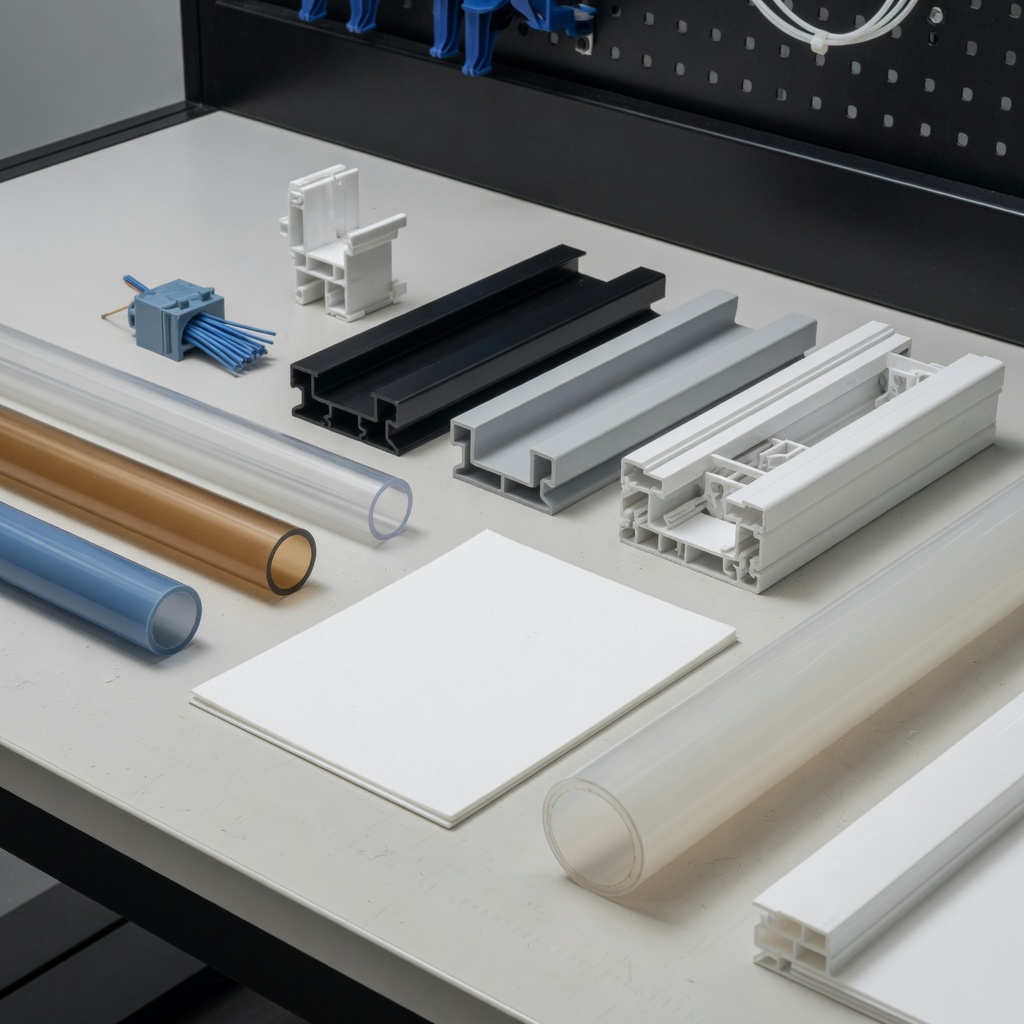
Many industrial and consumer products are made with plastic extrusion. Typical examples include:
- Pipes and tubes
- Plastic sheets and boards
- Cable insulation and jacketing
- Window and door profiles
- Edge trim and sealing strips
- Medical and industrial tubing
- Custom hollow or solid profiles
The main advantage is that once the profile shape is stable, the process can run continuously with high productivity and good cost efficiency.
Plastic Extrusion vs Injection Molding
Teams sometimes compare plastic extrusion with injection molding, but the two methods solve different manufacturing needs.
- Extrusion: best for continuous shapes with one cross-section
- Injection molding: best for discrete 3D parts with complex geometry
- Extrusion tooling: typically simpler die-based flow shaping
- Injection tooling: closed mold cavity and core system
- Extrusion output: profile is cooled and cut to length
- Injection output: each cycle creates individual molded parts
If the product is a long profile, pipe, strip, tube, or sheet, extrusion is usually the more suitable process. If the product needs ribs, bosses, undercuts, and complex 3D form, injection molding is normally the better choice.
Common Quality Problems in Plastic Extrusion
Even when the basic process is understood, production consistency still depends on setup control. Common extrusion issues include:
- Melt fracture: rough or distorted surface caused by unstable flow
- Die lines: surface marks linked to tooling or contamination
- Wall thickness variation: poor sizing, die imbalance, or unstable pull speed
- Warping: uneven cooling or residual stress
- Bubbles or voids: moisture, trapped air, or formulation instability
- Dimension drift: inconsistent melt temperature or haul-off control
For higher-value applications, defect reduction often requires a combination of correct die design, suitable resin rheology, stable drying conditions, and repeatable cooling control.
How to Evaluate an Extrusion Material or Supplier
For an extrusion project, do not focus only on nominal resin name. Ask for processing guidance and confirm whether the grade can support your actual profile geometry, target output, and downstream requirements.
A practical evaluation checklist includes:
- Melt flow behavior for the target die design
- Moisture sensitivity and drying requirement
- Heat stability during continuous processing
- Dimensional consistency after cooling
- Surface finish quality on the final profile
- Impact, stiffness, and environmental resistance
- Whether custom compounding is needed for the application
Plastic Extrusion: Final Answer
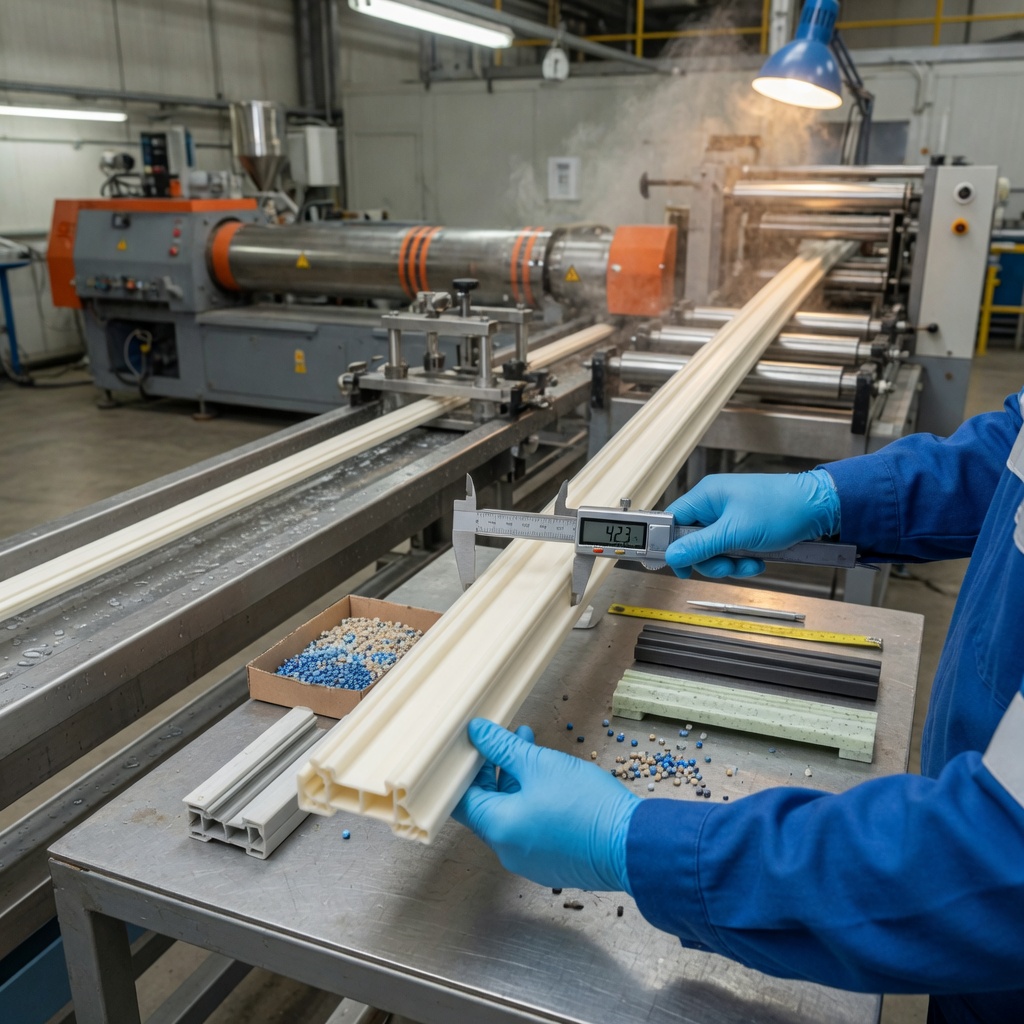
So, what is plastic extrusion? It is a continuous process that melts polymer material, forces it through a die, and forms a long product with a consistent cross-section. It is widely used for pipe, sheet, tubing, cable covering, and custom profiles because it combines production efficiency with strong dimensional repeatability.
For manufacturers, the key success factors are material selection, die design, screw and temperature control, and stable downstream cooling. If these are aligned, extrusion plastic production can deliver high output, good finish quality, and reliable cost performance.
Why Choose WanHan for Engineering Plastic Projects?
Since 2005, WanHan has focused on independent R&D, production, and global sales of functional engineering plastics for more sustainable industrial applications. Certified to ISO 9001, ISO 14001, ISO 45001, and IATF 16949, we operate with complete in-house testing equipment and strict quality control throughout development and production. Our materials are exported to more than 30 countries and are widely used in automotive, electronics, home appliances, and industrial applications that require higher-performance polymer solutions.
- Application-based material selection support for OEM, injection molding, and product development teams.
- Custom compounding capability for glass fiber, flame-retardant, carbon fiber, mineral-filled, impact-modified, anti-UV, and color-customized grades.
- Full quality control with in-house testing equipment and certified systems for more stable repeat orders and production consistency.
- Free sample support, technical data sheets, and processing guidance to shorten validation time before mass production.
- Fast quotation response, export-ready packaging, and practical support for long-term production supply programs.
If you are selecting a resin for a new project or replacing an existing grade, WanHan can help with grade matching, sample preparation, and custom compound evaluation. You can send your target application, part drawing, annual quantity, or required properties through WanHan's inquiry page to get a faster quotation and material recommendation. You can also review top-sale engineering plastic grades for faster project matching.
For extrusion projects, you can also review WanHan's PA6 guide, PA66 guide, and engineering plastic product range when matching profile performance, moisture control, and process stability.
Frequently Asked Questions
Q: What is plastic extrusion?
A: Plastic extrusion is a continuous manufacturing process that melts thermoplastic resin and pushes it through a die to create products such as pipe, sheet, tubing, film, and custom profiles.
Q: What materials are commonly used in plastic extrusion?
A: Common extrusion materials include PE, PP, PVC, ABS, PA6, PA66, TPE, TPU, PC, and other modified engineering plastics depending on profile design and performance requirements.
Q: What is the difference between plastic extrusion and injection molding?
A: Plastic extrusion makes continuous products with a fixed cross-section, while injection molding produces individual 3D parts inside a closed mold cavity.
Q: What products are made by plastic extrusion?
A: Typical extruded products include plastic pipe, tubing, sheet, film, cable jacketing, window profiles, sealing strips, and custom industrial profiles.
Q: Why is material selection important in plastic extrusion?
A: Material selection affects melt stability, surface quality, dimensional control, cooling behavior, and long-term performance, so the right resin or compound is essential for a stable extrusion line.
What Is ABS Material? Acrylonitrile Butadiene Styrene Properties, Uses, and Processing Guide
PC vs ABS: Differences, Properties, Applications, and How to Choose
Related Article



