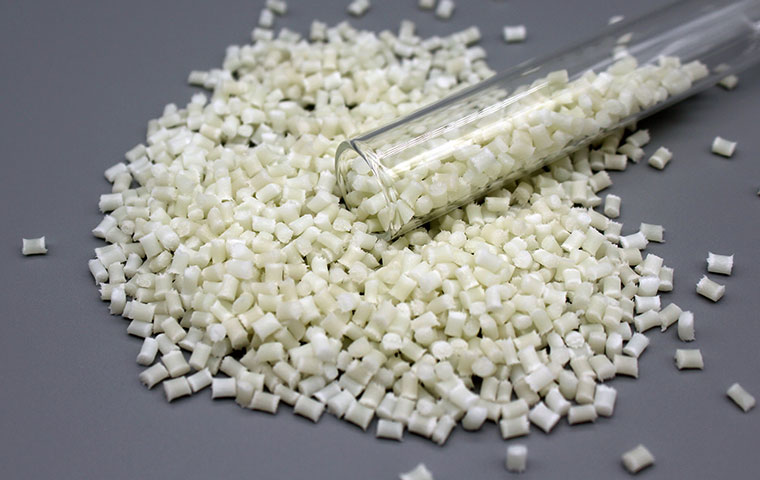
PA6 GF30 Datasheet, Properties and Material Guide
PA6 GF30 is polyamide 6 reinforced with 30% glass fiber. The reinforcement raises stiffness, strength, dimensional stability, and heat resistance compared with unfilled nylon 6, while moisture conditioning, fiber orientation, wall thickness, and molding conditions still affect finished-part performance.
This PA6 GF30 datasheet guide explains the material, reviews exact example values for WanHan grade PA6-WHG30B, and outlines applications and processing factors. For purchasing specifications, samples, and the current technical data sheet, use the PA6-WHG30B product page.
What PA6 GF30 Material Means
The designation combines PA6, the nylon 6 polymer matrix, with GF30, indicating 30% glass-fiber reinforcement by weight. The fibers carry part of the mechanical load and limit deformation, which makes the material useful for brackets, housings, supports, gears, clips, and other components that need more rigidity than unfilled PA6.
PA6 GF30 is a material family rather than one universal specification. Heat stabilizers, impact modifiers, lubricants, color systems, flame-retardant packages, and glass-fiber orientation can change the result. Designers should compare data for the exact grade, test condition, temperature, and moisture state instead of treating one generic value as applicable to every compound.
PA6 GF30 Datasheet: PA6-WHG30B Example
The following values are published for WanHan grade PA6-WHG30B. They are an exact-grade example and are not universal values for every PA6 GF30 material.
| Property | Test method | Unit / condition | Published value |
|---|---|---|---|
| Tensile strength | ISO 527 | MPa | 175 |
| Elongation at break | ISO 527 | % | 9 |
| Flexural strength | ISO 178 | MPa | 230 |
| Flexural modulus | ISO 178 | MPa | 8,500 |
| Izod notched impact strength | ISO 180 | kJ/m² | 17 |
| Heat deflection temperature | ISO 75 | °C | 175 |
| Melt flow index | ISO 1133 | g/10 min | 20 |
| Density | ISO 895 (as published) | g/cm³ | 1.4 |
| Molding shrinkage | ISO 2577 | % | 0.6 |
| Flammability | UL 94 | 1.6 mm | HB |
Data qualification: confirm the current technical data sheet, test specimen condition, color, lot requirements, and finished-part validation before final material approval. Moisture and fiber direction can make molded-part results differ from laboratory specimens.
Key PA6 GF30 Properties
High stiffness and load support
Glass fibers raise tensile and flexural performance, helping structural parts resist deflection under mechanical load.
Heat and creep resistance
Reinforcement improves short-term heat performance and reduces long-term deformation, but the actual service limit remains grade- and load-specific.
Dimensional stability
Lower shrinkage and greater rigidity help maintain dimensions, while flow direction and local fiber orientation must still be considered.
Wear and electrical applications
Selected grades can support gears, guides, housings, and insulating structures when friction, voltage, temperature, and compliance needs are verified.
For a test-focused discussion, see PA6 GF30 properties and test data. For application design examples, see the PA6 GF30 engineering application guide.
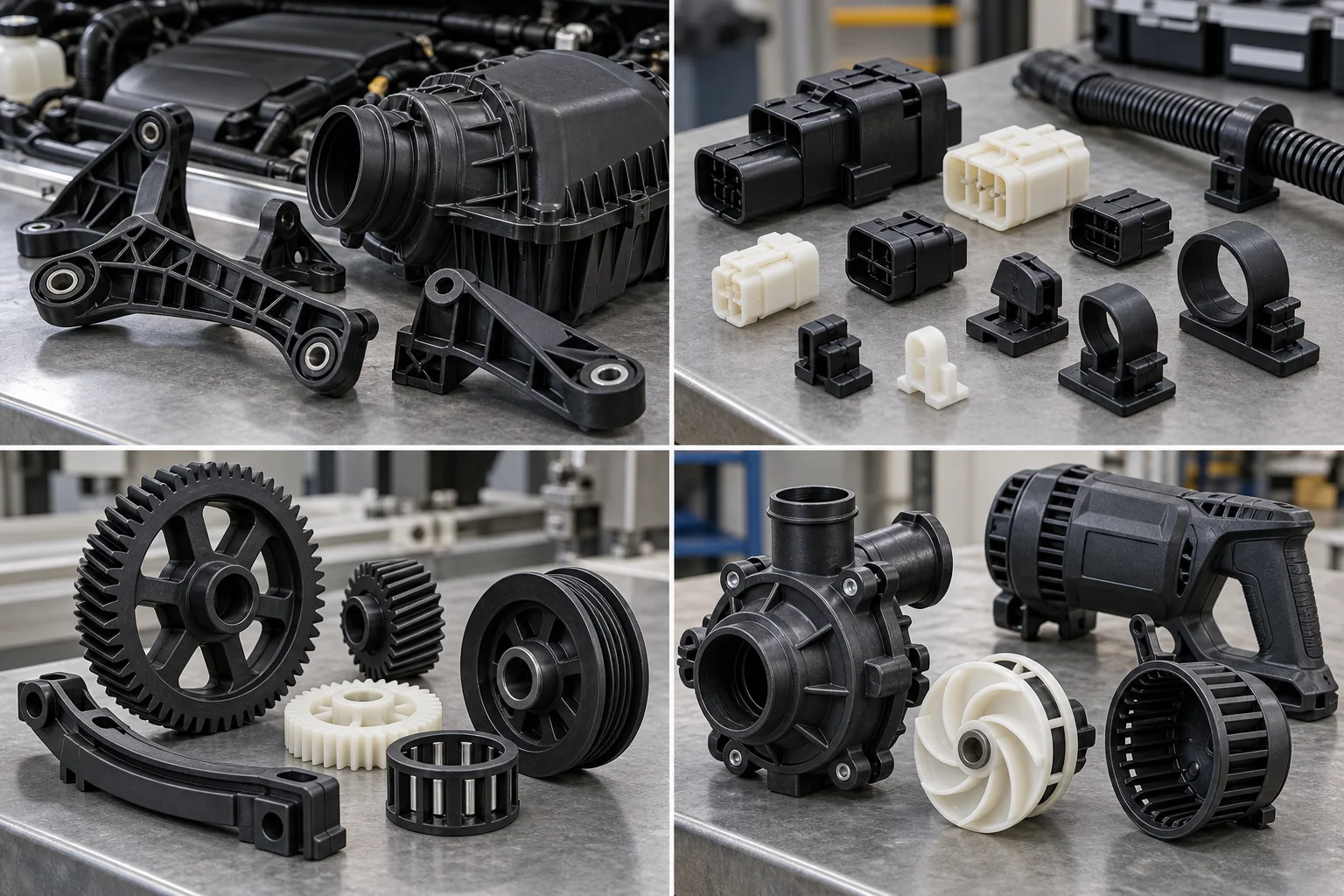
Typical PA6 GF30 application directions include under-hood brackets, connector housings, industrial gears and bearing cages, pump and fan components, and reinforced tool housings.
Typical PA6 GF30 Applications
Automotive components
Structural brackets, clips, supports, air-management parts, and selected under-hood housings where stiffness, heat aging, and dimensional stability are required.
Electrical and electronics
Connector bodies, terminal housings, cable-management parts, sensor supports, and insulating structures after electrical and flame requirements are confirmed.
Industrial machinery
Gears, pulleys, bearing cages, guides, covers, and load-supporting parts designed around wear, alignment, impact, and operating temperature.
Appliances and tools
Pump housings, fan structures, appliance supports, and power-tool housings that benefit from reinforced nylon strength and processability.
Injection Molding and Part Validation
PA6 GF30 should be dried and handled according to the exact grade instructions. Excess moisture before molding can affect appearance and mechanical consistency. Melt and mold temperatures, injection speed, packing, venting, and residence time should be set from the supplier's current processing guidance and then confirmed on the production tool.
Fiber orientation is especially important. Flow direction can change stiffness, strength, and shrinkage, while gates and weld lines influence local performance. Use balanced wall thickness, suitable radii, appropriate draft, and gate placement that supports the load path. Validate critical dimensions and mechanical targets on conditioned molded parts rather than relying only on dry specimen data.
How to Select a PA6 GF30 Grade
Provide the component function, load direction, continuous and peak temperature, moisture or chemical exposure, wall thickness, tolerance, impact target, color, flame requirement, regulatory requirement, and expected volume. If the project replaces metal or another polymer, include the current material and the reason for the change.
Grade selection may require heat stabilization, impact modification, lubrication, color matching, flame retardancy, hydrolysis resistance, or another controlled formulation. A sample trial and finished-part test help confirm processing behavior and service performance before production approval.
Why Choose WanHan
WanHan has worked with functional polymer materials since 2005 and supports automotive, electrical, appliance, and industrial applications in more than 30 countries.
Since 2005
Independent R&D, production, and application support for functional polymer materials.
Four Certified Systems
ISO 9001, ISO 14001, ISO 45001, and IATF 16949.
Material Verification
Testing equipment, grade evaluation, quality control, and production consistency checks.
Application Support
Grade recommendations, samples, technical documents, color support, and processing guidance.
Frequently Asked Questions
What does PA6 GF30 mean?
It means a nylon 6 matrix reinforced with 30% glass fiber by weight. The exact formulation can also include stabilizers, lubricants, colors, or other modifiers.
Are all PA6 GF30 datasheet values the same?
No. Values depend on the exact grade, test method, specimen conditioning, temperature, fiber orientation, and additive package. Use the current data sheet for the selected grade.
What is the density of PA6 GF30?
WanHan grade PA6-WHG30B publishes a density of 1.4 g/cm³ under the referenced test method. Other PA6 GF30 grades may differ.
Does moisture affect PA6 GF30?
Yes. The PA6 matrix absorbs moisture, which can change stiffness, toughness, and dimensions. Evaluate the material in the expected service condition.
What information is needed for grade selection?
Provide the application, load, temperature, moisture and chemical exposure, dimensions, tolerance, impact target, color, flame and compliance requirements, and expected volume.
Request PA6 GF30 Data and Samples
For the current PA6-WHG30B technical data sheet, sample discussion, color support, or grade comparison, contact WanHan at [email protected] or +86 13537012277.
PA6 Material Properties and Applications Guide
PA6 vs PA66: Key Differences and Material Selection
Related Article