PA6 GF30 Engineering Applications and Design Guide
PA6 GF30 engineering applications use the stiffness, strength, heat performance, wear behavior, and dimensional control of 30% glass-fiber-reinforced nylon 6. The material is a practical candidate for structural parts, but final suitability depends on the exact grade, moisture condition, fiber orientation, molding quality, service load, temperature, chemicals, and part geometry.
This guide connects application requirements with material and part-design decisions. WanHan grade PA6-WHG30B is used as an exact-grade example. For current specifications, samples, and commercial discussion, visit the PA6-WHG30B product page.
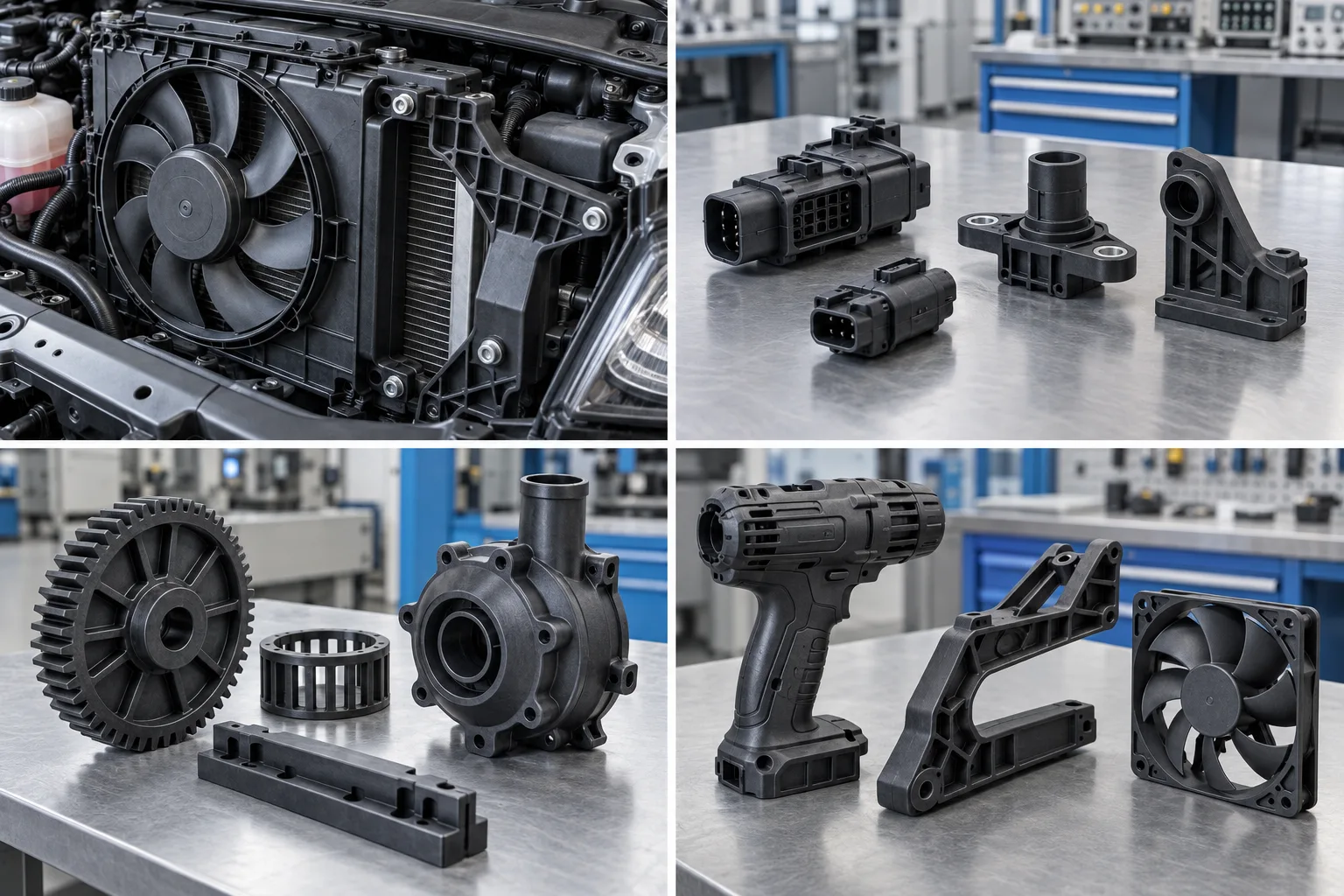
Representative PA6 GF30 application directions: automotive cooling structures, electrical housings, industrial motion and pump parts, reinforced tool structures, and appliance fan frames.
Where PA6 GF30 Is Commonly Considered
Automotive under-hood parts
Cooling-fan shrouds, air-management components, brackets, supports, covers, clips, and selected sensor structures can use PA6 GF30 where stiffness, heat resistance, vibration durability, and dimensional stability must be balanced.
Electrical and electronic parts
Connector bodies, terminal housings, sensor supports, switch structures, bobbins, and circuit-protection components may benefit from reinforced nylon. Electrical performance, flame rating, heat aging, moisture, and creepage requirements must be verified for the exact grade.
Industrial motion and fluid parts
Gears, bearing cages, guides, pulleys, impellers, pump housings, and mechanical supports require evaluation of load direction, wear, lubrication, pressure, temperature, moisture, chemical exposure, and long-term creep.
Tools, appliances, and equipment
Power-tool structures, garden-equipment supports, fan frames, pump components, and appliance brackets can use PA6 GF30 when low weight, stiffness, assembly strength, and repeatable molding are important.
Application-to-Design Decision Matrix
| Application direction | Why PA6 GF30 may fit | Design focus | Required validation |
|---|---|---|---|
| Cooling and air-management structures | Stiffness, heat performance, molded complexity | Rib layout, fan clearance, fasteners, vibration | Heat aging, vibration, dimensional stability |
| Connectors and electrical housings | Strength, dimensional control, thin structural features | Terminal retention, weld lines, creepage, gate position | Electrical, flame, thermal-cycle, moisture tests |
| Gears, cages, guides, and pulleys | Stiffness, wear potential, low weight | Fiber direction, tooth/root geometry, alignment | Wear, noise, lubrication, impact, life-cycle tests |
| Pumps and fluid-handling parts | Strength, moldability, dimensional repeatability | Pressure zones, sealing faces, chemical contact | Leak, pressure, fluid compatibility, temperature tests |
| Tool and appliance structures | Load support, stiffness, production efficiency | Bosses, screws, drop zones, surface finish | Drop, torque, heat, fatigue, assembly tests |
What the PA6-WHG30B Data Mean for Parts
PA6-WHG30B publishes 175 MPa tensile strength, 230 MPa flexural strength, an 8,500 MPa flexural modulus, 17 kJ/m² notched Izod impact strength, 175°C heat deflection temperature, 1.4 g/cm³ density, 0.6% molding shrinkage, and UL 94 HB at 1.6 mm. These values support initial comparison but are not universal PA6 GF30 values.
Standard specimens do not reproduce every molded part. Fiber alignment can raise performance in the flow direction while creating directional shrinkage and stiffness. Weld lines, sharp corners, thick-to-thin transitions, holes, bosses, and inserts may become local stress areas. Moisture conditioning can also change stiffness, toughness, and dimensions.
Engineering note: use the current exact-grade data sheet and test the molded component under its real load, temperature, moisture, chemical, vibration, and assembly conditions. Do not convert a single laboratory value into a finished-part guarantee.
Part Design Priorities for Reinforced Nylon 6
Keep wall thickness as uniform as practical, add gradual transitions, use suitable draft, and avoid sharp internal corners. Ribs can improve stiffness without excessive wall thickness, but rib proportions and intersections should limit sink and local stress. Bosses and screw features need adequate support and distance from edges.
Gate location should support balanced filling and direct fibers along important load paths where possible. At the same time, weld lines should be kept away from critical loads, sealing surfaces, fastener zones, and impact points. Tooling review should include shrinkage direction, warpage risk, venting, cooling balance, and dimensional measurement after conditioning.
Injection-Molding and Assembly Factors
Dry and handle the material according to the current grade instructions, then protect it from moisture regain. Establish melt temperature, mold temperature, injection speed, packing, residence time, and cooling on the production tool using supplier guidance. Excessive shear, residence time, or poor venting can affect appearance and consistency.
For assembled parts, confirm screw torque, insert design, snap-fit strain, press-fit stress, welding method, adhesive compatibility, and long-term clamp load. Glass-filled nylon is stiff, so assembly features should avoid forcing excessive deflection into thin sections or sharp notches.
How to Validate a PA6 GF30 Application
Start with the service environment and critical failure modes. Record continuous and peak temperatures, static and cyclic loads, impact, humidity, water or chemical contact, electrical and flame requirements, dimensional tolerances, appearance, service life, and regulatory needs. Then compare exact grades and test molded samples.
A practical approval plan can include incoming-material checks, conditioned and dry-as-molded dimensions, tensile or flexural comparison when relevant, impact tests, thermal aging, thermal cycling, vibration, torque retention, chemical exposure, wear, leakage, electrical tests, flame requirements, and final assembly trials.
For material values and test-method interpretation, read the PA6 GF30 properties and test-data guide. For a broader definition and datasheet overview, see the PA6 GF30 datasheet and material guide.
Why Choose WanHan
WanHan has worked with functional polymer materials since 2005 and supports automotive, electrical, appliance, and industrial applications in more than 30 countries.
Since 2005
Independent material development, production, and application support.
Four Certified Systems
ISO 9001, ISO 14001, ISO 45001, and IATF 16949.
Material Verification
Grade evaluation, quality control, and production consistency checks.
Application Support
Grade recommendations, samples, technical documents, and processing guidance.
Frequently Asked Questions
What parts are commonly made from PA6 GF30?
Typical candidates include automotive brackets and cooling structures, connector housings, sensor supports, gears, bearing cages, guides, pump components, tool structures, and appliance fan frames.
Is PA6 GF30 suitable for under-hood automotive parts?
It can be considered when the exact grade meets heat-aging, vibration, chemical, moisture, dimensional, and load requirements. Approval should use molded-part testing under the intended service conditions.
Can PA6 GF30 be used for electrical connectors?
Yes, for suitable connector or housing designs when electrical properties, flame rating, temperature, moisture, terminal retention, and dimensional requirements are confirmed for the exact grade.
Why does fiber orientation matter?
Glass fibers tend to align with melt flow, producing directional stiffness, strength, and shrinkage. Gate location, flow path, weld lines, and part geometry therefore affect performance and warpage.
What information is needed before selecting a grade?
Provide the part drawing, load, temperature, moisture and chemical exposure, tolerances, impact target, color, flame and electrical requirements, assembly method, expected volume, and validation plan.
Discuss Your PA6 GF30 Application
For PA6-WHG30B data, samples, grade comparison, or application review, contact WanHan at [email protected] or +86 13537012277.
PA6 GF30 Properties, Test Data and Design Guide
What are the key information of PA6 GF30 material?
Related Article