PC/ABS Data Sheet: Grade Selection and Test Values
A PC/ABS data sheet is useful only when it identifies the exact grade and the conditions behind each test. A general description of PC/ABS cannot establish the density, strength, heat resistance, flame rating or molding shrinkage of the material you will receive. Reinforcement, flame retardants, conductive fillers and other modifications can change these results.
This guide explains which fields to check when comparing PC/ABS grades. For a broad introduction to the blend, read our PC-ABS material guide. For a specific project, request the current technical data sheet for the proposed grade and validate it on molded parts.
What to check in a PC/ABS data sheet
| Field | Why it matters | What to verify |
|---|---|---|
| Exact grade and formulation | Unfilled, reinforced, flame-retardant and conductive grades are not interchangeable. | Grade code, color, filler or additive package and revision date. |
| Density | Helps estimate part mass and distinguish formulations. | Test method, units and whether the value belongs to the offered grade. |
| Tensile and flexural properties | Support preliminary load and stiffness comparisons. | Specimen geometry, test speed, temperature and conditioning. |
| Impact performance | Matters for clips, housings and parts exposed to handling or shock. | Notched or unnotched method, specimen thickness and temperature. |
| Heat deflection temperature | Helps screen parts exposed to heat under load. | Applied load and test standard; it is not a continuous-use rating. |
| Flammability and electrical properties | Can be critical for electrical enclosures. | Exact grade, test thickness, UL 94 result and the stated electrical test method. |
| Molding shrinkage | Affects tool dimensions and tolerance planning. | Flow direction, test plaque, wall thickness and processing conditions. |
Do not transfer a value between grades
A data-sheet image previously shown on this page was labeled for a particular conductive PC/ABS formulation, not for PC/ABS as a whole. Its electrical description and displayed resistivity were not suitable for use as a general specification, so it is not reproduced here. Do not use any value from another formulation to approve your part. Ask for the current document for the exact grade and clarify any inconsistent entries with the supplier before design release.
How to compare candidate grades
- Describe the finished part, its wall thickness, loads, temperature, chemical exposure and appearance requirements.
- Identify required approvals, including flame rating and test thickness where relevant.
- Compare the same property under the same standard and conditioning; a higher headline number from a different test is not a direct comparison.
- Review drying and molding guidance for the proposed grade, then mold samples in the intended tool.
- Confirm critical dimensions, appearance, assembly and performance on the production-like part.
Applications and grade choice
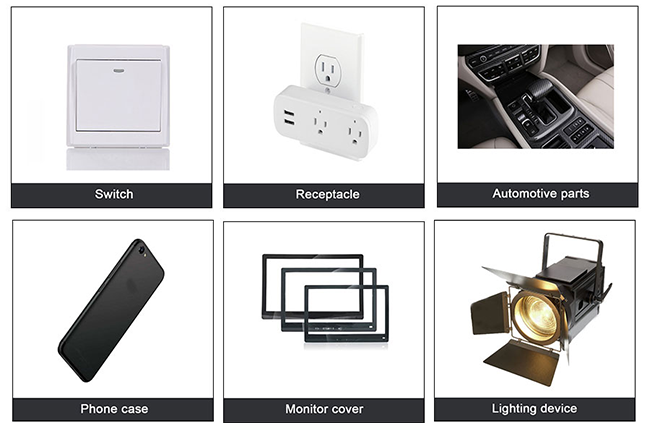
PC/ABS may be considered for selected automotive interior, electrical housing, appliance and equipment components. The part's actual service conditions determine which grade is appropriate. The illustration below shows example part categories, not an approval of any one formulation for every pictured application.
Request the matching grade document
Send WanHan your application, drawing or wall thickness, performance targets, color, required approvals and expected operating conditions. We can identify a candidate from the PC/ABS product range, provide the matching technical information available for that grade, and discuss sample testing. Ask about a specific PC/ABS grade.
Frequently asked questions
Is there one data sheet for all PC/ABS materials?
No. Values depend on the grade and its formulation. Use the current document for the exact material being proposed.
Can I use the heat deflection temperature as a continuous-use temperature?
No. It is measured under a defined short-term load. Assess long-term exposure with grade-specific aging data and part testing.
Why do shrinkage values need test conditions?
Tool design, wall thickness, flow direction and processing can affect the molded result. A data-sheet value is a starting point for tool trials, not a guaranteed part dimension.
Does a flame-retardant PC/ABS grade automatically meet my enclosure requirement?
No. Confirm the exact grade, rating, tested thickness and any other applicable requirements for your part.
What should I send to request the right PC/ABS data sheet?
Share the part application, operating temperature, mechanical and appearance targets, wall thickness, required standards, color and expected quantity. If replacing a material, include its grade and the problem to solve.
PC/ABS Injection Molding: Defects and Process Checks
Related Article