
ABS material Acrylonitrile Butadiene Styrene
author: WanHan Technology
2023-11-15
What is ABS material?
ABS (Acrylonitrile Butadiene Styrene) is a commonly used engineering plastic. It is a copolymer composed of acrylonitrile (Acrylonitrile), butadiene (Butadiene) and styrene (Styrene).
ABS (Acrylonitrile Butadiene Styrene) is a commonly used engineering plastic. It is a copolymer composed of acrylonitrile (Acrylonitrile), butadiene (Butadiene) and styrene (Styrene).
What types of ABS material are there?
1. Standard ABS: This is the most common ABS, formed from the basic copolymerization of acrylonitrile (Acrylonitrile), butadiene (Butadiene) and styrene (Styrene). It has good mechanical properties and versatile properties.
2. Flame-retardant ABS: Flame-retardant ABS is made flame-resistant by adding flame retardants. This makes it more suitable in some applications that need to meet flame retardant requirements, such as electronic equipment housings.
3. Heat-resistant ABS: By adding heat-resistant agents, the heat-resistant performance of ABS can be improved to maintain better stability in high-temperature environments.
4.UV Stabilized ABS: This ABS contains anti-UV additives to improve its resistance to UV decay and reduce color degradation and surface deterioration in outdoor environments.
5. Static conductive ABS: This type of ABS has conductive or antistatic agents added to it to make it conductive and suitable for some applications that require antistatic.
6. Food-grade ABS: Food-grade ABS meets specific food contact standards and can be used in applications such as food containers and food processing equipment.
7. Recyclable ABS: Some ABS materials are designed to be recyclable to reduce environmental impact.
The above are the more common types of ABS materials. Of course, there are also some special customized ABS materials.
What are the main properties of ABS material?
1. Strength and toughness: ABS has good mechanical strength and toughness, making it very useful in manufacturing engineering parts, impact-resistant applications, and lightweight design.
2. Chemical resistance: ABS has strong resistance to some chemicals, so it performs well in some applications that require chemical resistance.
3. Heat resistance: ABS has good heat resistance and can maintain strength and stability within a certain temperature range.
4. Electrical insulation: ABS is an electrical insulator, suitable for electronic and electrical fields.
What are the advantages of ABS materials?
1. Strength and toughness: ABS has high mechanical strength and toughness, making it suitable for various engineering applications, especially when impact resistance is required.
2. Chemical resistance: ABS has strong resistance to some chemical substances, making it perform well in chemical environments.
3. Heat resistance: ABS has good heat resistance within a certain temperature range, making it suitable for applications that require high temperature resistance.
4. Electrical insulation: ABS is an electrical insulator, so it is widely used in the electronic and electrical fields.
5. Surface treatment: ABS has a smooth surface, is easy to paint and surface treat, and can meet applications with higher appearance requirements.
6. Processability: ABS material is easy to process, and parts of various complex shapes can be manufactured through injection molding and other processes.
7. Environmentally friendly: ABS is a recyclable material that helps reduce environmental impact
What are the disadvantages of ABS material?
1. Poor weather resistance: ABS has poor resistance to ultraviolet rays and weather conditions, and is prone to color fading and surface deterioration.
2. Hygroscopicity: ABS has certain hygroscopicity, which may affect its physical properties when exposed to a humid environment.
3. Limited temperature range: Although ABS is heat-resistant within a certain temperature range, its operating temperature range is more limited than some high-temperature engineering plastics.
4. Flammability: ABS materials have certain flammability, and the use of flame retardants needs to be considered in some applications.
What are the properties of ABS material?
1. Mechanical properties:
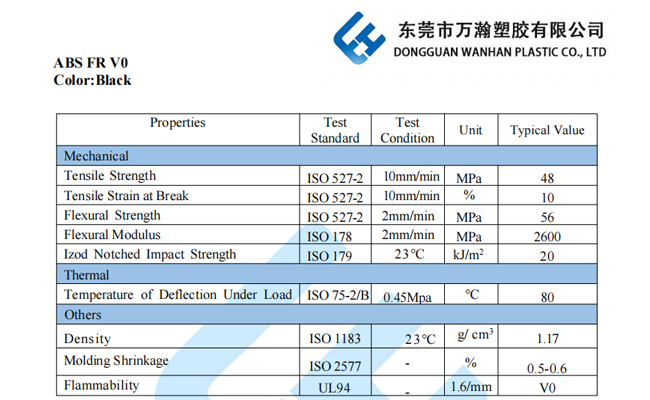
Tensile strength: approximately 30-50 MPa.
Bending strength: approximately 40-70 MPa.
Impact Strength: At room temperature, ABS exhibits good impact resistance, typically between 5-30 kJ/m², making it suitable for applications requiring impact resistance, such as toys and electronic housings.
hardness:
2. The hardness of ABS is usually between 70-110 Shore D and has a certain stiffness.
Thermal performance:
3. Melting point: The melting point of ABS is about 200-260°C, which makes it stable within a certain temperature range.
4. Operating temperature range: Usually between -20°C and 80°C. Under high temperature conditions, softening and deformation may occur.
5. Electrical properties: ABS is an electrical insulator, so it is widely used in electronic and electrical applications.
What are the application fields of ABS material?
1. Electronic and electrical products: ABS is widely used in the manufacture of electronic casings, accessories, keyboards, chassis, fuselages, etc. Its electrical insulation properties and surface treatment capabilities make it widely used in electronic devices.
2. Auto parts: ABS is commonly used in the manufacture of automotive interior parts, instrument panels, door panels, lamp covers, chrome decorative parts, etc. Its wear and impact resistance make it a commonly used material in the automotive industry.
3. Toys: ABS is very popular in making toys because its good color acceptance, abrasion resistance and impact resistance make it ideal for making toys.
4. Home and office equipment: ABS is used to manufacture household products such as furniture accessories, office equipment parts, such as chairs, tables, keyboards, etc.
5. Construction and decoration: ABS is used to manufacture some construction and decoration materials, such as pipes, decorative strips, bathtubs, shower doors, etc.
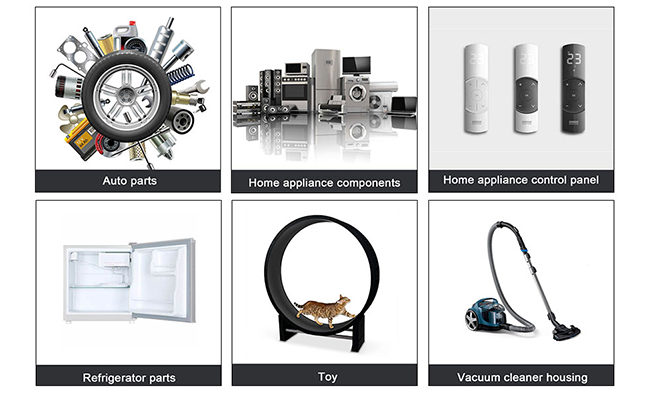
6. Medical Equipment: ABS is used in the manufacture of medical equipment casings, accessories and components as it complies with the hygiene and material requirements of the medical industry.
7. Communication equipment: ABS is often used to manufacture communication equipment casings, radomes, etc. because it can provide electrical insulation and mechanical strength.
8. Engineering parts: ABS is widely used in the manufacture of various engineering parts, such as gears, bearings, bolts, etc.
9. Consumer goods: ABS is used to manufacture various consumer goods, such as luggage, umbrella handles, bicycle accessories, etc.
10.3D printing: ABS is a commonly used 3D printing material because it is easy to process, has moderate strength, and is suitable for manufacturing prototypes and actual products.
The above is a comprehensive explanation of ABS materials. If you want to get more information about ABS materials, please contact us >>
Nylon plastic main models
PC/PBT plastic materaial PC+PBT
Related Article
Review nylon 66 density, melting point, temperature range, moisture effects and application guidance for PA66 automotive, electrical and industrial parts.
Nylon 66 Density, Melting Point and Temperature Guide
Polyamide nylon 6.6 refers to polyamide 6.6, which is a high-performance synthetic polymer and is a type of polyamide plastic. It is a polymer formed by polymerizing hexamethylenediamine and adipic acid and is used in many aspects.
Polyamide nylon 6.6 (PA)
Polypropylene (PP), as one of the most versatile plastics with a large output, is widely used in the automotive industry, building materials, electrical materials and packaging materials because of its excellent mechanical properties, low production costs, good processing and molding properties, and good chemical barriers.
What is flame retardant polypropylene pellet?
SEND MESSAGE