Hydrolysis-Resistant PBT: Selection and Validation for Hot, Humid Service
PBT is used for electrical and automotive components where dimensional stability and processability matter. When the application includes sustained heat and moisture, material selection needs a separate hydrolysis review. Low water absorption alone does not establish long-term resistance to chemical degradation.
Water absorption is not the same as hydrolysis
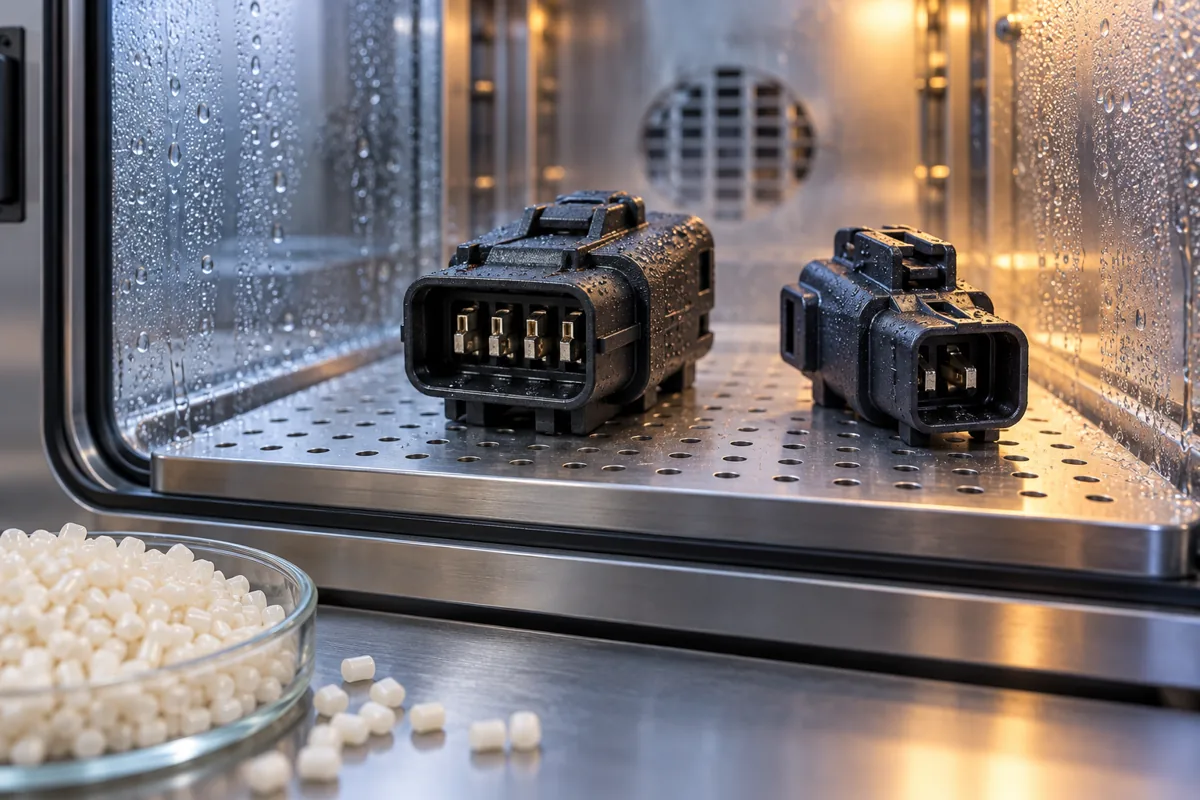
Absorption describes moisture entering a polymer. Hydrolysis is a chemical reaction that can shorten polymer chains and reduce retained properties. PBT's behavior in hot, humid service depends on the formulation and exposure conditions. A room-temperature water-absorption value cannot be converted into a universal humidity-aging lifetime.
What distinguishes hydrolysis-resistant PBT?
Hydrolysis-resistant grades are formulated for improved property retention under specified moisture and temperature exposure. Suppliers offer different combinations of reinforcement, stabilization, flame retardancy, and processing characteristics. The designation identifies a material option to evaluate; it is not a guarantee of unlimited hot-water use, resistance to every fluid, or compatibility with every electrical requirement.
Define the exposure before comparing grades
- Is the part exposed to humid air, intermittent condensation, immersion, or pressurized steam?
- What temperatures and exposure durations occur during normal use, shutdown, transport, and cleaning?
- Are coolant, detergent, salts, oils, or other chemicals present? Record their actual composition where possible.
- Does the part remain under mechanical load during exposure?
- Which dimensions, mechanical properties, electrical functions, and sealing requirements must remain within limits?
Keep these conditions in the material request. Two tests described simply as “humidity aging” may be unsuitable for direct comparison if temperature, specimen thickness, duration, or test conditioning differs.
Compare retained performance, not only initial values
A useful comparison includes the starting property, aged property, test conditions, and failure mode. For example, initial tensile strength does not establish connector-latch durability after aging. Review the relevant mechanical, dimensional, electrical, and assembly functions together.
Flame ratings and electrical listings must be checked for the exact grade, color, thickness, and approved conditions. Adding hydrolysis resistance does not automatically establish a required flame classification or electrical approval.
Drying and molding still matter
A hydrolysis-resistant grade still needs correct processing. Follow the exact supplier drying and molding recommendations and confirm moisture before processing. Record actual melt temperature, residence time, and regrind usage where applicable. Poor processing can make a good formulation appear unsuitable, while an unrepresentative trial can hide a problem.
A practical validation sequence
- Shortlist grades against the written application conditions and available supplier evidence.
- Mold representative samples using controlled settings and retain batch identification.
- Agree an exposure and testing plan with the responsible engineer, including unaged control specimens.
- Measure retained properties and test actual components for latch function, fit, sealing, or other defined requirements.
- Document the acceptance limits, approved formulation, processing window, and any restrictions on use.
Accelerated aging can support a comparison, but converting it into a service-life claim requires a validated model and evidence for the real environment. A short laboratory pass should not be presented as a lifetime guarantee.
Prepare an effective material inquiry
Send the drawing, current material, temperature and moisture profile, chemical exposure, expected life, relevant specifications, and approval criteria. Contact WanHan to discuss candidate PBT compounds and what test data or application trials are needed before selection. For related application context, see our PBT GF30 sensor-housing guide.
Technical reference: Celanese Polyester Technical Manual. General PBT guidance is not a specification for a WanHan grade.
Frequently Asked Questions
Q: Is low water absorption the same as hydrolysis resistance?
A: No. Water absorption describes moisture entering a polymer, while hydrolysis is a chemical reaction that can shorten polymer chains and reduce retained properties.
Q: Does hydrolysis-resistant PBT guarantee unlimited hot-water service?
A: No. Suitability depends on the exact formulation, temperature, moisture exposure, chemicals, load, and required service life. Validate the candidate grade under representative conditions.
Q: What should be compared when selecting hydrolysis-resistant PBT?
A: Compare initial and aged properties under clearly specified exposure conditions, then verify the required mechanical, dimensional, electrical, sealing, and assembly functions on representative components.
ABS vs PBT: Navigating the Choice Between Two High-Performance Thermoplastics
Related Article