Category


PA11 CF30 Carbon Fiber Reinforced Nylon 11 Pellets
For a molded bracket or housing where deflection or alignment governs the design, start by evaluating PA11 CF30 against the actual load and assembly tolerances. PA11-WHC30 is a nylon 11 pellet compound with nominal 30% carbon fiber. Use production-intent molded samples to compare loaded deflection, hole spacing and fit after conditioning.
Product Information
| Item | Details |
|---|---|
| Material | Carbon fiber reinforced polyamide 11 (nylon 11) |
| Model | PA11-WHC30 |
| Reinforcement | Nominal 30% carbon fiber |
| Supply form | Black pellets |
What PA11 CF30 Offers in a Molded Part
1. Rigidity for load-bearing features
Carbon fiber reinforcement makes this grade a candidate when an unfilled polymer deflects too far. Compare displacement at the actual mounting points and record the orientation of the load relative to mold flow.
2. Dimensional control at interfaces
Inspect flatness, boss position and hole pitch along and across flow. Gate location and fiber orientation can affect shrinkage, so measure again after the part has conditioned in its service environment.
3. Lightweight part consolidation
For a metal replacement study, evaluate the weight of the finished design with ribs, inserts and fasteners included. Check the stress around sharp transitions and retain the service safety margin.
4. Integrated mounting and locating details
Evaluate bosses, clips and locating features together. For screw joints, test installation torque, clamp retention and cracking around the boss on molded parts.
5. Performance under sustained load
Where a component stays clamped or loaded, measure permanent deflection over the relevant time and temperature. Share the acceptance limit so the trial can reproduce the actual service condition.
6. A starting point for custom formulations
If stiffness, impact behavior and surface finish compete, WanHan can review alternative fiber levels, impact modification and color requirements for a separately defined formulation.
PA11 CF30 Applications
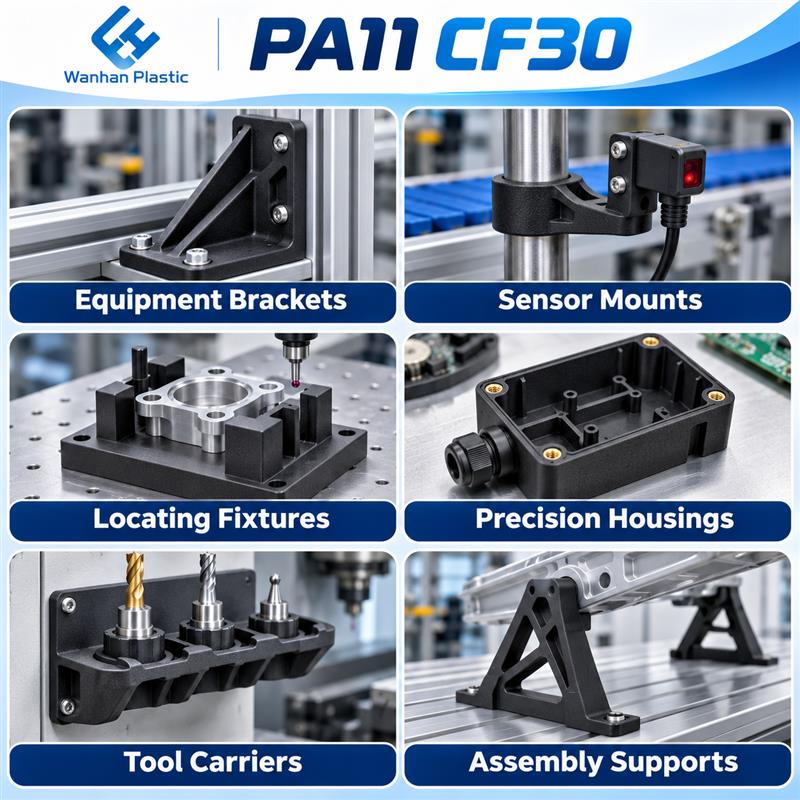
Equipment brackets
For a loaded mounting bracket, compare displacement at the mounting hole and residual deformation after unloading. Include fastener torque and weld-line position in the trial, because local joint behavior can govern the result even when overall stiffness is adequate.
Sensor mounts
Check that the sensor remains aligned after tightening the fasteners and applying the expected vibration. Measure the locating features after conditioning and inspect bosses for cracking or loss of clamp retention.
Locating fixtures
Evaluate positioning repeatability through the intended loading and assembly cycles. Track hole pitch and contact-face dimensions along and across mold flow so that fiber orientation and conditioning are included in the tolerance assessment.
Precision housings
Inspect mating-face flatness, insert retention and the fit of the assembled housing. Test sealing or electrical requirements separately when they apply; carbon fiber content alone does not establish these properties.
Tool carriers
Check retention, loaded deflection and repeated contact at the tool interface. Use representative surfaces and cycle counts in the trial, and review contact wear before accepting the carrier for production.
Assembly supports
Reproduce the actual assembly load, temperature and load duration. Compare elastic displacement and permanent set, then confirm that locating and fastening features still meet the assembly tolerance.
Material Selection and Processing
Request the current grade data and processing guidance. Record resin preparation, gate layout and molding conditions. Inspect weld lines near fasteners and compare critical dimensions after the intended conditioning. Where electrical behavior or fluid exposure matters, include the test method, exposure conditions and acceptance limit in the sample plan.
Why Choose WanHan for PA11 CF30
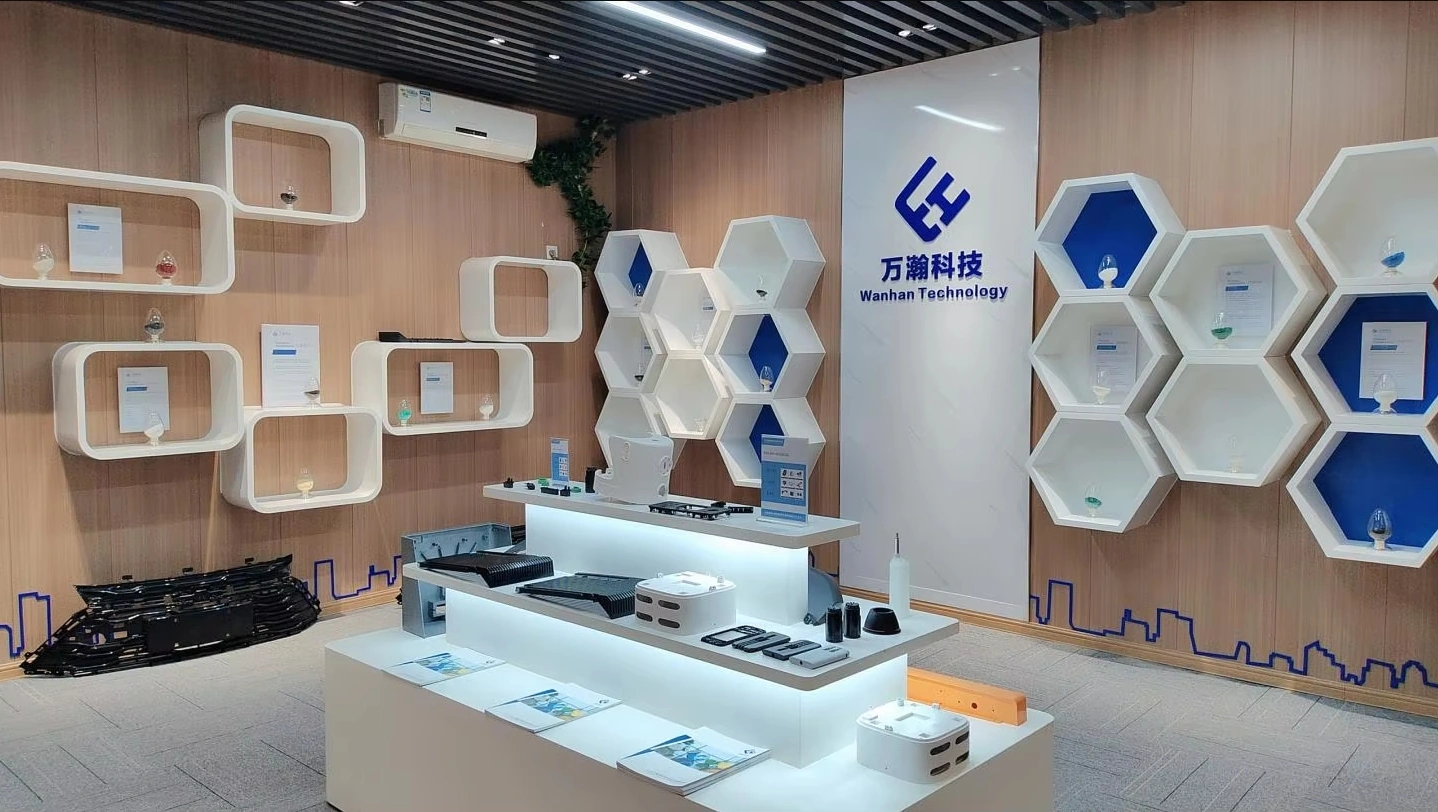
Guangdong Wanhan New Material Technology Co., Ltd. has specialized in modified engineering plastics since 2005. Our compounding portfolio includes PA6, PA66, PA11, PA12, PBT, PET, PPS, PPA, ABS, PC, PC/ABS and PP. For a PA11 project, our team can review the drawing, current material and failure mode, then discuss formulation, sample evaluation and production supply. Send your target annual volume and delivery destination so we can include packaging and shipment options in the quotation.
- Material selection around your part: Share the current material and the feature that fails first. Our team can review the drawing and target performance so that sample evaluation addresses the stiffness, fit or assembly problem you need to resolve.
- Formulation development: Discuss alternative carbon fiber levels, impact modification and color requirements when the standard grade does not meet your balance of properties. Define the modified specification and its validation plan before production.
- Support through sample evaluation: Align the requested grade data, molding guidance and critical measurements with your trial. This gives your engineering and purchasing teams a common basis for reviewing the sample results.
- Planning for production supply: Include estimated demand, packaging needs and the delivery destination with your inquiry. WanHan can discuss sample supply and mass-production requirements together with the quotation.
Frequently Asked Questions
1. What is PA11 CF30, and which parts should I evaluate it for?
PA11-WHC30 is a polyamide 11 compound with nominal 30% carbon fiber, supplied as black pellets. It is a candidate for molded brackets, sensor mounts, locating fixtures and precision housings where stiffness and assembly alignment are key requirements. Select the grade against the actual load, temperature, conditioning and dimensional tolerances of your part.
2. What grade data do I need before approving a metal replacement?
Request the current PA11-WHC30 TDS with test methods and specimen conditioning. For a load-bearing part, compare loaded deflection, permanent set and joint performance on production-intent molded samples. Include ribs, inserts and fasteners in the weight comparison, and check weld lines and fiber orientation at highly stressed features.
3. Can WanHan customize the carbon fiber level or formulation?
WanHan can review alternative fiber levels, impact modification and color requirements for a separately defined formulation. Send the drawing, current material, failure mode and target performance. Agree on the formulation specification and sample acceptance criteria before moving to production; a customized formulation requires its own validation.
4. What should I check in the first injection molding trial?
Follow the grade-specific resin preparation and molding guidance. Record the gate layout and process settings, then inspect weld lines, boss integrity, mating-face flatness and hole pitch along and across flow. Measure critical dimensions again after the intended conditioning, and test the assembled component under its service load.
5. How can I request samples, application support and a quotation?
Send the part drawing, load cases, operating temperature, fluid exposure, dimensional tolerances, required documents and estimated production volume. WanHan can review material selection, sample evaluation and production supply with you. Include your delivery destination and packaging requirements so the quotation can address the project as a whole.
6. Can I specify electrical performance or fluid exposure requirements?
Yes. Include the electrical test method and acceptance limit, or the fluid type, concentration, temperature and exposure duration, in your inquiry. Request corresponding data for the exact formulation and validate the molded part under the intended conditions.
Request a Sample and TDS
Send your drawing, service conditions, critical dimensions and expected quantity for a PA11-WHC30 material review, sample discussion and quotation.
 PA11 GF10 Glass Fiber Reinforced Nylon 11 PelletsEvaluate PA11 GF10 pellets for molded sensor housings, cable guides and connector bodies. Ask WanHan for grade data, formulation support and trial samples.PA11 GF10Send Inquiry
 PA11 GF15 Glass Fiber Reinforced Nylon 11 PelletsPA11 GF15 reinforced Nylon 11 pellets for molded instrument housings, cable guides and sensor holders. Ask WanHan for grade data, samples and formulation support.PA11 GF15Send Inquiry
 PA11 CF40 Carbon Fiber Reinforced Nylon 11 PelletsEvaluate PA11 CF40 pellets for stiff, lightweight molded camera mounts, robot linkages and brackets. Request grade data and samples for your part trial.PA11 CF40Send Inquiry
 PA11 GF40 Glass Fiber Reinforced Nylon 11 PelletsEvaluate PA11-WHG40 nylon 11 pellets with 40% glass fiber for rigid molded supports, brackets and housings. Request grade data, samples and material review.PA11-WHG40Send Inquiry
Send Message
ABOUT US -- WanHan Technology
--Boasting 18 years of extensive experience in both the Chinese and international markets.
--Highly specialized in catering to the specific needs of the industry.Boasting a highly qualified development team.
--Owns its own production plant.
--Customer-centric approach, providing customized final outcome plans.
--Material quality meets international standards, ensuring excellence.ISO9001, IATF16949, ISO14001, ISO45001, SGS, REACH, ROSH