PA66 GF50 Fiber Orientation and Warpage: A Part Design Guide
PA66 GF50 contains 50% glass fiber by mass in a nylon 66 matrix. Its stiffness makes it a candidate for demanding structural parts, but high reinforcement does not make an injection-molded component equally strong or dimensionally stable in every direction. Local fiber orientation is an important part of the design review.
Why fiber orientation matters
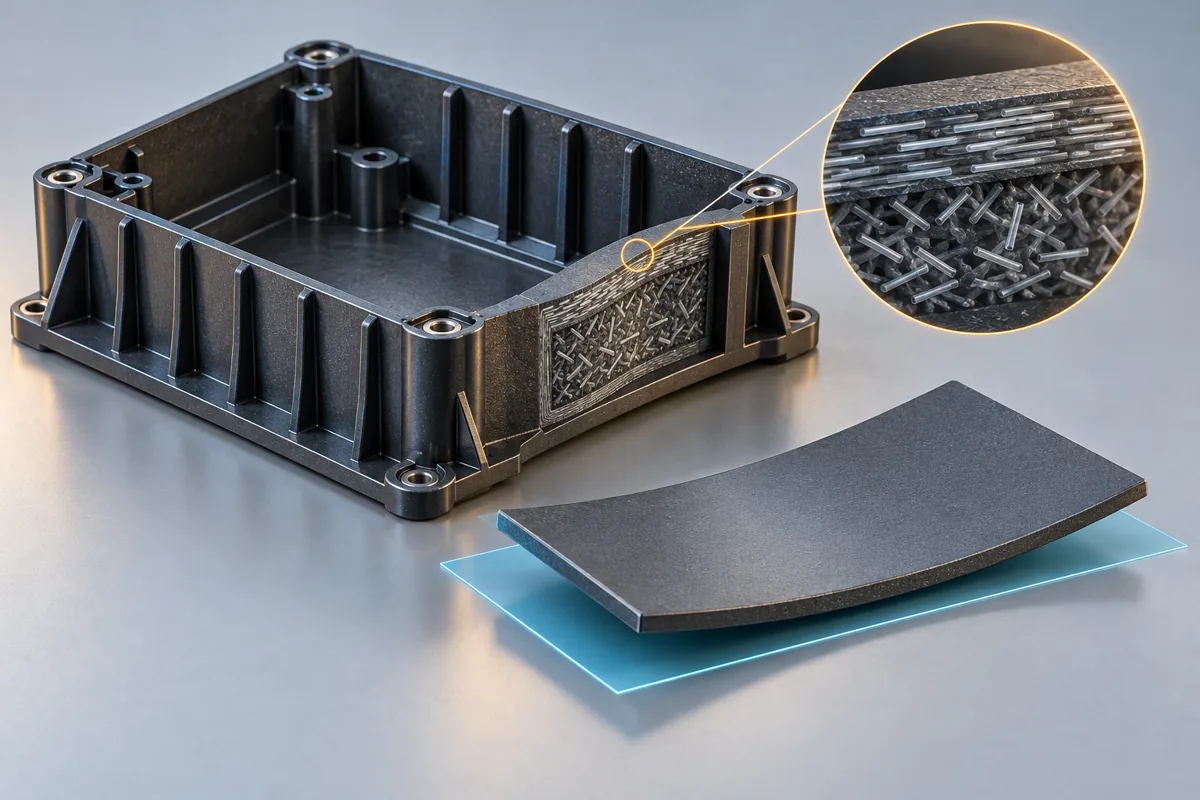
Short fibers rotate as the melt passes through the gate and fills the cavity. Orientation can change around ribs, holes, corners, and thickness transitions, and can differ through the wall. The resulting material response is anisotropic: stiffness, strength, and shrinkage depend on direction. A single datasheet modulus is therefore not a complete description of a housing, bracket, or mounting feature.
Warpage and shrinkage are related, but different
Shrinkage describes a dimensional change. Warpage describes a change in shape, such as bowing or twisting. Uneven cooling, geometry, packing, and direction-dependent shrinkage can interact. A high glass content may reduce shrinkage in one direction without eliminating distortion. An assembly can also force a warped component flat and introduce stress that was absent in the free part.
Review the geometry and the load path together
- Mark the critical datums, sealing surfaces, bearing seats, and assembly interfaces on the drawing.
- Identify the directions of sustained, peak, and cyclic loads rather than checking only a nominal tensile strength.
- Review gate options against both filling and fiber orientation. A gate that fills easily may still produce an unfavorable local structure.
- Check rib patterns and wall transitions for cooling imbalance and abrupt changes in flow.
- Discuss weld lines and stress concentrations at bosses and holes before freezing the tool design.
Use simulation as a decision tool
Where simulation is available, request the material model for the exact candidate grade and the intended molding process. Review the predicted orientation, shrinkage, and deformation together with filling and packing. A generic PA66 GF50 material card can help early screening, but it should not be represented as validated performance for a different formulation.
Use predicted results to compare design alternatives and plan trials. Confirm the selected approach on molded parts; numerical precision on a plot does not establish dimensional capability in production.
A useful dimensional validation plan
- Define the measurement fixture, datums, temperature, conditioning state, and time after molding.
- Measure the free part and, where relevant, the assembled part so forced-fit stress is not overlooked.
- Compare samples from different cavities and molding runs. Retain process and material-batch records.
- Check changes after the relevant moisture and temperature exposure, using an agreed conditioning method.
- Repeat functional tests on the final geometry, including the weakest expected load direction.
What to request from a compound supplier
Ask for grade-specific mechanical data, conditioning details, processing guidance, and any available directional or application test results. Also provide your dimensional tolerances, drawing, gate concept, service environment, and assembly method. This is more useful than requesting the highest possible modulus without explaining the part.
For a related example of part-level validation, read our PA6 GF30 weld-line strength guide. Contact WanHan to discuss candidate reinforced nylon compounds and the information needed for a material evaluation.
Technical reference: Envalior: stiffness, strength, and local fiber orientation. Reference information does not replace grade-specific or component-level testing.
Frequently Asked Questions
Q: Why does fiber orientation matter in PA66 GF50?
A: Short glass fibers develop different orientations during cavity filling. Stiffness, strength, and shrinkage can therefore vary with direction and location within the molded part.
Q: Does 50% glass fiber eliminate warpage?
A: No. Direction-dependent shrinkage, uneven cooling, packing, and geometry can still cause bowing or twisting. High reinforcement does not guarantee a flat or dimensionally stable component.
Q: How should dimensional validation be planned?
A: Define datums, fixtures, temperature, conditioning, and measurement timing. Compare free and assembled parts across cavities and molding runs, and repeat relevant functional tests after service-related exposure.
The Complete Engineer's Guide to PA66 (Nylon 66): Properties, Comparison & Material Selection
Related Article