What Is PA66 GF30? Properties, Uses, and Selection Guide
PA66 GF30 is polyamide 66 (nylon 66) compounded with approximately 30% glass fiber by weight. The material code is simple: PA66 identifies the nylon 66 base polymer, while GF30 indicates about 30% glass-fiber reinforcement. Compared with unfilled PA66, the reinforced compound is normally stiffer, stronger, more resistant to creep, and more dimensionally stable under load and heat.
That definition is only the starting point for material selection. PA66 GF30 is a family of compounds, not one universal grade. Heat stabilizers, hydrolysis resistance, flame-retardant systems, impact modification, color, lubrication, and low-warpage packages can produce very different molding behavior and long-term performance.
What Changes When 30% Glass Fiber Is Added to PA66?
| Selection factor | Unfilled PA66 | Typical effect of GF30 reinforcement |
|---|---|---|
| Stiffness and load resistance | Good toughness with moderate stiffness | Much higher modulus and lower deflection under structural load |
| Creep | More movement under long-term stress | Improved resistance to long-term deformation |
| Heat performance | Useful nylon heat resistance | Higher loaded-temperature capability when the grade is properly stabilized |
| Dimensional stability | More moisture- and temperature-driven movement | Lower overall movement, but stronger flow/transverse anisotropy |
| Toughness and elongation | Higher elongation and ductility | Lower elongation; ribs, weld lines, and sharp corners need careful design |
| Processing and tooling | Less abrasive | Greater screw, barrel, gate, and mold wear; fiber orientation affects warpage |
Glass fiber does not remove the moisture sensitivity of the PA66 matrix. It reduces dimensional change compared with unfilled nylon 66, but dry and conditioned test results can still differ. Buyers should compare data in the same conditioning state and validate dimensions after the part reaches its real service moisture level.
Typical PA66 GF30 Properties
The values below are broad screening ranges for injection-molding compounds. They are not a guaranteed specification. Resin formulation, conditioning, fiber orientation, specimen thickness, color, test method, and stabilizer package can all change the result.
| Property | Representative range | Buyer check |
|---|---|---|
| Density | About 1.35-1.40 g/cm3 | Confirm the exact grade value for shot size and weight calculations |
| Tensile strength, dry | Often about 150-200 MPa | Check flow direction, weld-line strength, and conditioned values |
| Flexural modulus, dry | Often about 7-10 GPa | Use production-part geometry and orientation for deflection approval |
| Melting temperature | Typically near 255-265 C | Use the supplier's processing window rather than a generic value |
| Mold shrinkage | Often about 0.2-0.8% | Measure both flow and transverse directions before tool correction |
| Water absorption | Grade- and test-dependent | Approve both dry-as-molded and conditioned performance where relevant |
A higher number on a datasheet does not automatically make a grade better. For a radiator tank, retained weld-line strength after coolant aging may matter more than initial dry tensile strength. For an electrical connector, flame rating, CTI, glow-wire behavior, dimensional repeatability, and deposit control may be more important than maximum modulus.
Common PA66 GF30 Applications
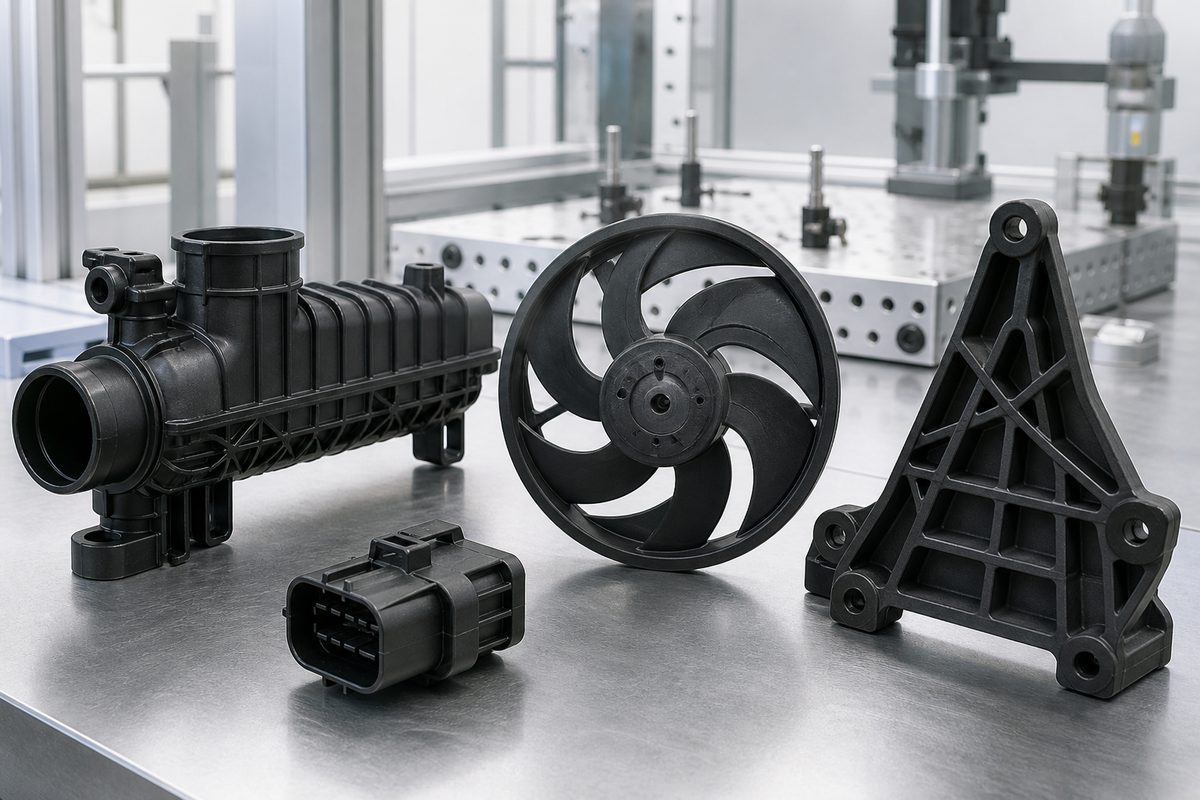
- Automotive: radiator end tanks, cooling fans, air-management parts, brackets, clips, covers, and under-hood structures
- Electrical and electronics: connector housings, coil supports, switch structures, terminal components, and dimensionally stable enclosures
- Industrial equipment: structural brackets, pump and valve parts, carriers, guides, gears, fan parts, and machine housings
- Appliances and power tools: heat-resistant frames, motor supports, handles, internal load paths, and repeated-assembly features
PA66 GF30 is not automatically the best choice for sliding against another surface. Exposed glass fiber can increase counterface wear. Sliding components may need an internally lubricated formulation, another reinforcement system, or a different polymer after tribology testing.
Injection Molding and Part-Design Risks
PA66 GF30 must be dried to the selected grade's moisture limit before molding. Excess moisture can cause hydrolytic degradation, reduced molecular weight, surface defects, and lower mechanical performance. The supplier's TDS should control drying temperature, drying time, melt temperature, mold temperature, and permitted residence time.
- Use wear-resistant screws, barrels, nozzles, gates, and mold components where production volume justifies them.
- Place gates so fiber orientation supports the main load path without creating unacceptable warpage.
- Avoid abrupt wall changes and sharp internal corners; use suitable radii at ribs, bosses, and mounting points.
- Keep critical weld lines away from pressure-loaded, torque-loaded, or safety-critical features.
- Validate dimensions in both the dry-as-molded and conditioned states when service moisture matters.
- Test actual production-tool parts for thermal cycling, chemicals, vibration, insert torque, and long-term load.
How PA66 GF30 Compares with Alternatives
| Alternative | Why buyers consider it | Main trade-off to review |
|---|---|---|
| PA6 GF30 | Processing, cost, impact behavior, and grade availability | Moisture behavior, heat capability, and dimensional requirements |
| PBT GF30 | Electrical use, dimensional stability, and lower moisture uptake | Hydrolysis, impact, heat aging, and application-specific flame performance |
| PA66 GF15 or GF20 | Better flow or toughness with less abrasion | Lower stiffness and load capacity |
| PA66 GF40 or GF50 | Higher stiffness for demanding structural parts | More brittleness, anisotropy, tooling wear, and processing difficulty |
| Carbon-fiber nylon | Higher specific stiffness and lower thermal expansion | Cost, electrical behavior, brittleness, and processing wear |
For deeper property tables and grade directions, review WanHan's PA66 GF30 properties and processing guide. Buyers can also compare the glass-filled PA66 product range and the broader PA66 material guide.
What to Send a PA66 GF30 Supplier
- Part drawing, wall thickness, gate constraints, and critical dimensions
- Continuous and peak temperature, load, vibration, and service-life target
- Moisture, coolant, oil, fuel, detergent, or other chemical exposure
- Flame, electrical, automotive, environmental, or customer-specific approvals
- Color, appearance, weld-line, warpage, and surface requirements
- Annual demand, sample quantity, current grade, and the problem to be solved
Why Choose WanHan?
Since 2005, WanHan has focused on independent R&D, production, and sales of functional engineering plastics. The company operates quality and environmental systems certified to ISO 9001, ISO 14001, ISO 45001, and IATF 16949, with testing equipment supporting incoming-material, process, and finished-compound control.
WanHan supplies engineering-plastic projects in automotive, electronics, home appliances, and industrial equipment across more than 30 countries. Support can include grade comparison, heat or hydrolysis stabilization, flame retardancy, color matching, samples, technical data, processing guidance, and production follow-up.
Contact WanHan with the application and validation requirements to discuss a practical PA66 GF30 starting grade.
Frequently Asked Questions
Q: What does PA66 GF30 mean?
A: PA66 GF30 is polyamide 66 compounded with approximately 30% glass fiber by weight. The reinforcement increases stiffness, strength, creep resistance, heat performance, and dimensional stability compared with unfilled PA66.
Q: What is PA66 GF30 used for?
A: Typical uses include automotive radiator tanks and brackets, cooling fans, electrical connector housings, appliance structures, power-tool supports, and industrial load-bearing parts.
Q: Is PA66 GF30 stronger than PA66?
A: It is normally much stiffer and stronger in the fiber direction than unfilled PA66, but it also has lower elongation, greater anisotropy, and more abrasive processing behavior.
Q: Does PA66 GF30 absorb water?
A: Yes. The PA66 matrix still absorbs moisture. Glass fiber reduces dimensional movement compared with unfilled PA66, but conditioned properties and final-part dimensions must still be validated.
Q: What are alternatives to PA66 GF30?
A: Alternatives can include PA6 GF30, PBT GF30, PA66 with a different glass level, mineral-filled nylon, carbon-fiber nylon, or higher-temperature polymers. The correct choice depends on heat, moisture, chemicals, load, electrical requirements, processing, and cost.
What is extrusion molding?
PC/ABS vs PC: Material Differences for Housings and Structural Parts
Related Article