PA66 VS PA12
Start with PA66 when a part needs stiffness under load at elevated temperature. Start with PA12 when moisture-sensitive fit, repeated flexing or low-temperature impact drives the design. These priorities help select trial grades. The final choice depends on the reinforcement, grade, manufacturing process and service environment.
PA66 vs PA12 by design requirement
- Moisture and tolerances: PA12 generally absorbs less water than PA66. Check both materials after conditioning, especially when a seal, bearing seat or connector fit depends on a tight dimension.
- Structural stiffness: Compare conditioned stiffness in the loading direction. A glass-filled PA12 and an unfilled PA66 can behave very differently from their base resins.
- Heat exposure: Separate continuous load, short temperature peaks and thermal cycling. Compare heat-aging or creep data for the selected grade at the actual temperature and load.
- Flexibility and impact: A suitable PA12 grade can be a starting point for flexible routing and repeated movement. Check bend radius, fatigue and impact at the lowest operating temperature.
- Fluid exposure: Specify the actual fluid, concentration, temperature, contact time and mechanical stress. For a pressurized component, agree on the relevant leakage and pressure-cycle tests before approving a material.
Shortlist grades for the part
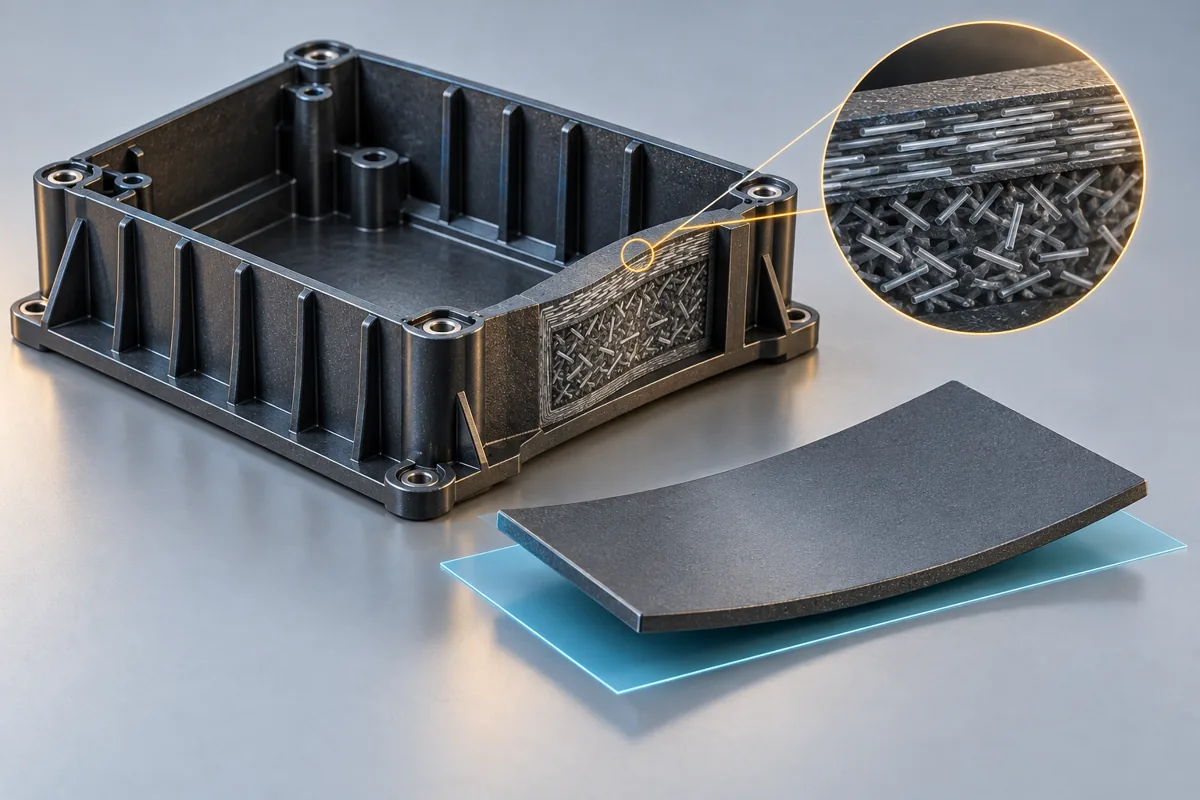
Rigid brackets and housings: Review a reinforced PA66 grade when deflection or fastener retention controls the design. Test bosses, weld lines and mating faces after temperature and moisture conditioning.
Tubing, flexible clips and protective routing: Review a PA12 grade designed for the process and movement expected. Injection-molding and extrusion grades have different requirements. Confirm the supplier’s data and evaluate finished samples.
Precision parts in changing humidity: Measure the same critical dimensions at three stages: after molding, after conditioning and after the relevant service exposure. Compare fit and load retention before committing to tooling adjustments.
What to compare on the datasheet
Request the exact grade code and check specimen conditioning, test method and temperature for each property. For molding, follow the exact grade’s moisture limit, drying guidance and processing window. Where an approval is required, ask for documents tied to that grade and color and confirm the tests required for the finished part.
For background on the moisture difference between the polymer families, see Evonik’s polyamide matrix guidance.
Frequently asked questions
Does PA12 absorb less water than PA66?
Typically, yes. Compare the chosen grades using the same conditioning method. Measure actual parts if humidity can change fit or sealing.
Can PA12 solve warpage in a PA66 part?
PA12 is worth screening if moisture-driven swelling is the cause. If the part warps directly after molding, first review wall thickness, gating, cooling and fiber orientation.
Can glass-filled PA12 replace unfilled PA66?
Compare the specific grades against stiffness, impact, heat, weld-line strength and assembly tolerances. Test representative parts under the expected loads and environment.
What should I send to request a sample?
Send the drawing, critical tolerances, operating temperature, loads, fluids, processing route and expected volume. Include the current material code and failure mode if you are replacing a grade.
Discuss your PA66 or PA12 grade and sample requirements with WanHan.
PA66 Material: Properties, Applications and Manufacturers
What is pa66?
Related Article