Plastic Extrusion Cooling: Sizing and Defect Control
Plastic extrusion cooling must remove enough heat for the product to retain its specified dimensions through pulling, cutting and storage. The practical target is stable size and shape at the required line speed. A cold outer surface alone does not establish that a thick section is ready for handling. Select the cooling and sizing arrangement for the polymer, wall thickness, cross-section and tolerance.
Where cooling fits into the extrusion line
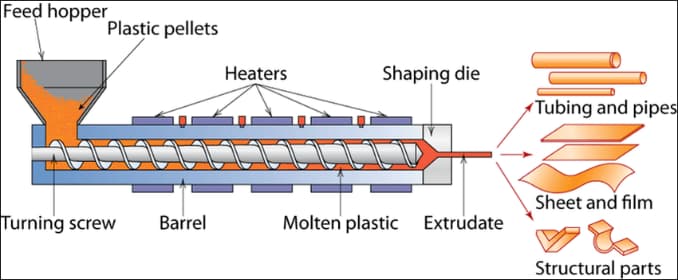
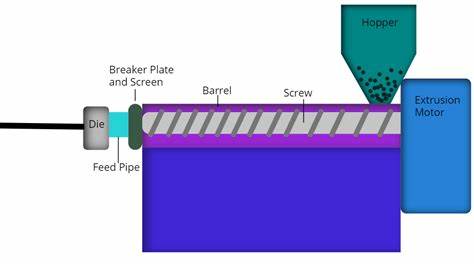
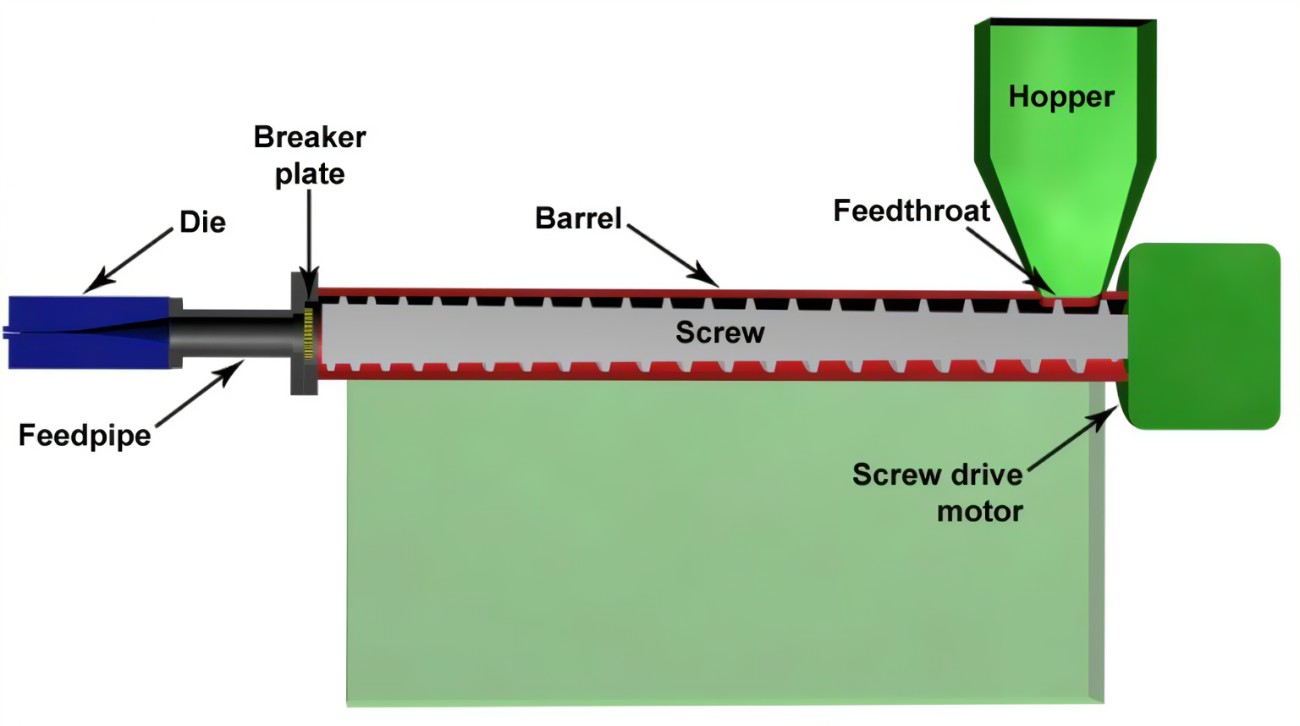
The extruder delivers a hot continuous melt through a die. Downstream equipment then supports or calibrates the shape, removes heat and conveys the product to cutting or winding. A tube, a solid profile and a pelletizing strand require different handling. For the upstream stages, see our extrusion molding process guide.
Choose the cooling system for the product
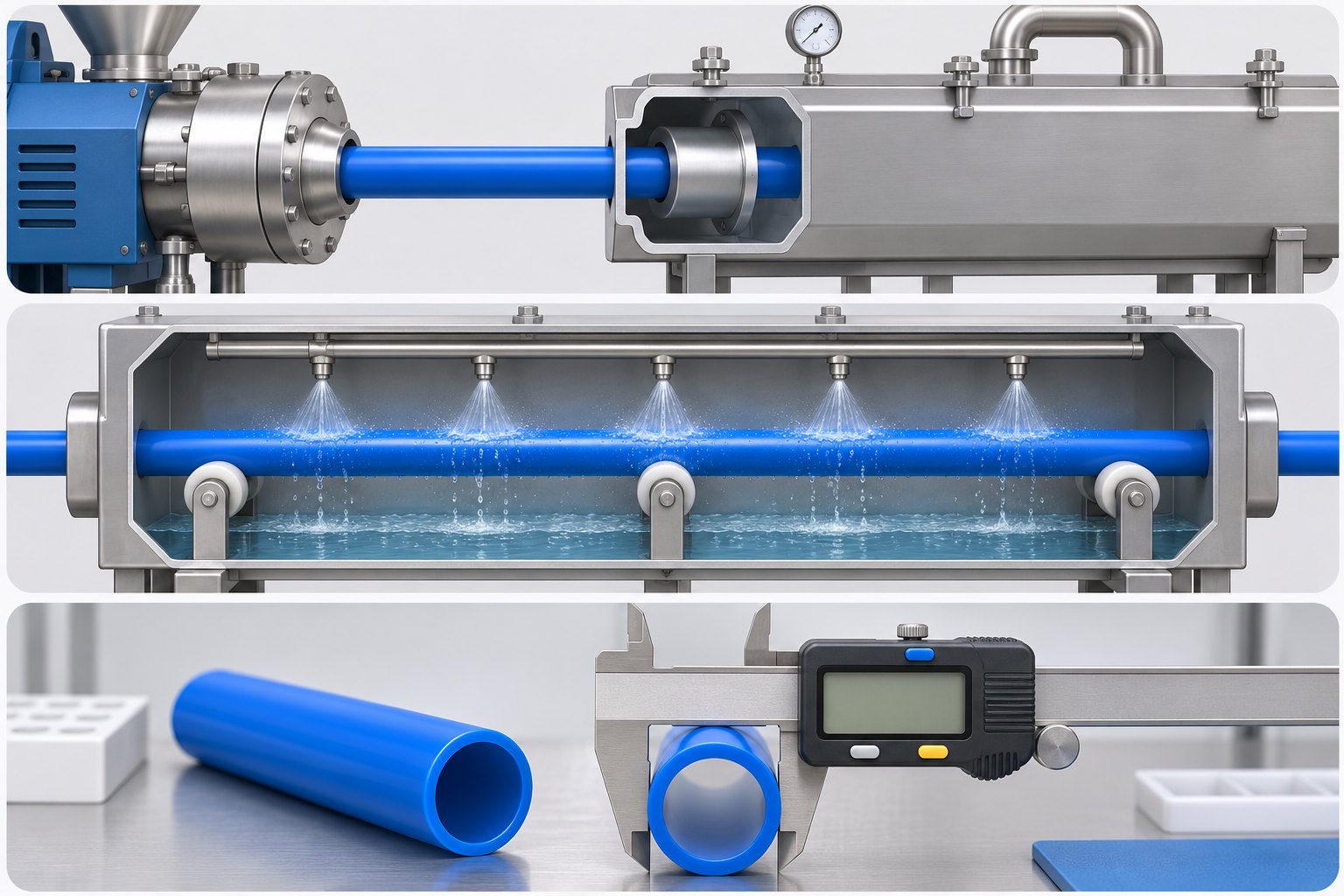
Tube and hollow profiles: Vacuum sizing equipment can combine shape control with cooling. The calibrator, vacuum system and water circuit must work together; changing coolant temperature alone will not correct an unsuitable sizing tool. Conair describes these roles in its vacuum sizing equipment guidance.
Other continuous products: Water immersion, spray or air cooling may be appropriate, depending on the product and downstream equipment. Check support and alignment as well as heat removal. Conair's extrusion auxiliary equipment guide separates cooling, sizing, pulling and measurement functions.
Compounding strands: These are intermediate feed for a pelletizer, rather than finished profiles. Coperion describes strand solidification in a water bath followed by surface-water removal and cutting. Its engineering plastics compounding guidance also describes underwater pelletizing as a different discharge route.
Record the variables that determine the result
- Material: Record the exact grade, reinforcement, color and material preparation. Use its processing guidance; a polymer family name is insufficient to set a validated cooling recipe.
- Product: Identify the thickest section, unsupported features, critical dimensions and the locations where size changes first appear.
- Line: Record output, puller speed, cooling length, water temperature and flow, vacuum where used, and the position of supports.
- Measurement: Compare dimensions at a defined point after cooling and again after an agreed storage or conditioning period. Use the same measurement method when comparing trials.
Investigate defects before changing several settings
Dimensions drift during a run: Compare the time of the drift with material changes, output, puller speed and cooling-water records. A gradual change and a repeating oscillation need different investigations.
A profile bends or twists: Inspect alignment, support and cooling around the cross-section. Mark where distortion begins. Compare sections from the same run before attributing the problem to the compound.
The product marks at the puller or changes after cutting: Review handling and whether the section has cooled sufficiently at that point. Reduce one variable at a time within the equipment and material operating limits, then compare the measured result.
What to send for a material review
WanHan develops modified engineering plastic compounds. For an extrusion-grade discussion, send the section drawing, current grade, extrusion route, process records, defect photographs and acceptance limits. Our team can review formulation and sample requirements with your processing feedback. Confirm extrusion suitability for the exact grade before a production trial; injection-molding suitability does not establish extrusion performance.
Frequently asked questions
What is the best water temperature for extrusion cooling?
There is no single setting for every resin and section. Use the equipment and exact-grade guidance as the starting point, then validate dimensions and handling at the intended output.
Does colder water always improve production?
Judge a trial by dimensional stability, surface quality and the downstream result. Do not approve a temperature change solely because the surface feels cooler.
Why does an extruded product change size after cutting?
Compare measurements before cutting and after a defined rest period. Review remaining heat, pulling conditions, material conditioning and the measurement method before selecting a correction.
Is cooling the same as vacuum sizing?
No. Cooling removes heat; sizing controls geometry. A vacuum sizing tank can perform both functions, but each function still needs its own checks.
What information is needed to compare compound samples?
Use the same tool, section, output and measurement conditions. Record preparation, process settings and accepted tolerances for each sample so the comparison is meaningful.
Send your extrusion material and sample requirements to WanHan.
Extrusion Cutting: Tube Length and Cut Quality
Extrusion Molding Process: Steps and Quality Checks
Related Article