PA6 vs PA66: Key Differences and Material Selection
PA6 and PA66 are related polyamide engineering plastics, but they are not interchangeable in every molded part. PA6 often provides easier flow, useful toughness and a practical balance for wear components and housings. PA66 is often selected when higher thermal stiffness and strength retention are priorities. The correct choice depends on the exact grade, moisture condition, reinforcement, part design and service environment.
PA6 vs PA66 at a Glance
| Selection factor | PA6 / Nylon 6 | PA66 / Nylon 66 |
|---|---|---|
| Polymer route | Produced from caprolactam | Produced from hexamethylenediamine and adipic acid |
| Processing window | Generally processed at a lower melt temperature and often valued for flow | Generally requires a higher processing temperature and tight moisture control |
| Mechanical balance | Often selected for toughness, wear behavior and surface finish | Often selected for higher stiffness, strength and thermal retention |
| Moisture response | Typically absorbs more moisture, which can change stiffness and dimensions | Also absorbs moisture; dry and conditioned properties still require review |
| Common starting point | Gears, rollers, clips, housings, tools and general industrial parts | Automotive under-hood parts, connectors, structural brackets and heat-exposed components |
These are material-family tendencies, not guaranteed specifications. Reinforcement, impact modification, heat stabilization, flame-retardant packages and conditioning can change the result substantially. Compare grade-specific data measured under the same test condition.
Key Differences That Affect Part Design
Heat and stiffness
PA66 is often the stronger starting point for sustained heat and stiffness. A stabilized or reinforced PA6 grade may still meet many application targets.
Toughness and flow
PA6 is often considered where flow, toughness, appearance or complex filling matter, subject to the selected grade and conditioning state.
Moisture and dimensions
Both materials need moisture control. PA6 typically shows a larger moisture effect, so tolerances should be checked after realistic conditioning.
Processing and validation
Drying, melt temperature, mold temperature, gates, wall thickness and fiber orientation must be matched to the chosen grade and part geometry.
Application Comparison
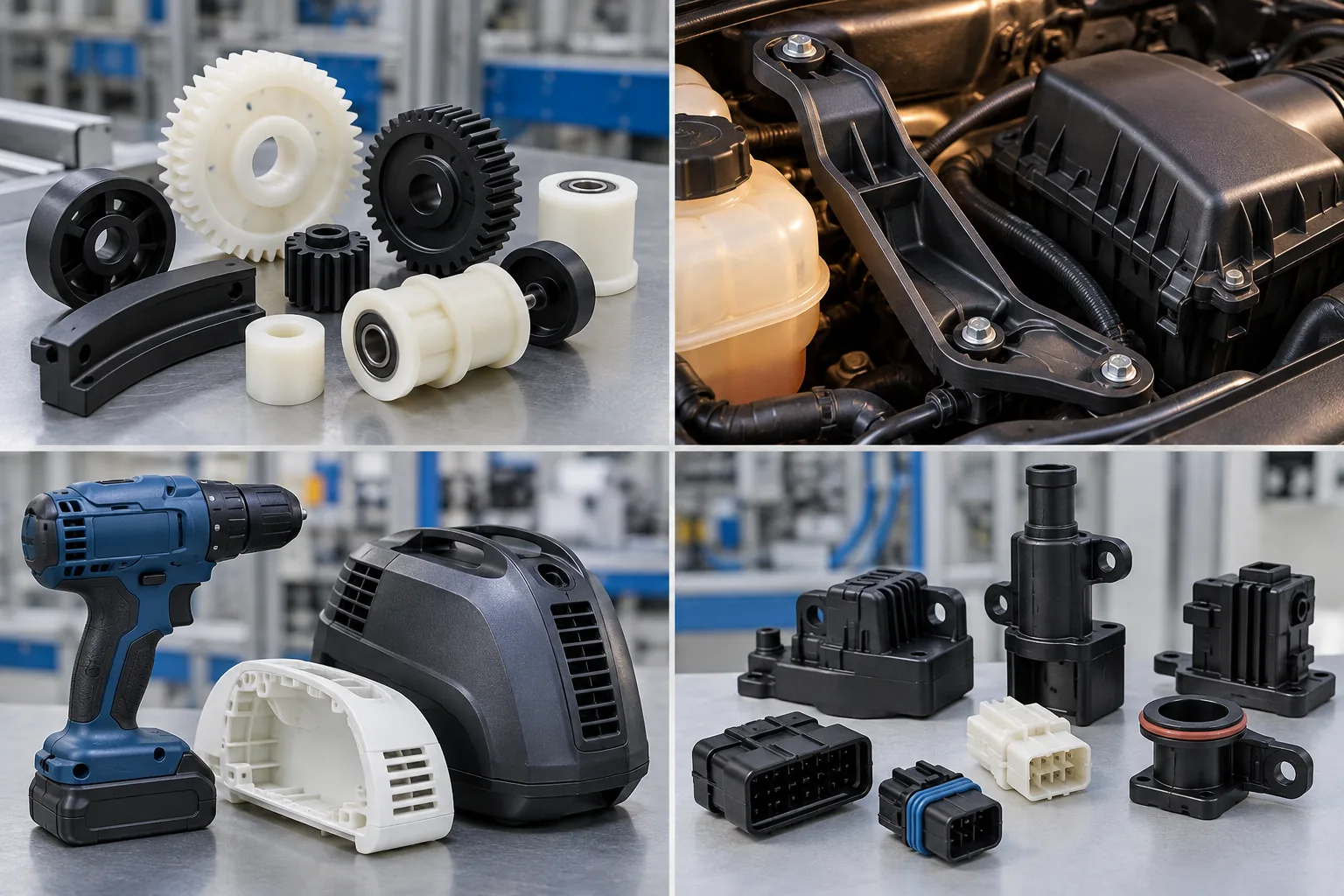
Choose PA6 as the first candidate when flow, toughness, wear behavior, surface finish or a lower processing temperature is important and the expected moisture effect can be controlled.
Choose PA66 as the first candidate when the part needs higher stiffness, stronger retention at elevated temperature or a proven route for demanding automotive and electrical structures.
Compare modified grades when neither base resin is enough. Glass fiber, impact modifiers, heat stabilizers, flame-retardant packages, lubricants and color systems can move performance in different directions. Review the PA6 material guide and PA66 material guide before selecting test candidates.
A Practical Material-Selection Workflow
- Define service conditions: load, temperature, humidity, chemicals, wear, electrical duty and expected life.
- Set measurable targets: identify the relevant mechanical, thermal, dimensional, flame and appearance requirements.
- Select comparable grades: compare unfilled with unfilled, or match reinforcement and modification levels.
- Review processing: confirm drying, equipment, gate design, wall thickness, shrinkage and warpage risks.
- Mold and condition samples: evaluate prototype parts under the conditions they will experience in use.
- Approve the exact grade: lock the grade, color, test condition and supporting documents before repeat production.
Why Choose WanHan?
Side-by-side grade review
PA6 and PA66 candidates can be compared against the same part requirements, conditioning state and test priorities.
Documented properties
Available grade data and stated test conditions support a traceable comparison rather than a generic family-level assumption.
Application guidance
Heat, moisture, loads, tolerances, chemicals, flame needs and molding constraints can be reviewed together.
Sample validation support
Material samples and molding feedback help confirm the selected grade in the intended geometry and operating conditions.
Frequently Asked Questions
What is the main difference between PA6 and PA66?
PA66 generally provides higher thermal stiffness and strength retention, while PA6 often offers useful toughness, flow and wear performance. Exact results depend on grade and conditioning.
Which material absorbs more moisture, PA6 or PA66?
PA6 typically absorbs more moisture. Both materials change after conditioning, so compare dimensional and mechanical data at the moisture state expected in service.
Is PA66 always stronger than PA6?
Not always. Resin family is only one factor. Reinforcement, impact modification, temperature, moisture and test method can make one specific PA6 grade outperform a different PA66 grade.
Which is better for injection molding?
Both are widely injection molded. PA6 often offers easier flow, while PA66 generally uses a higher processing temperature. The better choice depends on geometry, equipment and performance targets.
Should PA6 or PA66 be used for automotive parts?
Either may be suitable. PA66 is often considered for heat-exposed structural parts, while PA6 is common in clips, housings, wear parts and reinforced structures. Validate the exact application.
What information is needed to compare PA6 and PA66 grades?
Provide the drawing, loads, temperature, humidity, chemicals, tolerances, process, color, flame or electrical needs, current material and required documentation.
Compare PA6 and PA66 for Your Part
Send the part requirements and operating conditions for a focused grade comparison, technical data and sample evaluation.
Contact WanHanPA6 GF30 Datasheet, Properties and Material Guide
PA6 GF30 Properties, Test Data and Design Guide
Related Article