
Drone Parts Material Selection: PA12, Nylon, PC/ABS, and PBT
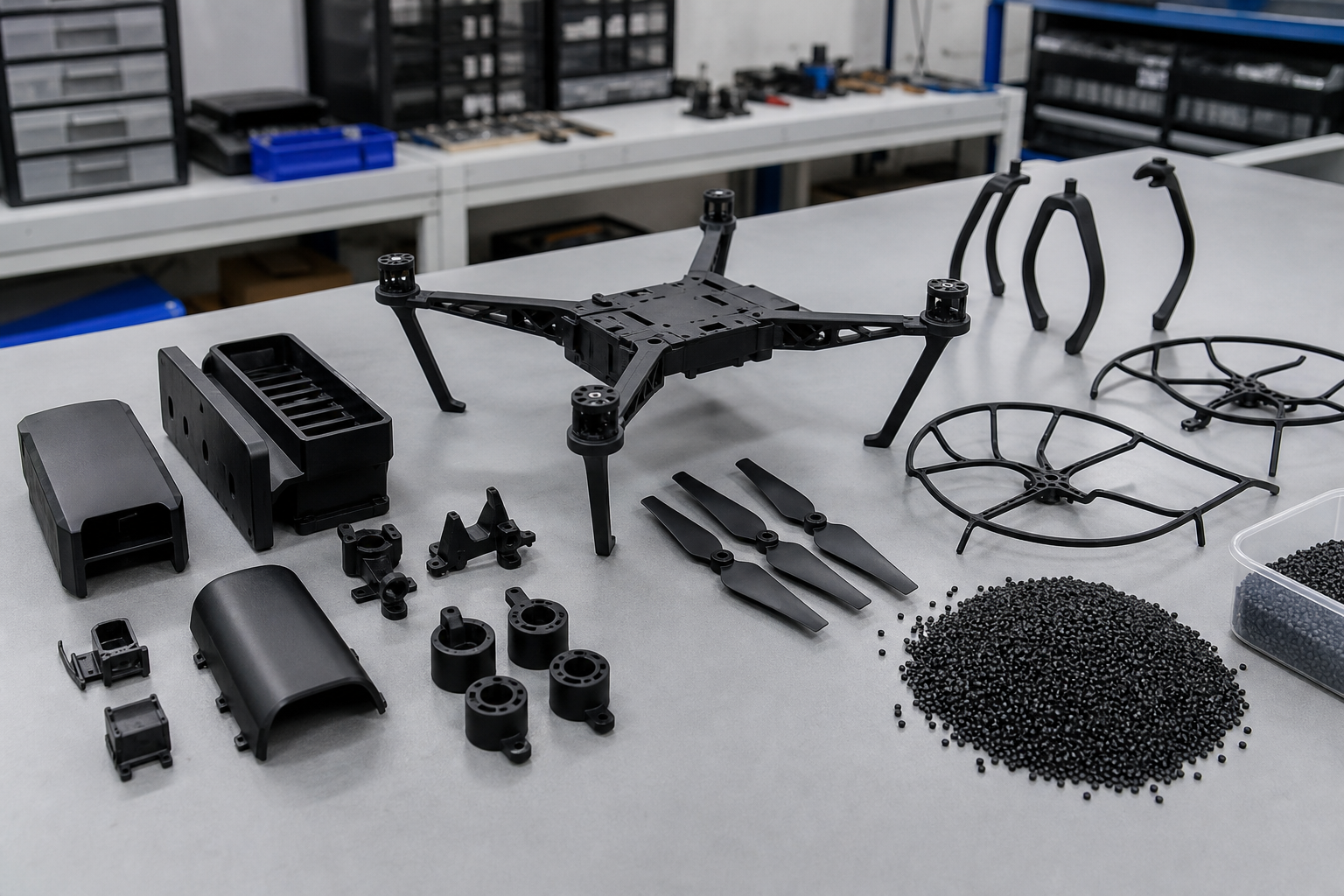
Drone parts material selection affects flight weight, motor alignment, vibration life, impact resistance, dimensional stability, and production consistency. A material that works for an electronics cover may not be suitable for a motor mount, propeller hub, landing gear, or load-bearing UAV frame.
For injection-molded drone accessories, the practical material shortlist often includes PA12 material, carbon-fiber-reinforced PA12, glass-filled nylon, PC/ABS, and reinforced PBT. The correct choice depends on the part geometry and service conditions rather than the resin name alone.
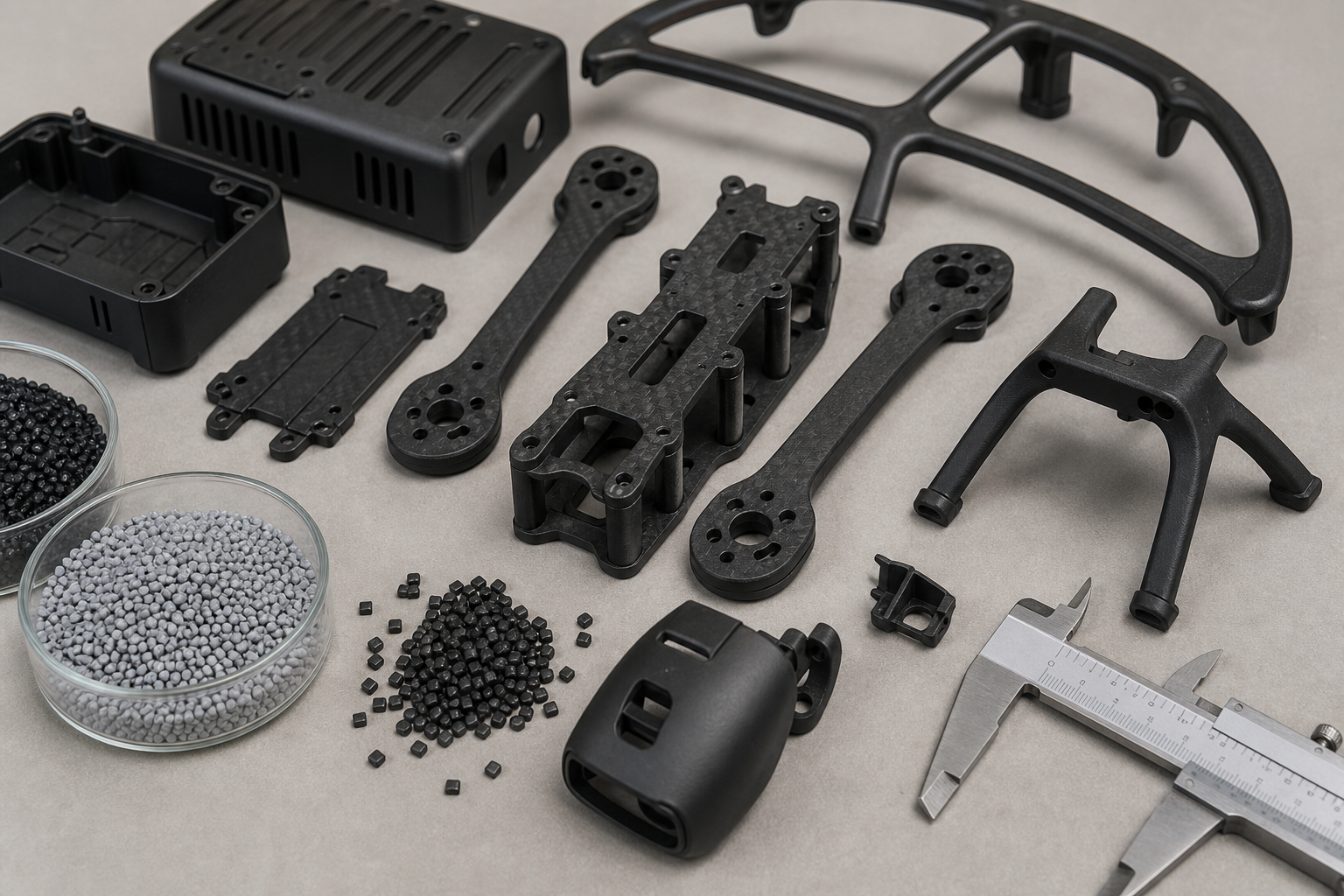
Material Options for Common Drone Components
| Drone component | Material starting point | Main reason for selection | Critical validation |
|---|---|---|---|
| Frame arms and motor mounts | PA12 CF30 or carbon-fiber-reinforced nylon | High stiffness-to-weight ratio, fatigue resistance, and lower moisture sensitivity than many short-chain nylons | Motor alignment, vibration, screw retention, crash impact, creep, and thermal cycling |
| Propeller hubs, guards, and structural supports | PA6 GF or PA66 GF | Stiffness, strength, heat resistance, and productive injection molding | Dynamic balance, fiber orientation, fatigue, weld lines, impact, and warpage |
| Landing gear and protective brackets | Impact-modified PA6, PA12, or moderate glass-filled nylon | Balance of toughness, flexibility, wear, and structural support | Repeated landing impact, low-temperature behavior, stress concentration, and fasteners |
| Battery and avionics housings | PC/ABS or PC/ABS FR | Impact resistance, appearance, dimensional stability, and housing moldability | Drop test, flame target, battery heat, UV, cleaners, bosses, and snap fits |
| Connectors and sensor housings | PBT GF or PBT FR | Electrical insulation, low moisture sensitivity, dimensional control, and heat resistance | Terminal retention, CTI, flame, humidity, sealing, and thermal cycling |
PA12 and PA12 CF30 for Lightweight UAV Structures
PA12 is attractive for drone parts that need toughness, fatigue resistance, chemical resistance, and relatively low moisture absorption. It can be used for clips, ducts, cable guides, landing components, covers, and other parts that must tolerate vibration and repeated handling.
For rigid frame arms, camera supports, payload brackets, and motor mounts, PA12 CF30 can provide a higher stiffness-to-weight ratio. Short carbon fiber also lowers shrinkage and can improve dimensional control, but it creates directional properties. Gate position, fiber orientation, weld lines, and screw-load direction must be considered during tool design.
- Check motor-axis and bearing alignment after molding and conditioning
- Measure creep around screws, inserts, and clamped joints under sustained load
- Validate vibration fatigue across the expected motor speed range
- Inspect electrical conductivity risks when carbon-fiber compounds are used near antennas or circuits
- Do not treat injection-molded PA12 CF30 as equivalent to continuous carbon-fiber laminate
Glass-Filled Nylon for Propeller and Structural Parts
Glass-filled nylon is widely used when a molded drone component needs more stiffness and heat resistance than unfilled nylon. PA6 GF and PA66 GF30 can be screened for motor brackets, fan guards, propeller hubs, equipment mounts, and rigid landing structures.
Rotating parts require special caution. A propeller or rotor component must maintain mass balance, blade geometry, fatigue strength, and impact performance over the full temperature and humidity range. Glass percentage alone does not guarantee a safe result.
- Use balanced gates and cavities to control fiber orientation and blade-to-blade variation
- Measure runout, mass balance, pitch, and dimensional capability on production-tool parts
- Test overspeed, fatigue, impact, UV exposure, and temperature aging
- Keep weld lines away from the highest bending and centrifugal load zones
- Approve recycled-material limits and lot-to-lot controls before mass production
PC/ABS for Battery, Controller, and Electronics Housings
PC/ABS material is a practical choice for battery shells, remote-controller housings, avionics covers, camera housings, and protective electronics enclosures. It combines impact resistance with good flow and surface quality, which helps with large housings, ribs, bosses, and snap-fit assemblies.
The grade direction changes when the housing contains a lithium battery, high-current electronics, or heat-generating modules. The project may require PC/ABS FR, higher heat resistance, UV stabilization, chemical resistance, or a different resin family.
| Housing condition | Grade direction | Approval focus |
|---|---|---|
| Indoor controller housing | Standard or impact PC/ABS | Drop, texture, color, screw bosses, and assembly |
| Battery enclosure | PC/ABS FR or higher-heat route | Flame target, cell temperature, impact, vents, and dimensional stability |
| Outdoor UAV electronics | UV-stabilized PC/ABS or alternative weatherable material | UV, rain, sealing, color shift, and low-temperature impact |
| Precision camera or sensor cover | Low-warpage PC/ABS | Optical alignment, gasket compression, threads, and vibration |
PBT for Drone Connectors and Sensor Components
PBT material is useful for precision connectors, terminal carriers, coil parts, sensor housings, and small electrical structures. Reinforced or flame-retardant PBT offers stable dimensions, useful electrical insulation, and lower moisture sensitivity than many nylon grades.
For drone electronics, confirm terminal retention, dielectric spacing, CTI or flame requirements, soldering or heat exposure, sealing, potting, and vibration. Hydrolysis-stabilized or laser-compatible formulations may be needed for wet-service sensor housings and welded enclosures.
Engineering Validation Before Production
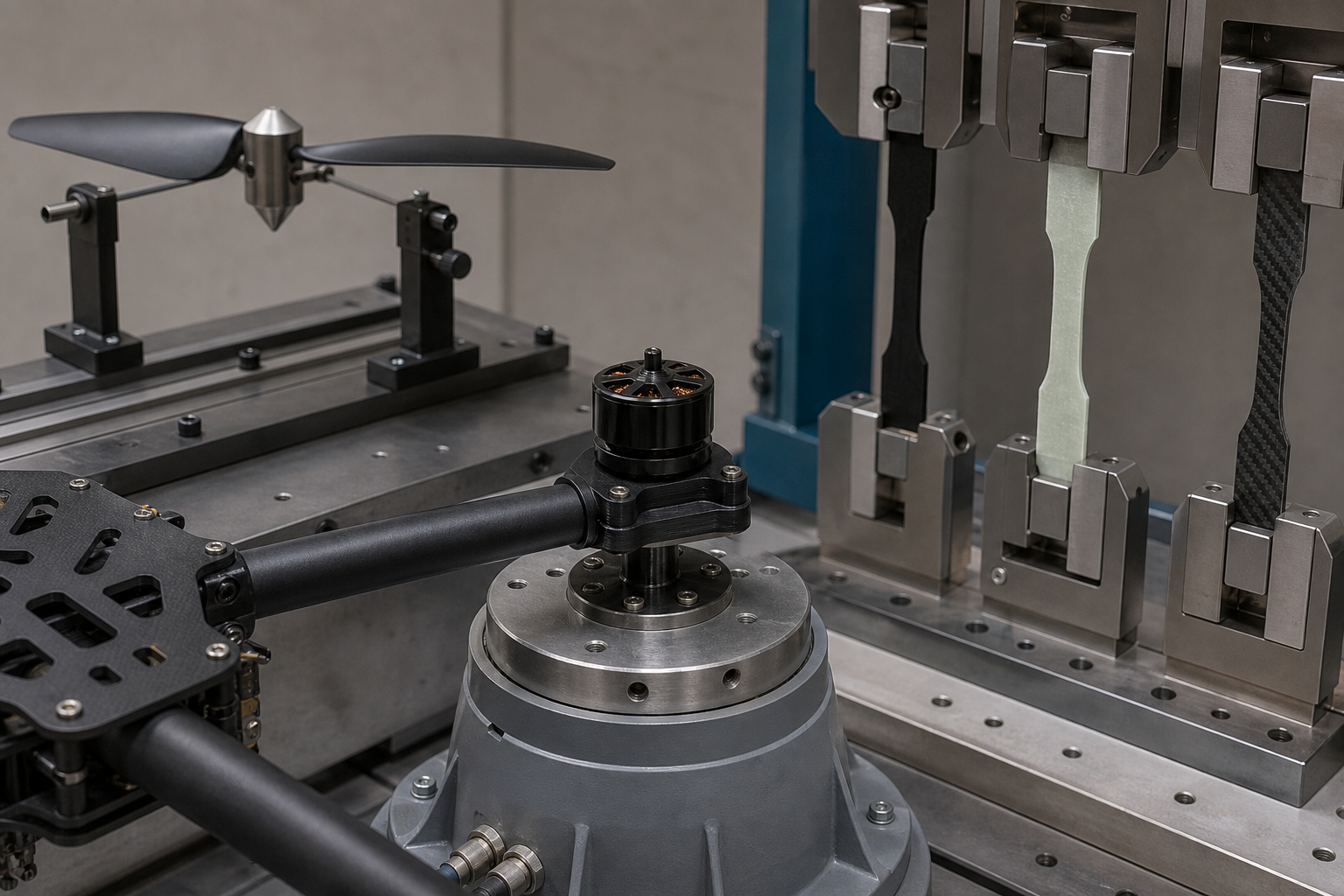
Drone parts combine lightweight design with concentrated loads and continuous vibration. Material approval should therefore be based on molded components and representative assemblies, not only tensile data from a supplier datasheet.
- Record target weight, continuous load, peak load, vibration spectrum, and crash or drop conditions
- Define continuous and peak temperature near motors, batteries, electronic modules, and sunlight-exposed surfaces
- Include humidity, rain, UV, fuels, lubricants, cleaning agents, and salt exposure where relevant
- Measure critical datums after molding, moisture conditioning, thermal cycling, and assembly
- Validate screw torque, inserts, snap fits, adhesives, welding, sealing, and repeated maintenance
- Use representative production cavities and multiple material lots for final capability studies
Why Choose WanHan?
Since 2005, WanHan has focused on the independent R&D, production, and sales of functional polymer materials for automotive, electronics, home appliances, industrial equipment, and other demanding applications.
- ISO 9001, ISO 14001, ISO 45001, and IATF 16949 certified management systems
- Full sets of testing equipment supporting incoming, process, and finished-compound quality control
- Experience with PA6, PA66, PA12, PBT, PC/ABS, glass-fiber, carbon-fiber, flame-retardant, heat-stabilized, and color compounds
- Sample, technical data, processing guidance, and production follow-up for B2B development projects
- Engineering plastic solutions exported to more than 30 countries
Request a Drone-Parts Material Recommendation
Send the part drawing, component function, target weight, load and vibration conditions, operating temperature, UV and humidity exposure, flame requirement, color, molding process, annual demand, and the main issue with the current material. Contact WanHan for material screening, samples, technical data, and molding support, or review the engineering plastic product range.
Frequently Asked Questions
Q: Which plastic is suitable for drone frames and motor mounts?
A: PA12 CF30 and other carbon-fiber-reinforced nylon grades are useful starting points where low weight, stiffness, fatigue resistance, and dimensional stability are required. The final grade must be validated for vibration, impact, temperature, moisture, and the real load path.
Q: Can glass-filled nylon be used for drone propellers?
A: Glass-filled PA6 or PA66 can be evaluated for propeller hubs, guards, and selected blade designs, but fiber orientation, dynamic balance, fatigue, impact, temperature, and molding consistency must be proven on the finished rotating part.
Q: Is PC/ABS suitable for drone battery and electronics housings?
A: PC/ABS is often considered for housings that need impact resistance, dimensional stability, good molding, and a controlled surface. Flame-retardant, UV-resistant, or higher-heat grades may be required according to the battery and operating environment.
Q: Why is moisture absorption important for UAV parts?
A: Moisture can change nylon stiffness, strength, impact behavior, and dimensions. Critical mounting holes, motor alignment, gears, and connector interfaces should be checked after realistic humidity conditioning.
Q: What information does WanHan need to recommend a drone-parts material?
A: Send the part drawing, component function, target weight, load and vibration conditions, temperature, UV and humidity exposure, flame requirement, color, molding process, annual demand, and the main problem with the current material.
ABS vs Polypropylene: Material Differences, Uses, and Selection
What Is PA12 GF23? Properties, Uses, and Low-Moisture Part Guide
Related Article



