PA6 GF30 Injection Molding and Processing Guide
PA6 GF30 injection molding requires controlled material drying, balanced filling, stable cooling, and careful management of glass-fiber orientation. These factors influence surface quality, weld-line strength, dimensional repeatability, shrinkage, and warpage in the finished component.
This practical guide explains the main processing and part-design priorities for 30% glass-fiber-reinforced nylon 6. WanHan grade PA6-WHG30B is used as an exact-grade example. For current specifications, samples, and supply information, visit the PA6-WHG30B product page.
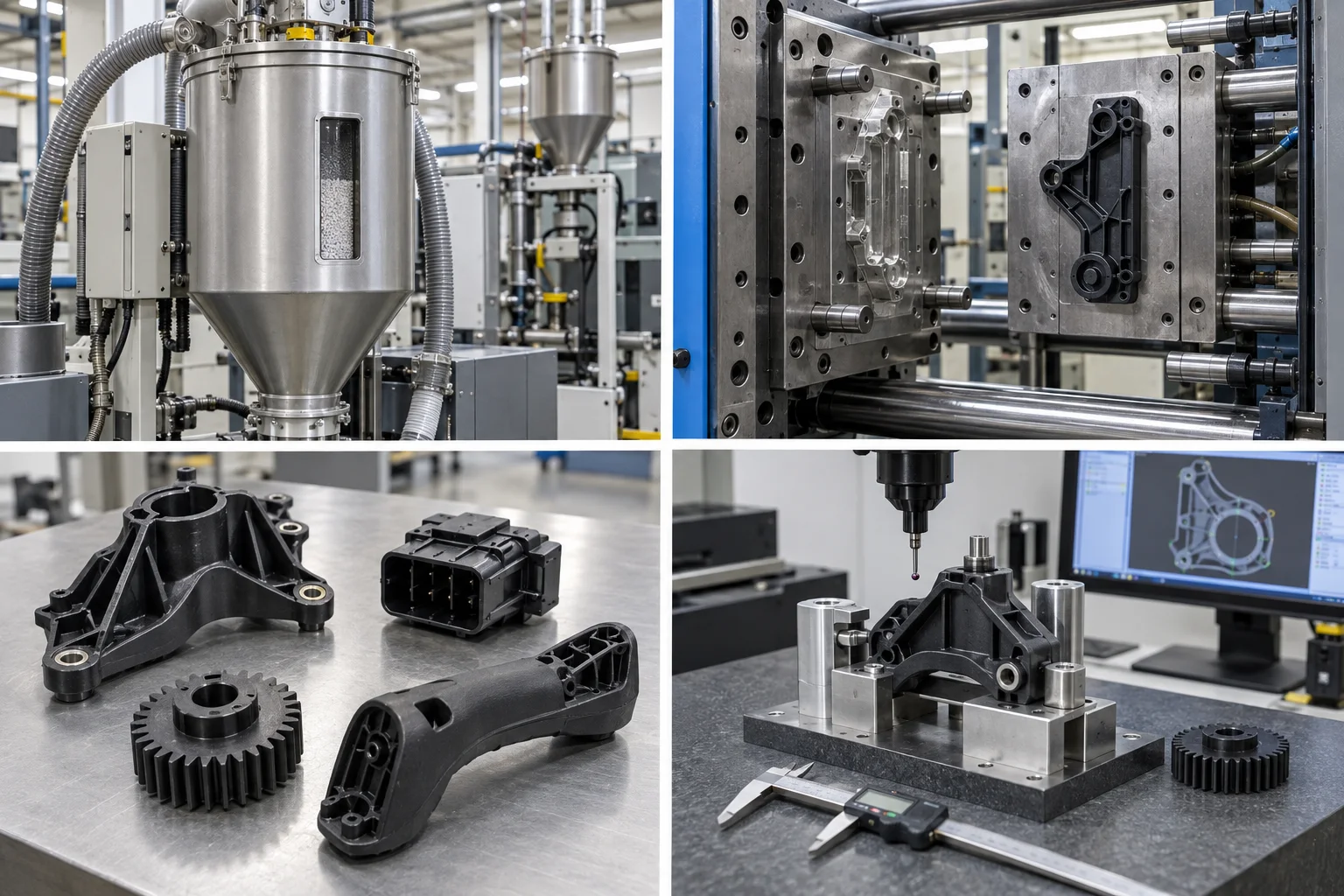
A representative PA6 GF30 production flow: drying and feeding, injection molding, finished engineering parts, and dimensional inspection.
PA6 GF30 Processing Workflow
Dry and protect the material
Use the current exact-grade instructions to dry the resin and prevent moisture regain before molding. Moisture can affect melt quality, appearance, strength, and dimensional consistency.
Establish a stable molding window
Set melt temperature, mold temperature, injection speed, holding pressure, residence time, and cooling on the production tool. Begin with supplier guidance, then validate the part rather than relying on a universal setting.
Control flow and fiber orientation
Gate position and flow path influence fiber alignment, weld-line location, anisotropic shrinkage, stiffness, and warpage. Direct flow toward important load paths while keeping weld lines away from critical zones.
Condition and inspect the molded part
Measure dimensions in a defined moisture condition and after a consistent time. Confirm appearance, warpage, critical tolerances, assembly fit, and performance using production-representative samples.
Part and Tool Design Priorities
Wall thickness and transitions
Keep walls as uniform as practical and use gradual thick-to-thin transitions. Abrupt section changes can disturb flow, increase local stress, and create uneven cooling.
Ribs, bosses, and radii
Use ribs to improve stiffness without excessive wall thickness. Support bosses, add suitable internal radii, and avoid sharp notches that can concentrate stress in a stiff reinforced material.
Gate and weld-line placement
Choose gate locations that promote balanced filling and useful fiber direction. Keep weld lines away from sealing faces, fasteners, impact zones, and highly loaded sections where possible.
Cooling, draft, and ejection
Balanced cooling helps control dimensional variation and warpage. Provide adequate draft and stable ejection so the reinforced part leaves the mold without excessive stress or surface damage.
PA6 GF30 Shrinkage and Warpage
Glass fibers reduce overall shrinkage but also make it directional. The flow direction, fiber distribution, wall thickness, gate layout, packing, cooling, and moisture condition can produce different lengthwise and cross-flow behavior. Mold compensation must therefore be based on the exact grade, tool geometry, and molded trials.
PA6-WHG30B publishes 0.6% molding shrinkage as an exact-grade reference. This value should not be treated as universal for every PA6 GF30 resin or finished part. Critical dimensions should be checked after the intended conditioning and assembly sequence.
Processing note: use the current data sheet for the supplied batch, record material condition and machine settings, and approve the component with production-tool samples under its real service and assembly conditions.
Common Molding Symptoms and Review Points
| Observed symptom | Review first | Practical direction |
|---|---|---|
| Splay, bubbles, or unstable appearance | Material moisture, drying control, storage, and residence time | Verify the drying procedure and material handling before changing multiple machine settings. |
| Warpage or inconsistent flatness | Fiber orientation, gate layout, packing, wall balance, and cooling | Compare flow direction and cooling symmetry, then validate changes with dimensional measurements. |
| Weak weld-line area | Weld-line position, venting, flow balance, and local part geometry | Move the weld line away from critical loads where possible and confirm strength on molded parts. |
| Dimensional drift | Moisture condition, cycle stability, packing, cooling, and measurement timing | Standardize conditioning and measurement time, then review process repeatability. |
| Surface or burn marks | Venting, injection speed, shear, residence time, and local restrictions | Inspect the tool and flow path, then adjust one controlled variable at a time. |
Validation Checklist Before Production Approval
Confirm resin identity, batch traceability, material condition, critical machine settings, cycle stability, cavity balance, dimensions, warpage, appearance, assembly fit, and the required mechanical, thermal, electrical, chemical, wear, or vibration performance. Use actual components and production-representative conditions for final approval.
For exact material values and test-method interpretation, read the PA6 GF30 properties and test-data guide. For material selection and data-sheet context, see the PA6 GF30 datasheet guide. Application examples are available in the PA6 GF30 engineering applications guide.
Why Choose WanHan
WanHan has worked with functional polymer materials since 2005 and supports automotive, electrical, appliance, and industrial applications in more than 30 countries.
Since 2005
Independent material development, production, and application support.
Four Certified Systems
ISO 9001, ISO 14001, ISO 45001, and IATF 16949.
Material Verification
Grade evaluation, quality control, and production consistency checks.
Application Support
Grade recommendations, samples, technical documents, and processing guidance.
Frequently Asked Questions
Why must PA6 GF30 be dried before molding?
PA6 can absorb moisture. Excess moisture during processing may affect melt quality, appearance, mechanical performance, and dimensional consistency, so the current exact-grade drying instructions should be followed.
How does fiber orientation affect a molded PA6 GF30 part?
Glass fibers tend to align with melt flow, creating directional stiffness, strength, and shrinkage. Gate position, flow path, weld lines, and part geometry therefore influence performance and warpage.
What commonly causes warpage in PA6 GF30 parts?
Uneven fiber orientation, unbalanced filling or cooling, non-uniform walls, gate location, packing variation, and inconsistent moisture condition can all contribute. The part and tool should be reviewed together.
What shrinkage value should be used for mold design?
Use the current data sheet for the selected grade and confirm it with the actual tool. PA6-WHG30B publishes 0.6% molding shrinkage as an exact-grade reference, but finished-part behavior depends on direction, geometry, process, and conditioning.
What information helps with a processing or grade review?
Provide the part drawing, wall thickness, gate concept, load, temperature, moisture and chemical exposure, tolerances, appearance target, assembly method, expected volume, molding equipment, and validation requirements.
Discuss Your PA6 GF30 Molding Project
For PA6-WHG30B data, samples, grade comparison, or processing review, contact WanHan at [email protected] or +86 13537012277.
Polyamide 66 PA66 GF30-WanHan Technology
PA66 GF33 Properties, Applications and Processing Guide
Related Article